
Lieferung heute & morgen

Qualitätsgarantie

Willkommens-Angebote freischalten: KOSTENLOSE Lieferung | Bis zu 80 % RABATT | Kostenlose 30-Tage-JoyPlus-Testphase
App herunterladen
A night light for children should help them find their way at night without lighting up the room more than necessary. It also needs to suit your child’s age, where you plan to put it and how you’ll use it every day. But there are clear differences between decorative children’s room lighting, LED night lights for children and practical models with a sensor or timer.
Three common buying mistakes are particularly likely to lead to the wrong choice:
A warm-white night light of around 2,700 to 3,000 Kelvin is often perceived as less harsh than cool-white light. However, colour temperature alone doesn’t tell you how bright the light actually is. Also look for:
A colour-changing night light is better suited to decorative accents or more flexible use. For night-time care, a subtle, dimmable light may be more practical.
Battery-powered models can be placed wherever you need them. Check which batteries they use and whether they’re included. For example, the Premier Housewares cloud model takes three AA batteries. Remove the batteries if the light won’t be used for an extended period.
A rechargeable night light with a USB connection means you won’t need to replace batteries regularly. Models with a charging station are handy because the light has a dedicated place to sit. If you choose a baby night light with a rechargeable battery, make sure the charging accessories are kept out of your child’s reach.
A night light with a motion sensor can be particularly useful in hallways, on staircases or along the route to a child’s room. Check whether it plugs into a socket and whether the sensor only activates in the dark.
Ceramic, ABS and PC are different materials, each with its own properties. Ceramic models can be decorative and sturdy, but they aren’t toys and should be kept out of reach of young children. Plastic models are often lighter and suitable for portable use.
Before buying, check:
A light that plugs into a socket must not be used in damp areas unless it’s specifically designed for that purpose. Always follow the manufacturer’s instructions for each model.
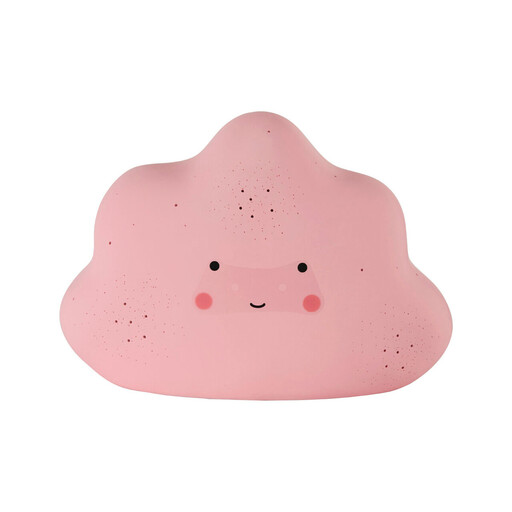
Why this product suits this profile: Its decorative cloud shape combines simple battery-powered operation with compact lighting for a child’s room. It’s a good choice if you don’t need a charging function or sensor controls.
Light shines through perforated openings in the ceramic. There are no complicated app or colour controls to set up before bedtime.
Ceramic body, cloud shape, dimensions of approx. 25 × 15 × 18 cm and powered by three AA batteries.
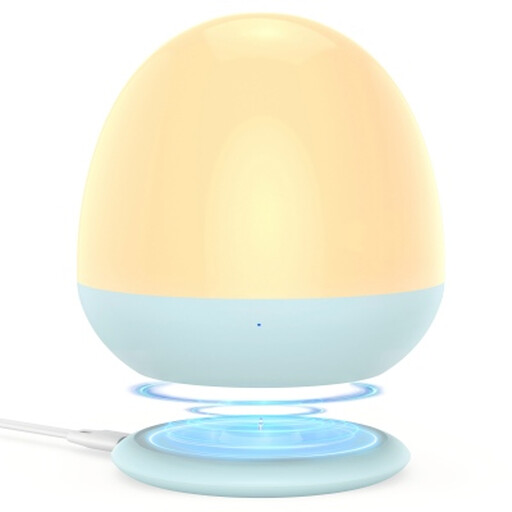
Why this product suits this profile: This model is designed for households looking for touch controls, a timer and flexible charging options in a portable lamp.
The timer’s automatic shut-off can help prevent the light being left on unnecessarily. The charging plate gives it a dedicated place to sit, and it can also be charged via USB.
ABS and PC casing, touch controls, timer, and wired or wireless charging via a charging station.

Why this product suits this profile: This plug-in model is designed for children’s rooms, hallways, staircases and other indoor areas where light is only needed when it’s dark and movement is detected.
The dusk sensor stops the lamp staying on when there’s enough light. According to the product information, it switches off after 60 seconds without movement.
Five brightness settings, 2,700 Kelvin warm-white LED light, detection range of up to 3 metres and 0.5 watt power consumption according to the product description.
We’ve put together a complete, regularly updated list of products that meet these strict selection criteria and fully comply with the safety regulations in force in the EU.
For a baby’s room, look for low, adjustable brightness, a stable position and simple controls. Don’t point the light directly at your baby’s face. Keep cables, chargers and battery compartments out of your child’s reach. Follow the manufacturer’s age guidance.
Battery life depends on the battery capacity, brightness setting, colour mode and use of the timer. Without specific information from the manufacturer, it’s not possible to give a reliable estimate. Also check whether a USB cable or charging station is included, and whether the light can be used while it’s charging.
A motion sensor can reduce running time because the light only comes on when it detects movement in the dark. However, actual consumption depends on the power rating, sensor controls and how often it’s used. For a model rated at 0.5 watts, the specific daily time it’s switched on also makes a difference.