
Lieferung heute & morgen

Qualitätsgarantie

Willkommens-Angebote freischalten: KOSTENLOSE Lieferung | Bis zu 80 % RABATT | Kostenlose 30-Tage-JoyPlus-Testphase
App herunterladen
A night light in a child’s room should provide orientation without brightening the space unnecessarily. In practice, however, models differ significantly in terms of light colour, operation, power supply and safety instructions. Three buying patterns in particular often lead to disappointment:
Before you buy, it is worth looking at the technical specifications rather than just the shape, colour or marketing claims.
For night-time care, feeding or finding your way to the child’s room, a warm-white night light at around 2700 to 3000 K can offer subtle orientation. Cool-white light at 6500 K is better suited to hallways, stairs or areas where clearer illumination is needed.
A dimmable night light – or a model with multiple brightness levels – offers flexible use. A low setting is usually enough for falling asleep, while a higher brightness can be handy for nappy changes or preparing a bottle. Figures given in lumens show how much light is emitted. Watts, on the other hand, primarily describe energy consumption and are not a direct measure of brightness.
A night light with a dusk sensor switches on when the ambient light is low. This is practical for plug-in models in hallways or children’s rooms, as no manual switch is needed. A night light with a motion detector also responds to movement and often switches off again after a set period.
Pay attention to the technical limits: with the GRIFEMA model, the stated range is up to 3 metres with a detection angle of 120 degrees. According to the product data, it switches off after 60 seconds without movement. A timer, such as on the VAVA model, ends the lighting after a fixed time regardless of movement.
A rechargeable night light can be used flexibly next to the bed, at the changing station or when travelling. The battery capacity, charging time and run time per brightness level are key factors. The VIVREAL A046 is specified with a 1200 mAh battery, a charging time of around three hours and up to six hours of run time at maximum brightness.
A plug-in night light does not need a battery and is suitable for hallways, stairs or permanently dark areas. However, it should be positioned so that it does not block neighbouring sockets and so that the sensor and housing are not covered.
For mobile children, robust, easy-to-clean surfaces are a good idea. Silicone can feel soft, but it does not replace supervision. Electrical products should not be placed in water and should not be dismantled or charged incorrectly within a child’s reach. CE and RoHS markings in product information can indicate declared conformity; in addition, the instruction manual, mains voltage and safety instructions for each model are decisive.

Why this product suits the profile: The two-pack is ideal for a child’s room and hallway when you need several points of orientation without changing batteries. The built-in dusk sensor switches the light on when it gets dark.
The three brightness levels prevent a fixed light output. At 2700 K, the stated light colour is warm white, designed for subtle orientation.
Two lights, 0.5 W power consumption and automatic on/off via the dusk sensor.
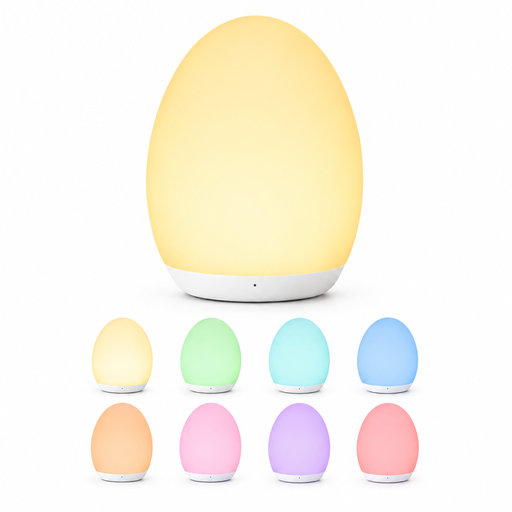
Why this product suits the profile: This baby night light offers touch operation, warm-white light, eight colour modes, a memory function and a one-hour timer. It can be used at the changing station, on the bedside table or on the go.
The run time is differentiated by brightness: around seven hours at maximum brightness and up to 100 hours at the lowest setting are stated. This makes it easier to put the marketing claim into perspective.
2000 mAh battery, five operating functions and compact dimensions of 9.2 × 9.2 × 11 cm.
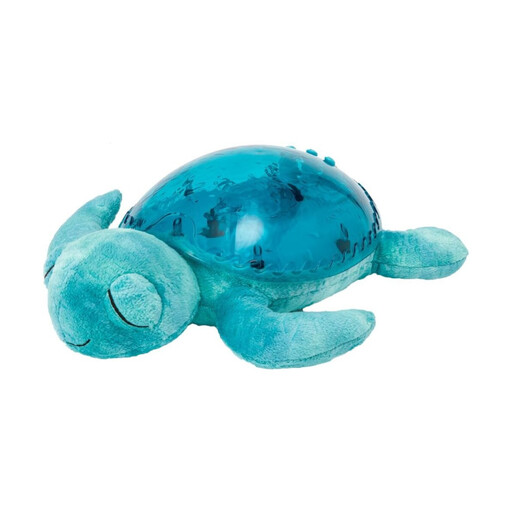
Why this product suits the profile: If you are looking for a night light with music and projection, this model offers underwater projections, four sound options, adjustable brightness and USB-C charging.
The automatic switch-off after 23 minutes limits the operating time. The description also explicitly states that the device should not be covered and should only be used under supervision.
Projection, music and ocean sound options, USB-C battery and an adjustable sound sensor.
We have put together a complete, regularly updated list of products that fully meet these strict selection criteria and the safety regulations in force in the EU.
The consumption depends on the power, operating time and control. A model with 0.3 W or 0.5 W uses relatively little energy when running continuously. A rechargeable night light consumes electricity while charging and can be operated for longer at low brightness. For an accurate cost calculation, you need the electricity price and the actual daily usage time.
It can be useful for night-time trips, in hallways or on stairs. The motion detector activates the LED lighting only when movement is detected and it is dark. For a constant orientation light next to the bed, a dusk sensor or a manually dimmable night light is usually more suitable.
The lifespan of the LED is stated as up to 25,000 hours for some plug-in models. With rechargeable versions, the ageing of the battery is also relevant. Charging time, run time per brightness level and the possibility of safe replacement should therefore be considered separately. The housing, switch and charging port can also affect the practical service life.