
Lieferung heute & morgen

Qualitätsgarantie

Willkommens-Angebote freischalten: KOSTENLOSE Lieferung | Bis zu 80 % RABATT | Kostenlose 30-Tage-JoyPlus-Testphase
App herunterladen
A night light with a motion sensor can automatically light the way to the toilet, a child’s bedroom or through the hallway. To make sure it’s genuinely practical for everyday use, don’t focus solely on a high lumen rating or modern design. The sensor, light colour, power supply and mounting options are all important.
Many models only respond when they also detect low ambient light. Without a dusk sensor, the light may switch on during the day too. For a bedroom, child’s bedroom or hallway, check whether the product has a set brightness threshold and how long the light stays on after the last movement is detected.
A very bright light can be disruptive when you get up during the night. A dimmed, warm white night light is often enough to light a short route. If you choose a model with several brightness settings, you can adjust the light to suit a child’s bedroom, bedroom, stairs or bathroom.
A plug-in night light doesn’t need charging, but it may take up a socket. A rechargeable night light with USB charging can be placed more flexibly, but needs to be charged regularly. When choosing one, consider the charging time, runtime in sensor mode and availability of sockets where you plan to use it.
Check the detection range and angle. For example, a model with a 3-metre range and a 120-degree angle could suit a short stretch of hallway or the area in front of a staircase. A larger sensor range may be useful in bigger rooms.
The shut-off time matters too. According to the product details, the GRIFEMA model switches off after 60 seconds without detecting movement. Other products simply state that they switch off automatically. A short delay helps avoid unnecessary running time, while a longer one may be more comfortable if movement in a child’s bedroom is slow.
Colour temperature is measured in kelvins:
A dimmable night light with several settings is versatile. The GRIFEMA night light has five brightness settings, from 20 to 100 per cent. The 2-pack with USB charging also has five dimming settings, plus three adjustable colour temperatures.
Compact casings made from ABS or polycarbonate are common for dry indoor spaces. Make sure the light isn’t covered and that the sensor has a clear view of the area where movement is expected. A model rated IP20 is intended for dry indoor use only. Even if a night light is marketed for use in a bathroom, it shouldn’t come into contact with water or high levels of moisture.
When children are around, remember that the product isn’t a toy. Plug-in models should be positioned so that children can’t pull on them or remove them by themselves. Before use, also check that the socket and mains voltage are suitable for the product.

Why this product suits this need: This plug-in night light combines motion and dusk sensors, making it suitable for a child’s bedroom, hallway, kitchen, stairs or bathroom. Its five brightness settings make it easy to adjust the light to suit its surroundings.
According to the product description, the dusk sensor prevents the light from switching on when there’s enough ambient light. It switches off after 60 seconds without movement.
Warm white 2,700-kelvin LED light, five brightness settings, 0.5-watt power consumption and a stated detection range of up to 3 metres and 120 degrees.

Why this product suits this need: This rechargeable night light is ideal for homes where you want to light several areas without a spare socket, such as beside the bed and in the hallway.
You can adjust both the brightness and colour temperature, rather than being limited to a single fixed setting that may be too bright.
500-mAh battery, USB charging at 5 V and 1 A, three colour temperatures, five dimming settings and a stated sensor-mode runtime of up to 10 hours.
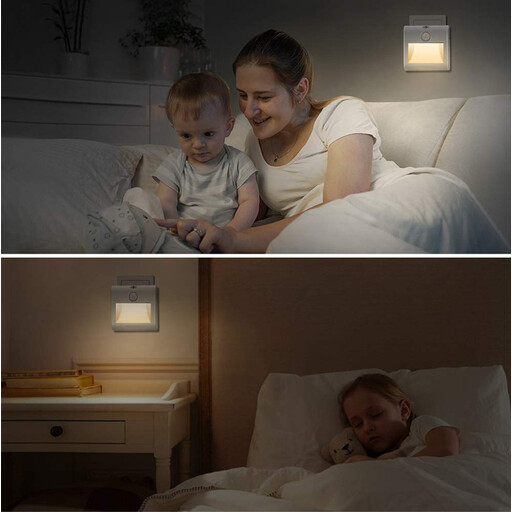
Why this product suits this need: A 2-pack is ideal for lighting several areas, such as the bedroom and bathroom, or the hallway and stairs. The lights can be used in steady-light or sensor mode.
Stepless touch dimming means you’re not restricted to choosing between just a few fixed brightness settings. According to the product details, a memory function saves your last setting.
Two lights, 20 lumens, 1-watt power consumption, sensor detection at 20 lux or below and a stated range of 3 to 5 metres.
We’ve put together a complete, regularly updated list of products that meet these strict selection criteria and fully comply with the safety regulations in force in the EU.
Position the light so the sensor covers the route you want to illuminate, but doesn’t point directly at a highly reflective or constantly moving surface. In a hallway, a wall socket at around hip height may work well. In a child’s bedroom, keep the light out of reach of young children. Don’t cover the sensor or LED.
Runtime depends on the operating mode, brightness and power supply. A plug-in model doesn’t need its battery replacing, while a rechargeable night light needs regular USB charging. When choosing one, consider the stated battery capacity and runtime in sensor mode separately.
Many LED models have low power consumption. The GRIFEMA model is rated at 0.5 watts, while other products are rated at 1 watt. Actual consumption depends on how often the light is activated and how long it stays on. A dusk sensor and automatic shut-off can help prevent unnecessary activation.