
Lieferung heute & morgen

Qualitätsgarantie

Willkommens-Angebote freischalten: KOSTENLOSE Lieferung | Bis zu 80 % RABATT | Kostenlose 30-Tage-JoyPlus-Testphase
App herunterladen
A night light with a motion sensor can help you find your way at night without having to search for the light switch. In a child’s bedroom, beside the bed, in the hallway or on the stairs, however, it is not just the advertised sensor function that matters. The key factors are suitable brightness, reliable activation, safe positioning and a power supply that suits the location.
As a Joybuy Product Recommendation Officer, I assess product information against clear, verifiable criteria. This shows that some common assumptions when buying a night light can make it less practical in everyday use than expected.
A long detection range may initially sound like an advantage. In a bedroom or nursery, however, a highly sensitive sensor may react to people simply walking past. This can cause the light to switch on frequently and disturb your sleep. For use beside a bed, changing area or along a short hallway, specifications such as a 3 to 5 metre detection range are often sufficient, provided the sensor is not aimed directly at a busy area.
More lumens do not automatically mean greater comfort. For a children’s or baby’s bedroom, 17 to 30 lm may be enough for orientation, while a cupboard, garage or longer staircase requires a brighter light. A 400 lm model is suitable for a dark work area, but may be unnecessarily bright beside the bed.
With battery-powered lamps, you need to factor in battery costs and replacement intervals. Rechargeable night lights, on the other hand, need time to recharge and an accessible USB power source. Mains-powered models do not need recharging, but they permanently occupy a socket. It is therefore important to check specific information about battery capacity, runtime and automatic switch-off.
A motion-sensor night light reacts to movement, often only when it is dark as well. A night light with a light sensor, by contrast, switches on and off according to the ambient brightness. A dusk sensor can be useful for a hallway that remains dimly lit throughout the day. For the short walk to the bathroom or changing table, motion detection is usually more practical.
Look out for the following details:
A warm-white night light of around 2,700 to 3,200 K is often chosen for bedrooms, hallways and children’s rooms. More neutral or cooler light colours can make it easier to find your way in bathrooms, cellars or work areas. A dimmable night light is particularly useful if you want to use the same lamp differently during the day and at night.
The colour rendering index, CRI or Ra, describes how naturally colours appear under the light. The products featured specify values above 80, while individual models state CRI >85. This figure does not replace checking the actual light distribution or glare.
A mains-powered model is quick to set up, but is only suitable where a compatible socket is available. Magnetic, hanging or self-adhesive lights can be positioned more flexibly. For adhesive mounting, the surface must be smooth, clean and dry.
The models mentioned are primarily intended for indoor use. An IP25 or IP20 rating does not automatically mean that a product is approved for direct contact with water. For bathrooms, utility rooms or damp cellar areas, you should check the specific IP rating and the manufacturer’s instructions. The same applies to a baby’s bedroom: small parts, cables and batteries must be kept out of children’s reach.
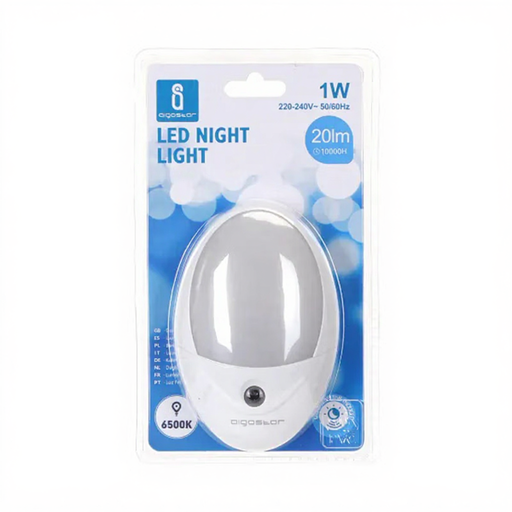
Why this product suits this profile: This mains-powered model needs neither batteries nor a charging cable and is designed for hallways, bedrooms and children’s rooms. The light sensor switches it on and off automatically in the dark.
The power supply is clearly specified as 220–240 V mains operation. With 20 lm and 1 W, it remains intended for orientation lighting rather than promising an unnecessarily powerful lamp.
Automatic dusk sensor, 120° beam angle and IP25 rating for indoor use according to the product data.
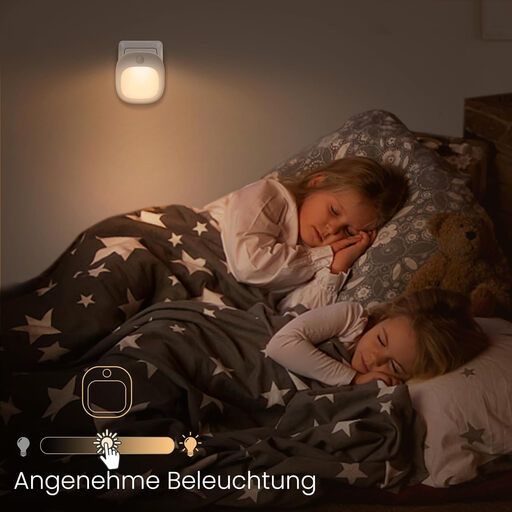
Why this product suits this profile: This rechargeable night light can be placed independently of a socket, for example beside the bed, in the nursery or on a shelf. Two lights allow you to use them in separate locations.
The product data specifies an integrated 500-mAh battery, up to 10 hours in sensor mode and activation at a maximum of 20 LUX. This makes the charging requirements and usage limitations easy to understand.
30 lm, three colour temperatures, five brightness levels and USB charging at 5 V/1 A according to the product description.
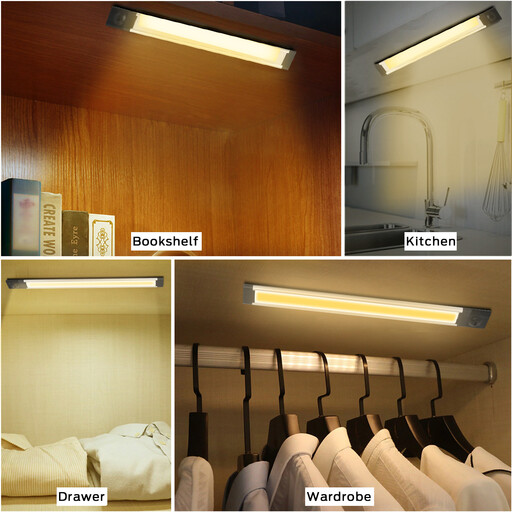
Why this product suits this profile: With its elongated design, magnetic mount and hook, this light is suitable for cupboards, cellars, stair walls or areas without a spare socket.
The mounting options are clearly specified and are not limited to a single adhesive surface. Before mounting, you should still check whether the magnet or hook will hold securely on the intended surface.
36 SMD LEDs, 400 lm, gesture control and a colour temperature range of 2,800 to 6,500 K according to the product information.
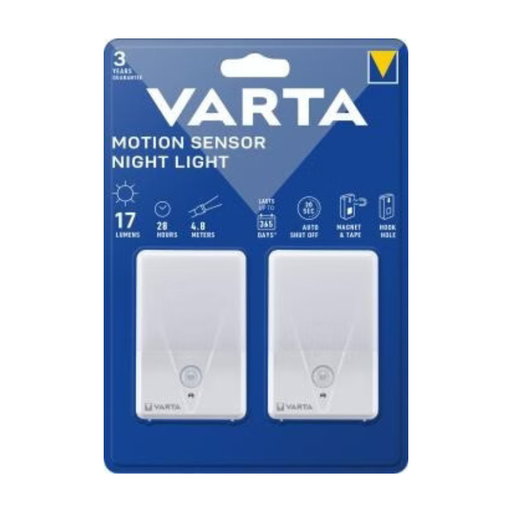
Why this product suits this profile: This twin-pack night light is designed for hallways, bedrooms, bathrooms and cupboards. Depending on the surface, you can use the magnet, adhesive tape or screws for mounting.
The 30-second switch-off time and the three AAA batteries required are clearly specified. This makes it easier to assess ongoing costs and maintenance before buying.
17 lm, PIR sensor with a range of up to 3 m and a 120° detection angle; the product data states a total runtime of up to 28 hours.
We have put together a complete, regularly updated list of products that fully meet these strict selection criteria and the safety regulations applicable in the EU.
For a night light for hallways and stairs, the detection area should cover the route you take without being aimed constantly at doors or windows. Low to medium brightness is usually sufficient for orientation. On stairs, secure mounting is also more important than decorative features.
In a nursery, the light should not shine directly into the child’s face. Position the device so that cables, the battery compartment and small parts are out of reach. A warm-white, dimmable model may be more comfortable for getting around at night than a very bright, cool-white light.
Rechargeable models with a magnet or hook are practical for cupboards or shelves without a socket. Check in advance how often the light needs charging and whether the USB cable is included. For passageways that need to remain lit, an economical mains-powered model with a light sensor may be more suitable.
Position the sensor at hip or chest height and point it towards the route you expect to take. Then test it when the room is as dark as possible. If the lamp activates too often, reduce the range or sensitivity if possible, and adjust the angle.
Runtime depends on brightness, how often the light is activated and the operating mode. According to the product information, the 2-pack mentioned above provides up to 10 hours in sensor mode with an integrated 500-mAh battery. This should be treated as a guide; actual runtime may vary in your home.
LED night lights generally have low power consumption. For example, the mains-powered models featured specify 0.3 W, 0.5 W or 1 W. In sensor mode, the device only illuminates intermittently. Running costs depend mainly on the wattage, daily activation time and electricity tariff. With battery-powered models, you also need to factor in the cost of replacement batteries.