
Lieferung heute & morgen

Qualitätsgarantie

Willkommens-Angebote freischalten: KOSTENLOSE Lieferung | Bis zu 80 % RABATT | Kostenlose 30-Tage-JoyPlus-Testphase
App herunterladen
A night light with a motion sensor should provide guidance at night without making the room unnecessarily bright. In UK homes, it is often used in hallways, bathrooms, stairwells, bedrooms, children's rooms or inside cupboards. Choosing one may initially seem straightforward, but some product specifications can lead to unsuitable purchases.
A high lumen rating does not automatically mean that a night light is suitable for its intended location. A cupboard light with a motion sensor generally needs to provide even illumination over a short distance. For a hallway or staircase, on the other hand, a wide beam angle may be more important. A 20 lm LED night light should be assessed differently from a 400 lm rechargeable sensor light when it comes to providing guidance.
A PIR sensor responds to movement, while a dusk sensor measures the ambient light level. Some models combine both functions: they only switch on in darkness when movement is detected. A night light with a dusk sensor alone, however, may stay lit continuously when the light level is low. So check whether the product switches off automatically after a set period and whether the motion range and detection angle are specified.
A plug-in night light requires neither battery replacement nor charging time, but it does occupy a socket. A rechargeable night light can be installed more flexibly, but needs to be charged regularly via USB. For models with built-in batteries, details of the capacity and charging connection are important. If this information is missing, it is difficult to assess how practical the product will be for everyday use.
Brightness is measured in lumens (lm). Low values are often sufficient for finding your way around at night, while a brighter motion-sensor light can be useful for cupboards, kitchen worktops or stairs. A dimming function expands the range of uses, particularly in bedrooms or children's rooms.
Colour temperature is measured in Kelvin (K):
The term “warm white” should be checked against the specific Kelvin value. For example, a model with 4,000 to 4,500 K falls into a more neutral range than a classic warm-white night light with 2,700 to 3,000 K.
Pay attention to the specified detection range, angle and trigger conditions. The actual range may depend on the installation height, room layout and obstacles. For a hallway night light, the sensor should be positioned so that it reliably detects people entering, without being triggered unnecessarily by passing vehicles or pets.
Plug-in models operate directly from a suitable wall socket. Magnetic or adhesive lights are suitable for cupboard sides, shelves and walls, provided that the surface is stable and clean. Models with IP20 are intended for dry indoor areas and are not suitable for direct contact with water. Even in the bathroom, the night light should not be installed in areas exposed to splashes.
For products displaying CE or RoHS information, these details refer to the product information provided by the supplier. Before buying, you should also check the mains voltage, charger, installation accessories and safety instructions.
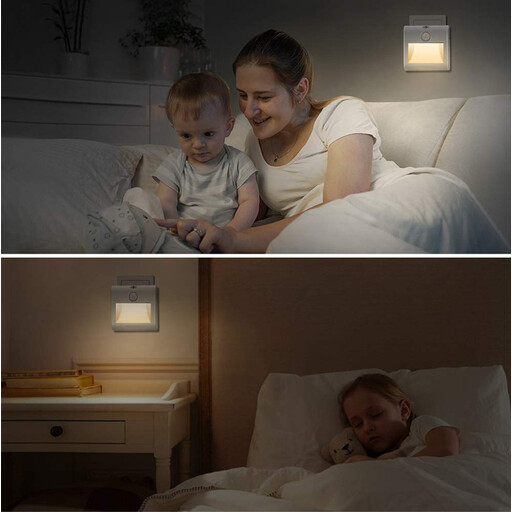
Why this product suits the profile: The two-piece set can be used in the bedroom and hallway at the same time. It plugs directly into a standard socket and requires no installation.
The specifications state two operating modes, a sensor range of 3 to 5 m and activation at no more than 20 lux. This makes the key usage conditions clear.
1 W power consumption, stepless touch dimming and a memory function; compact dimensions of 7,2 × 7,1 × 5,8 cm per light.
Why this product suits the profile: This light is suitable for users who want adjustable brightness and a variable light colour. It can be used in bedrooms, children's rooms, hallways or wardrobes.
The product data specifies 400 lm, a range of 2,800 to 6,500 K and gesture control with dimming. This lets you adjust the light output to suit the location.
USB charging, magnetic attachment and hook mounting; dimensions of 26 × 4 × 1 cm for narrow surfaces.

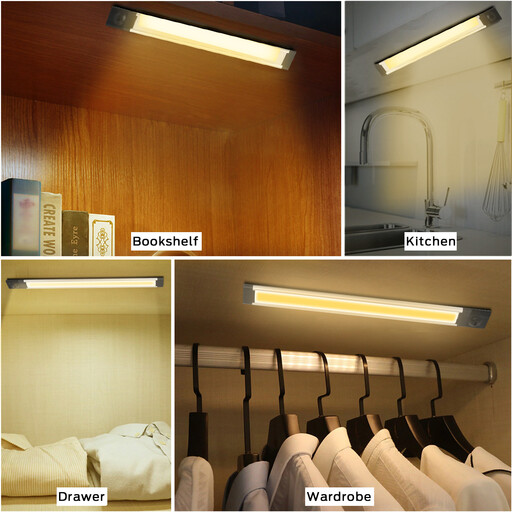
Why this product suits the profile: For kitchens, wardrobes, shelves and other narrow areas, this set provides two independently positioned lights without a fixed power cable.
PIR detection with a range of 3 to 5 m and three selectable colour temperatures make the intended use clear. Installation is carried out using adhesive strips, with no drilling required.
41 LEDs per light, integrated 1,100-mAh battery and USB charging at 5 V; slim casing measuring 300 × 38 × 10 mm.

Why this product suits the profile: This plug-in model combines motion and dusk sensors and is suitable for children's rooms, hallways, bathrooms, kitchens or indoor staircases.
Automatic switch-off after 60 seconds without movement limits unnecessary operating time. The specified sensor range is up to 3 m at 120°.
Five brightness levels from 20 to 100 per cent, 2,700 K warm-white light and 0,5 W power consumption.
We have put together a complete, regularly updated list of products that fully meet these strict selection criteria and the safety regulations applicable in the EU.
Install the light so that the sensor faces the area where movement is expected. Doors, furniture edges and curtains can affect detection. For adhesive installation, the surface must be dry, clean and stable. Plug-in models should not be covered and should only be used in suitable indoor areas.
The lifespan depends on the LED module, electronics, switching cycles and usage. For permanently installed LEDs, the lifespan is often given in hours; for rechargeable models, battery ageing is also relevant. It is therefore not possible to determine a general operating lifespan from the LED specification alone.
Running costs depend on the power rating, daily operating time and electricity tariff. A 0,3 W model uses less energy over the same operating period than a 1 W light. With a motion-sensor light, automatic switch-off reduces the actual time the light is on. For a rough estimate, you can multiply the power in kilowatts by the operating hours and your current price per kilowatt-hour.