
Lieferung heute & morgen

Qualitätsgarantie

Willkommens-Angebote freischalten: KOSTENLOSE Lieferung | Bis zu 80 % RABATT | Kostenlose 30-Tage-JoyPlus-Testphase
App herunterladen
A night light with motion sensor can automatically illuminate paths at night, cupboards or work surfaces. For households, tenants, families and older people, price is not the only deciding factor. Unclear sensor specifications, unsuitable light colours or hidden ongoing costs often result in an unsuitable purchase.
This guide explains what to look for in an LED night light, a motion-sensor light and a cordless LED light for indoor use.
A long detection range does not automatically mean bright illumination. When choosing a hallway night light or a night light for stairs, buyers should therefore consider light output in lumens and the PIR sensor’s detection area separately. A model with 18 lumens may be sufficient for a wardrobe, while a brighter version may be more suitable for stairs.
Cool white light at around 6,500 Kelvin can be practical inside a kitchen cupboard or for task lighting. In the bedroom, children’s room or on the way to the toilet, however, warm white night light at around 2,800 to 3,200 Kelvin is often preferred. Colour temperature describes the appearance of the light, not its actual brightness.
Adhesive fixings only adhere reliably to clean, dry and smooth surfaces. On rough plaster, dusty cupboard surfaces or damp areas, adhesion may deteriorate. Before buying, you should also decide whether a battery-powered night light or a rechargeable night light is better suited to the location. Battery-powered models incur ongoing replacement battery costs, while USB models require regular charging.
A PIR sensor detects changes in heat radiation caused by movement. Specifications such as 3 to 5 metres’ range or a 120-degree detection angle help you assess whether the light will activate in the intended location. Check whether the range is stated for an open room or under real-life conditions.
An automatic switch-off time prevents the light from staying on unnecessarily long. For the VIVREAL model, the stated run-on time is 20 seconds without detected movement. This may be sufficient for a short journey through the hallway or opening a cupboard. For longer tasks, manual continuous lighting or a longer run-on time is more practical.
Lumens indicate luminous flux. 18 to 35 lumens are more suitable for orientation lighting in cupboards, hallways or beside the bed. Higher values may be useful for illuminating a larger area. The model with 36 Epistar LEDs is specified as providing 400 lumens, making it more suitable for noticeably brighter illumination.
Several colour temperatures increase flexibility: cool white is around 6,500 to 7,000 Kelvin for the available lights, daylight white is around 4,500 to 5,000 Kelvin, and warm white is around 2,800 to 3,200 Kelvin. An LED cupboard light with three settings can therefore be used both for orientation and for short tasks.
The dimensions are crucial for a cupboard light with sensor. An under-cabinet light measuring 20 or 30 centimetres in length will fit different recesses from a 40-centimetre version. Check the available space and the position of the sensor before ordering.
Battery models can be mounted flexibly straight away, provided suitable batteries are available. For USB-rechargeable lights, you should consider the battery capacity. The available models offer, for example, 800 mAh, 1,100 mAh or 500 mAh. These figures allow a technical comparison, but on their own do not indicate the actual operating time for every type of use.
Bathrooms, utility rooms and other damp spaces have specific requirements. The products described here are intended for indoor areas; according to the product specifications, they should be kept away from water and high humidity. A night light should therefore not be used in an unprotected wet area.
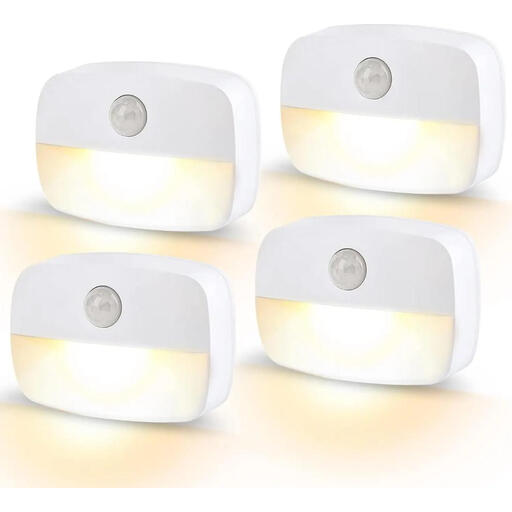
Why this product suits the profile: The 4-piece set is ideal when several small areas, such as a hallway, staircase, bookcase or wardrobe, need to be fitted with a battery-powered night light.
The specifications state 35 lumens, a 120-degree sensor angle, a detection range of 13 to 20 feet and a 20-second switch-off time. This makes it easier to assess brightness and sensor performance before buying.
Four lights, warm white light at 3,200 to 2,800 Kelvin, adhesive mounting without drilling and operation using three AAA batteries per light.
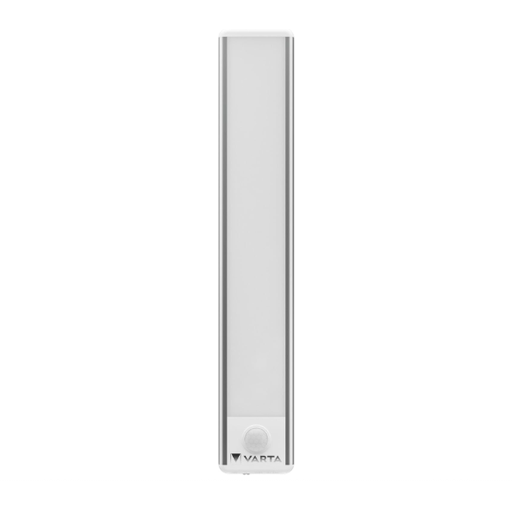
Why this product suits the profile: The slim design, measuring 24 × 4 × 1.66 cm, is suitable for tight spaces, such as beneath shelves, inside cupboards or along narrow sections of hallway.
The product specifications list both self-adhesive mounting and screw fixing. Buyers can choose the fixing method according to the surface and the desired durability.
Battery-powered, automatic switch-off, slim plastic housing and two intended mounting options.

Why this product suits the profile: The two USB-rechargeable lights are intended for kitchens, wardrobes, shelves and hallways when a rechargeable night light without battery changes is preferred.
The technical data specifies 21 LEDs, a sensor range of 3 to 5 metres, an 800-mAh battery and three colour temperatures. This makes the key purchasing criteria transparent and easy to compare.
Slim 20 × 3.8 × 1 cm design, USB charging at 5 volts, and warm white, natural or cool white setting.
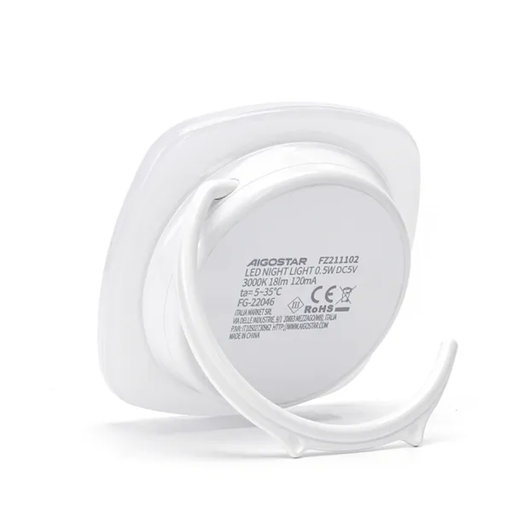
Why this product suits the profile: The USB battery and additional dusk sensor are ideal for households where lighting needs to activate automatically in darker areas.
The product data specifies 18 lumens, a 3.5-metre detection range, a 120-degree beam angle and 3,000 Kelvin. This makes the light more suitable for use as orientation lighting.
500-mAh battery, USB charging, warm white 3,000-Kelvin light and a compact design for indoor use.
We have put together a complete, regularly updated list of products that fully meet these strict selection criteria and the safety regulations applicable in the EU.
Many models are fixed with double-sided adhesive tape and require no drilling. The surface must be clean, dry and sufficiently smooth. For permanently higher loads, screw fixing may be more suitable, provided the product offers this option.
Operating time depends on sensor range, how often the light is activated, brightness and switch-off time. A short automatic run-on time reduces energy consumption. With a rechargeable night light, battery capacity should be considered as a comparison value; the actual runtime can only be assessed reliably based on how the light is used.
LEDs require little electrical power compared with many older light sources. Nevertheless, battery-powered models incur the cost of replacement batteries. USB-rechargeable lights avoid the need to buy batteries regularly, but they must be charged from a suitable power source. Ongoing costs therefore depend not only on wattage, but also on usage time and charging or battery routines.