
Lieferung heute & morgen

Qualitätsgarantie

Willkommens-Angebote freischalten: KOSTENLOSE Lieferung | Bis zu 80 % RABATT | Kostenlose 30-Tage-JoyPlus-Testphase
App herunterladen
A night light with a motion sensor should help you find your way around at night without lighting up the room more than necessary. So whether you’re choosing one for a bedroom, child’s room, hallway, stairs or bathroom, price isn’t the only thing to consider. Sensor range, colour temperature, installation and power supply all affect how well automatic night lighting works in everyday use.
Product specifications can sound very similar, but there can be significant differences in practice. The following criteria can help you avoid common buying mistakes.
A very bright light can be useful in a hallway or on the stairs, but may be disruptive in a bedroom or child’s room. Conversely, 18 to 20 lumens may be enough to help you find your way at night, but not for a larger passageway.
So check the stated luminous flux in lumens (lm):
A dimmer function or several brightness settings makes it easier to adjust the light to suit each room.
A motion sensor responds to movement. A dusk sensor also checks whether it’s dark enough. Without dusk detection, the LED night light may switch on during the day too. A model with both sensors only switches on when it’s dark and movement is detected.
Detection angle, range and auto-off time also matter. A sensor with a 120-degree angle and a range of 3 metres is suitable for a small hallway or the area beside a bed. A longer range may be useful in longer hallways. An auto-off time of 20 seconds saves energy, while 60 seconds may be more practical if you walk slowly or are using the stairs.
A plug-in night light is ready to use straight away, but takes up a socket. A battery-powered night light can be attached more flexibly to cupboards or walls, but the batteries need replacing regularly. Rechargeable models reduce this hassle, but need to be charged via USB.
Before you buy, check:
For bathrooms and outdoor areas, check the stated IP rating. A product designed for indoor use with an IP20 rating shouldn’t be used in damp or unprotected outdoor areas.
A warm white night light with a colour temperature of around 2700 to 3200 Kelvin is often considered gentle. Light around 4000 to 4500 Kelvin appears more neutral and can work well in hallways, kitchens or work areas. For finding your way around a bedroom at night, a lower colour temperature is often more practical than cooler light.
Install a motion-sensor night light so that people pass the sensor from the front or side. Detection may be limited if it’s placed directly behind doors, furniture or curtains. For adhesive-mounted models, make sure the surface is clean, dry and sturdy. Plug-in models work most reliably when the sensor isn’t blocked by furniture or decorations.
Power consumption is measured in watts. Models rated at 0.3 to 1 watt are designed to provide light for finding your way around. For battery-powered products, battery life also depends on how often the light is triggered, its brightness and its auto-off time. Treat manufacturers’ figures as a guide, rather than a guarantee of a fixed operating time.
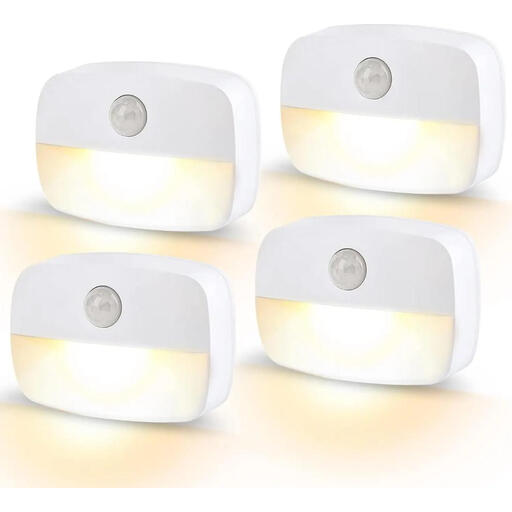
Why this product suits you: Four battery-powered lights let you illuminate your hallway, cupboard, stairs or bathroom all at once. They attach with double-sided adhesive tape, so there’s no need to drill.
The specifications state 35 lm, 3200–2800 K, a range of 13–20 feet and an auto-off time of 20 seconds. Batteries aren’t included, though.
Four lights, a 120-degree sensor and a power consumption of 0.5 W, according to the product specifications.
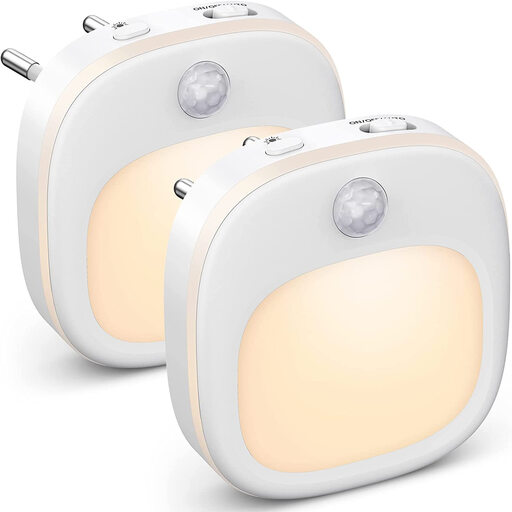
Why this product suits you: Three colour temperatures and five brightness settings make it easy to adjust the light for a bedroom, nursery or hallway.
The dimming settings and choice of colour temperature reduce the risk of the light being too bright or too cool for the room.
SMD LED, five brightness settings, three colour temperatures and 100–240 V, according to the product description.

Why this product suits you: This plug-in night light combines motion and dusk sensors and is designed for use in children’s rooms, hallways, kitchens, bathrooms and on stairs.
According to the description, the dusk sensor prevents the light from switching on unnecessarily when it’s bright. The auto-off time is 60 seconds.
Five brightness settings, 2700 K warm white light, a 3 m range and 0.5 W power consumption.
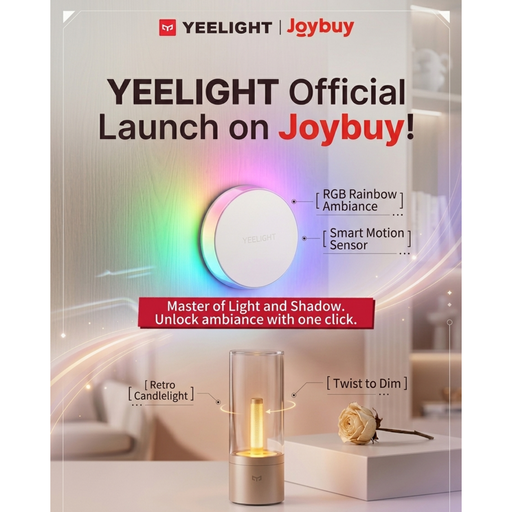
Why this product suits you: This rechargeable USB-C model comes with a magnetic holder, making it easy to position wherever you need it in a living room, bedroom or playroom.
The magnetic holder means you don’t need to install it permanently, while the USB-C rechargeable battery offers an alternative to disposable batteries. Check the specific sensor and battery life details before buying.
USB-C charging, a magnetic holder and eleven preset lighting effects, according to the product description.
We’ve put together a complete, regularly updated list of products that meet these strict selection criteria and fully comply with the safety regulations in force in the EU.
Position the light so that the sensor covers your usual route through the room. In a hallway, it makes sense to install it at passage height, while a model beside the bed should be aimed towards the floor. Make sure the sensor and light aren’t blocked by furniture, curtains or decorations.
Lifespan depends on the LED module, electronics, operating time and heat dissipation. For battery-powered devices, the number of times the light is triggered and its brightness also affect how long each set of batteries lasts. As well as checking the LED lifespan, find out whether the batteries are replaceable or the rechargeable battery can be charged via USB.
Running costs depend on power consumption and how long the light is on. A 0.5-watt model running continuously for ten hours a day would use around 1.5 kilowatt-hours a year. With sensor-operated models, actual consumption is usually lower because the light only comes on when it’s dark and movement is detected.