
Lieferung heute & morgen

Qualitätsgarantie

Willkommens-Angebote freischalten: KOSTENLOSE Lieferung | Bis zu 80 % RABATT | Kostenlose 30-Tage-JoyPlus-Testphase
App herunterladen
A night light with a motion sensor is designed to guide you through the dark without flooding the room with constant light. In many British households, typical uses include navigating the hallway, a trip to the bathroom, or checking on little ones in the children’s room during the night. However, products vary significantly when it comes to sensor technology, light colour, power supply and operation.
A motion-activated light that triggers with every movement regardless of ambient brightness can end up glowing unnecessarily during the day. Far more practical is a combination of a motion sensor and a dusk sensor. This way, the light only activates when the surrounding light levels are low. Look for specific details such as “≤20 lux” or an adjustable lux range.
The wattage describes power consumption, not the amount of light output. For brightness, the key figure is lumens. A small night light with 18 to 20 lumens is better suited for orientation than for illuminating a whole room. When it comes to light colour, you should distinguish between a warm white night light at around 2700 to 3000 Kelvin and more neutral tones around 4000 Kelvin. The higher the Kelvin value, the whiter the light appears.
A dimmable night light is especially versatile for bedrooms and children’s rooms. Some models offer just two or three levels, while others provide stepless touch dimming. Also check whether the light remembers the last brightness setting you chose. A memory function can save you from having to readjust the light every time you use it.
For hallways, stairs and small bathrooms, a range of around three to five metres is often sufficient. The detection angle is also crucial. A sensor with 120 degrees covers a wider area than a narrowly focused model. Furniture, doors or wall projections can restrict detection.
Pay attention to the shut-off time. With a plug-in night light that has a 60-second delay, the path is briefly illuminated after movement is detected. For longer stays in the bathroom or by the coat rack, a longer delay may be more practical.
An LED night light with a motion sensor that plugs directly into a socket is ready to use immediately and requires no battery changes. However, it does occupy a socket and is limited to that location. Rechargeable models can be placed more flexibly but need to be charged regularly via USB.
Hardwired 230-volt motion sensors are a different product category. With these devices, installation should be carried out by a qualified electrician in accordance with current electrical regulations. A battery-operated sensor, on the other hand, usually requires a compatible smart home hub or app if it is to communicate with other lights.
ABS plastic and metal are common housing materials for compact lights. For bathrooms, you need to check whether the product is explicitly suitable for damp environments. An IP44 rating means protection against splashing water, not against immersion or continuous rising steam. For a night light in the bathroom, therefore, do not mount it directly next to the shower or washbasin unless the manufacturer expressly permits this.
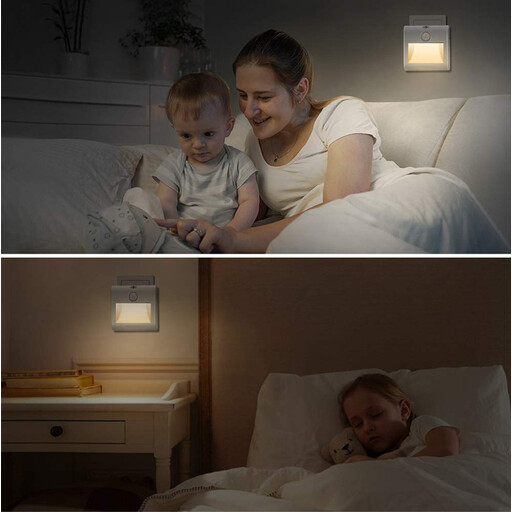
Why this product fits the profile: This 2-pack of night lights can be used simultaneously in the bedroom, hallway or toilet. It plugs directly into a standard socket and requires no installation.
The stated motion detection range is 3 to 5 metres, and automatic activation occurs at a maximum of 20 lux according to the product data. The stepless touch dimming reduces the risk of a permanently too-bright setting.
Two lights, 1 W power consumption per light, 20 lm brightness and a memory function. The light colour is specified as 4000–4500 K.

Why this product fits the profile: Five brightness levels allow separate settings for the children’s room, bedroom, hallway and bathroom. The matt housing made from PC and ABS is designed for indoor use.
The integrated dusk sensor prevents activation in bright surroundings, according to the description. The automatic shut-off after 60 seconds limits unnecessary illumination time.
2700 K warm white light, 0.5 W power consumption, five levels and a range of up to 3 metres with a 120-degree detection angle.
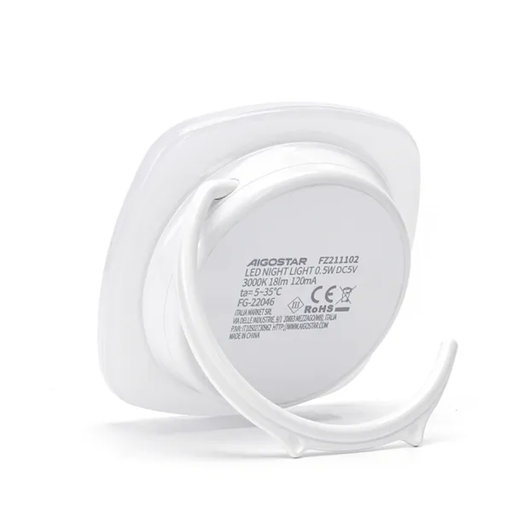
Why this product fits the profile: This rechargeable light is ideal for spots without a free socket, such as under a wall cabinet, inside a wardrobe or along a short hallway section.
The product data specifies a concrete sensor range of 3.5 metres and a 120-degree beam angle. This allows you to plan the placement more precisely than with vague range specifications.
USB charging, 500 mAh battery, 3000 K warm white light, 18 lm and 0.5 W LED power. The stated illumination time on motion is up to 6 hours.
We have compiled a complete, regularly updated list of products that fully meet these strict selection criteria and the safety regulations in force in the EU.
Consumption depends on the power and the duration of illumination. A model with 0.5 W uses less energy during short activations than a light that stays on permanently. For an accurate cost calculation, multiply the power in kilowatts by the operating hours and the electricity price of your tariff.
For pathways, a low, unobstructed position with a direct view of the walking area is recommended. Avoid areas directly next to radiators, ventilation outlets or windows with strongly changing sunlight, as this can cause false triggers with some sensors.
LEDs generally have a long expected service life. However, the actual lifespan also depends on the electronics, heat generation, switching cycles and the environment. With rechargeable lights, you also need to consider the ageing of the battery.