
Lieferung heute & morgen

Qualitätsgarantie

Willkommens-Angebote freischalten: KOSTENLOSE Lieferung | Bis zu 80 % RABATT | Kostenlose 30-Tage-JoyPlus-Testphase
App herunterladen
A night light with a motion sensor is designed to guide you in the dark without staying on permanently or lighting up the room unnecessarily. For hallways, stairs, bedrooms, children's rooms or bathrooms, the choice might seem straightforward at first. In practice, however, unclear sensor specifications, unsuitable light colours and an inappropriate power supply often lead to the wrong purchase.
A range of several metres does not automatically mean the sensor will reliably trigger in every spot. Furniture, doors, narrow hallways and an awkward mounting height can all restrict the detection area. That is why you should always look for:
A motion sensor night light with a wide angle can be suitable for a hallway, whereas in a narrow cupboard a smaller detection area is sufficient.
Lumens describe the amount of light, while Kelvin describes the colour temperature. A warm white night light at around 2700 to 3200 Kelvin usually feels more subdued than neutral or cool white light. For a child's bedroom, a master bedroom or the night-time trip to the bathroom, this can be more pleasant. For stairs or a longer hallway, however, sufficient brightness also matters.
So look for specific values such as 20, 35 or 40 lumens rather than just terms like "soft" or "bright". High brightness is not always an advantage, especially if the light shines directly into the bedroom.
A battery-operated night light can be flexibly attached to a cupboard, wall or staircase. However, you will need to buy replacement batteries and change them regularly. A plug-in night light requires no batteries, but it may block a socket and is not practical in every location for tenants. A USB rechargeable night light combines flexible placement with a rechargeable power supply, but it does need a charging cable and regular recharging.
An automatic night light with a PIR sensor reacts to movement. An additional built-in light sensor prevents the light from activating when there is enough ambient brightness. This saves switching cycles and reduces unnecessary power consumption.
Check whether the specifications match your surroundings. Among the available models, the stated values range, for example, from around 3 to 7 metres; the detection angles vary by product up to 120 degrees. The shut-off time is also relevant: 20 seconds works well for short trips, while 60 seconds can be more practical for slower movements or in the bathroom.
A dimmable night light makes sense if you want to use the same light in several locations. For a child's bedroom, a low setting may be enough, whereas a hallway might need a higher setting. Touch dimming or several fixed brightness levels should be clearly distinguished in the product description.
When it comes to light colour, consider where you will use it:
For the bathroom, also look for the note "indoor use only" or an IP rating. An indoor night light should not be treated the same as a light for damp outdoor areas.
Adhesive fixings require no drilling and are therefore suitable for rented homes. The surface should be clean, dry and smooth. With plug-in models, there is no mounting needed, but the socket and its surroundings must remain freely accessible.
A low power consumption of, for example, 0.5 or 1 watt is an objective indicator of an energy-saving night light. For battery models, the actual runtime also depends on how often it is triggered, the brightness setting and the battery quality. Claims such as "long runtime" should therefore not be taken at face value without concrete operating data.
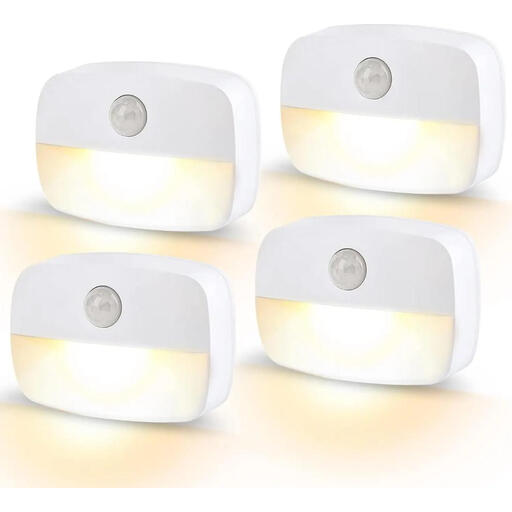
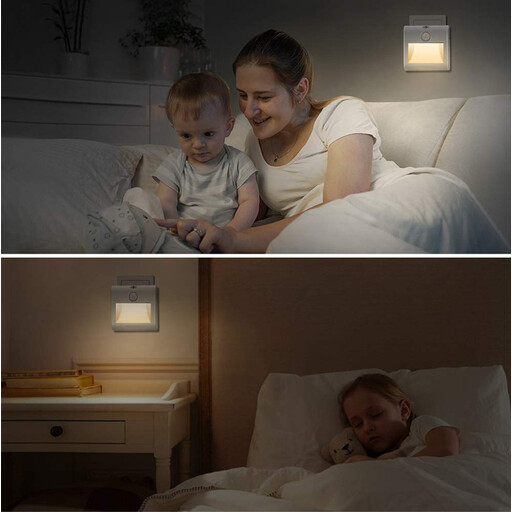
Why this product fits the profile: The four-pack lets you equip several spots such as the hallway, cupboard, stairs or bedroom. The double-sided adhesive tape fixing is suitable for rented homes without drilling.
The description states 35 lumens, 3200–2800 Kelvin, a 120-degree detection angle and a 20-second shut-off time, rather than just vague marketing claims.
Four lights, PIR sensor, stated range of 13–20 feet and operation on three AAA batteries each.
Why this product fits the profile: Two operating modes, stepless touch dimming and a memory function give you more control than a simple on/off model.
The brightness can be adjusted, so you are not stuck with a fixed light level that may not suit every room.
20 lumens, 1 watt, 100–240 volts, automatic activation at a maximum of 20 lux and motion detection at 3–5 metres.

Why this product fits the profile: This night light for children's rooms, hallways and stairs plugs directly into a socket and offers five brightness levels for different rooms.
The built-in dusk sensor takes ambient brightness into account; according to the product details, the light only activates in darkness and when motion is detected.
2700 Kelvin, 0.5 watts, five levels from 20 to 100 per cent and a stated range of up to 3 metres at 120 degrees.
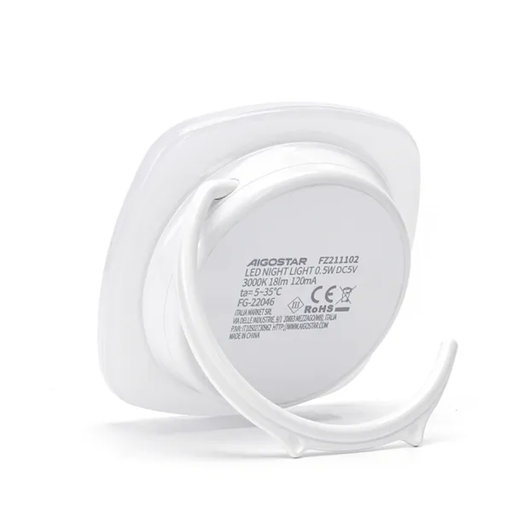
Why this product fits the profile: This USB rechargeable night light is ideal for cupboards, shelves and areas without a free socket. It can be placed independently of any fixed installation.
The power supply is clearly described as a 500 mAh battery with USB charging, rather than assuming an undefined cordless use.
3000 Kelvin, 18 lumens, stated sensor range of 3.5 metres and a 120-degree beam angle.
We have put together a complete, regularly updated list of products that fully meet these strict selection criteria and the safety regulations in force in the EU.
Mount an adhesive model on a clean, dry surface and point the sensor towards the expected walking path. For a plug-in night light, make sure the sensor is not blocked by furniture, curtains or other objects. Then test the range and trigger angle in actual darkness.
That depends on the power rating, how long it is on and how often it is triggered. The models mentioned here, for example, use 0.5 or 1 watt. A model with both a motion and light sensor only lights up when motion is detected and it is dark. With battery models, you also have the cost of AAA batteries; USB models need regular charging cycles.
A colour temperature of around 2700 to 3200 Kelvin is often chosen for subtle orientation lighting. However, brightness, mounting location and personal preference are still the deciding factors. For a night light in the bathroom or on the stairs, a slightly brighter setting can be more practical. All lights should be used only in suitable indoor spaces, in line with the manufacturer's instructions.