
Lieferung heute & morgen

Qualitätsgarantie

Willkommens-Angebote freischalten: KOSTENLOSE Lieferung | Bis zu 80 % RABATT | Kostenlose 30-Tage-JoyPlus-Testphase
App herunterladen
A night light with a motion sensor should switch on automatically when someone enters a dark area. In practice, however, models vary considerably in sensor range, light colour, power supply and ease of use. If you focus only on a high lumen rating or an attractive design, you could end up with a light that’s too bright for everyday use, reacts too late or needs frequent charging.
A bedroom or children’s room night light usually doesn’t need to illuminate the whole room. A high light output can be disruptive when you get up during the night. What matters more is whether the beam makes the floor, steps or doorway clearly visible. Ratings such as 20 lm or 18 lm are better suited to helping you find your way than to lighting an entire room.
Light colour is measured in Kelvin. A warm-white night light at around 2700 to 3000 K will typically feel softer than one rated at 4000 to 4500 K. Some products also describe the latter as warm white or warm daylight, but technically the light is more neutral. This colour can work well in a bathroom, hallway or on a staircase; beside the bed, many people prefer a dimmer, warmer light.
A PIR sensor detects movement, but it doesn’t necessarily switch the light on only when it’s dark. For energy-efficient operation, look for a dusk sensor or a specified lux threshold as well. The Aigostar NL01, for example, is described as activating when ambient light is low. This keeps the light off when the room is already bright enough.
Check the range and detection angle. A motion-sensor night light with a range of 3 to 5 metres is suitable for many hallways and bedrooms. A longer range, of up to 7 metres, may be more practical in a long hallway. These figures apply under the conditions specified for each product. Furniture, doors and movement from the side can affect detection in practice.
For a plug-in night light, make sure the socket isn’t hidden behind furniture or curtains. A battery-powered or USB-rechargeable night light is more flexible to position, but you’ll need to recharge it regularly or replace its batteries.
As well as the lumen rating, a dimming function is useful. A dimmable night light with several settings can be adjusted to suit a child’s room, bedroom or bathroom. The two-pack with motion detection offers five brightness settings and three colour temperatures, so you can adjust the light to suit where you’re using it.
Also check whether the light has a memory function. On suitable models, this saves the last setting you selected. Stepless touch dimming is listed, for example, for the two-pack with 1-W LED, 20 lm and a memory function.
A permanently installed plug-in night light doesn’t need batteries and is practical for hallways, stairs or bathrooms. Models with a power consumption of 1 W use little energy when switched on occasionally; the actual cost depends on how long you use the light and your electricity tariff.
A USB-rechargeable night light is a good choice if there isn’t a socket nearby. The Aigostar model is listed with a 500-mAh battery, 3000 K and up to six hours of illumination when activated by movement. If you expect to use it regularly throughout the night, factor charging into your decision.
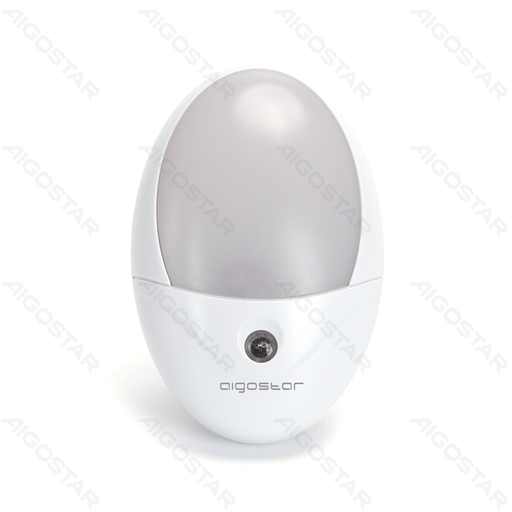
Why this product is a good fit: This model plugs straight into a socket and needs neither batteries nor a charging cable. It’s suitable for indoor use in hallways, on stairs, in bedrooms or in bathrooms.
The integrated PIR and dusk sensors help prevent unnecessary activation when there’s enough ambient light. The product details list 20 lm, 3000 K, a 7 m range and a 120° detection angle.
1-W LED, fixed 220–240-V plug-in design and a housing made from flame-retardant PC material, according to the product description.
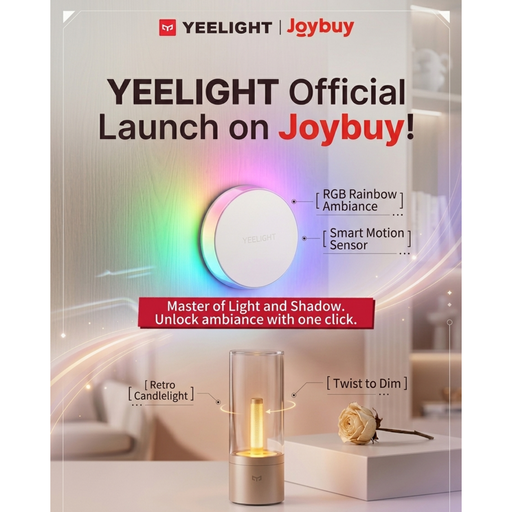
Why this product is a good fit: If you want to combine practical lighting with a decorative touch, this model offers RGB lighting, pre-set effects, a magnetic mount and USB-C charging.
The magnetic mount makes it easy to position the light where you need it. Before buying, check that the RGB effects and need to recharge it suit the bedroom or living area where you plan to use it.
11 pre-set lighting effects, a USB-C port, rechargeable operation and a motion sensor, according to the product details.
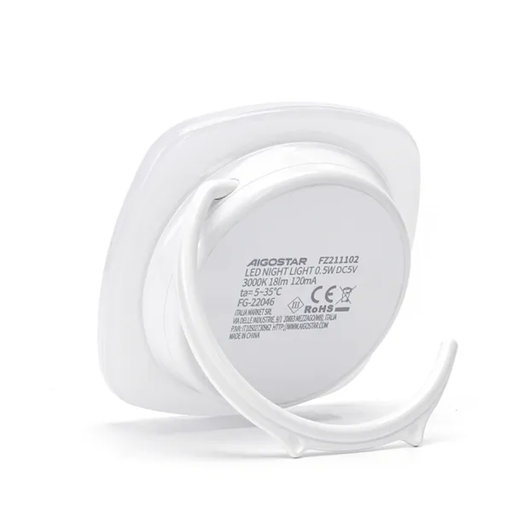
Why this product is a good fit: This USB-rechargeable model is designed for wardrobes, hallways and areas beneath wall cabinets where a socket isn’t within easy reach.
The product description lists a 3.5 m detection range, a 120° beam and a 500-mAh battery. This makes it easier to assess where to install it and how often it may need charging.
0.5-W LED, 18 lm, 3000 K and compact dimensions of 110 × 110 × 37,1 mm, according to the product details.
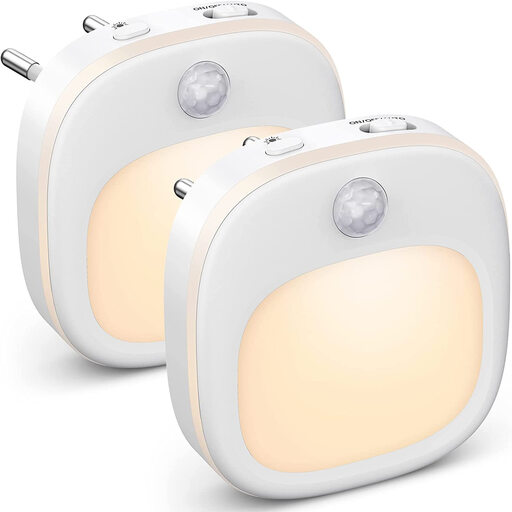
Why this product is a good fit: You can use the two lights in a bedroom, nursery, hallway or toilet. The combination of dimming settings and three colour temperatures lets you tailor the light to different rooms.
Five brightness settings mean you don’t have to make do with the same fixed light output in every room. Before buying, check that the power supply suits the place where you plan to use the lights.
A two-pack, three colour temperatures and five dimming settings, according to the product name; suitable for several indoor spaces.
We’ve put together a complete, regularly updated list of products that meet these strict selection criteria and fully comply with the safety regulations in force in the EU.
Position the sensor so that furniture doesn’t block the area where you want it to detect movement. For plug-in models, place the light at around knee or hip height, with a clear view of the route you’ll be walking. Then check whether the dusk sensor activates the light only when the ambient light is low.
Its lifespan depends on the LED component, electronics, heat dissipation and how long it’s used. One model, for example, is rated for 10,000 hours of operation. This is a product specification, not a guarantee of how long it will last in your home. Rechargeable models also need regular charging, and battery capacity can decrease over time.
A model with a power consumption of 1 W uses relatively little energy when it’s switched on for short periods. Overall consumption depends on how often the sensor is triggered and how long the light stays on. Plug-in night lights save you from changing batteries, while USB-rechargeable or battery-powered models offer more flexibility if there isn’t a socket nearby.