
Lieferung heute & morgen

Qualitätsgarantie

Willkommens-Angebote freischalten: KOSTENLOSE Lieferung | Bis zu 80 % RABATT | Kostenlose 30-Tage-JoyPlus-Testphase
App herunterladen
A night light with a sensor provides guidance at night without keeping the room brightly lit. For families, it can be practical in a child’s bedroom, hallway or stairwell, while adults often use an LED night light on the way to the bathroom or kitchen. However, not every model is suitable for every location.
Three common buying misconceptions often lead to unnecessary spending:
A dusk sensor switches the light on as brightness decreases and off again when there is sufficient daylight. This is suitable for a hallway or stairwell night light when the illumination needs to remain active automatically for several hours. Some products specify a precise threshold, such as 20 lux.
A PIR motion sensor responds to movement caused by heat. The key factors are the range, detection angle and switch-off time. A model with a range of 3 metres and a detection angle of 120 degrees may be sufficient for short trips to the bathroom or through the hallway. For larger areas, these figures should be compared with the size of the room and the position of the socket.
Combining motion and dusk sensors prevents the light from being activated unnecessarily by movement during daylight.
Colour temperature is measured in kelvin:
Brightness is measured in lumens. Low light output is often sufficient for a short journey. A dimmable night light with several settings can be adjusted to suit different situations. Also check the colour rendering index, CRI or Ra, if you want colours to appear as naturally as possible. Specifications such as Ra ≥ 80 or CRI > 85 are technical product details, not a medical quality guarantee.
The wattage indicates how much electrical power the night light uses. A product rated at 0.5 watts theoretically consumes around 0.5 kilowatt-hours over 1,000 operating hours. For a 1-watt model, this is around 1 kilowatt-hour. The actual cost depends on your electricity tariff and how long the light is used.
For an energy-efficient night light, low power consumption, automatic switch-off and sensor control that responds to actual needs are all important. Plug-in models do not need recharging, while rechargeable lights should be assessed for their charging time, battery capacity and operating time.
Robust housing materials such as PC or ABS are common for children’s rooms and bedrooms. However, IP20 only means protection against solid foreign objects indoors; it does not provide protection against water. An IP20 night light is therefore not suitable for direct contact with splashing water. In the bathroom, it should be positioned at a sufficient distance from water sources and used in accordance with the manufacturer’s instructions.
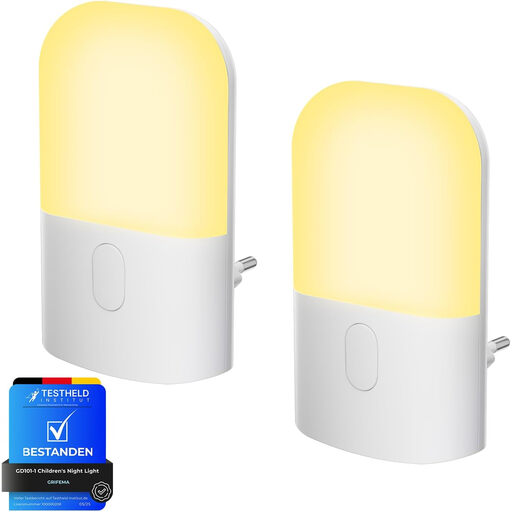
Why this product suits this profile: The two-pack can be used in several rooms, such as a child’s bedroom and hallway. Automatic dusk control and three brightness settings reduce the need for manual operation.
The three dimming levels prevent the light from being unnecessarily bright. The stated consumption of 0.5 W is a clear and verifiable technical specification.
Two lights, 2700 K warm white light and automatic activation in the dark.
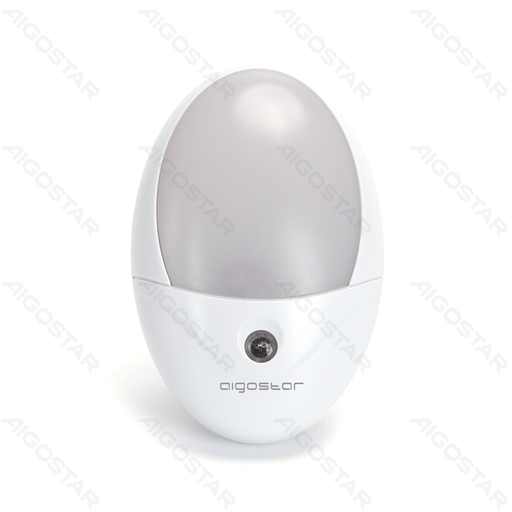
Why this product suits this profile: This plug-in model combines a PIR motion sensor with dusk detection and is designed for indoor areas such as hallways, bedrooms, bathrooms and stairwells.
The sensor type is clearly specified as PIR motion detection, with a range of up to 7 m and a 120-degree angle. This makes it easier to compare with your preferred installation location.
3000 K warm white light, 20 lm light output and battery-free operation via the mains socket.

Why this product suits this profile: The two rechargeable lights are suitable for cupboards, kitchen areas, shelves and hallways where there is no suitable socket nearby.
The rechargeable battery requirements are clearly stated through the specified 800 mAh capacity and USB charging. The adhesive-strip installation requires no drilling.
Three colour temperatures from warm white to cool white, a PIR range of 3 to 5 m and two lights in the set.
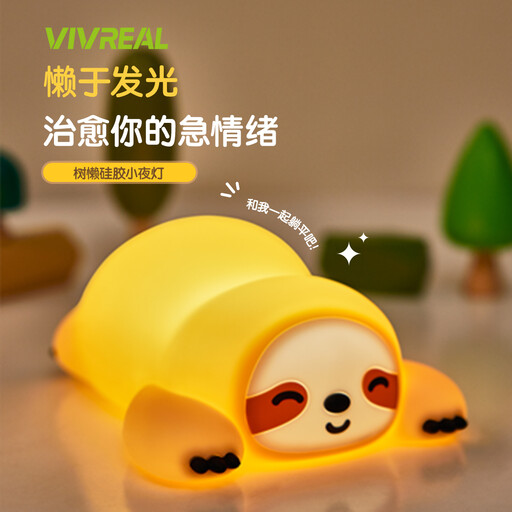
Why this product suits this profile: This battery-powered light can be placed without installation and moved between the bedside, children’s room and other indoor areas as needed.
The three brightness settings allow the light to be adjusted to suit its use. The stated operating time of up to 6 hours at maximum brightness makes it easier to plan when charging will be needed.
1200 mAh battery, USB-C charging and three brightness settings with a warm yellow light colour.
We have compiled a complete, regularly updated list of products that fully meet these strict selection criteria and the safety regulations applicable in the EU.
Before installation, check that the socket is securely fixed and that the mains voltage specified on the product is compatible with the electrical installation. The sensor and LED must not be blocked by furniture, curtains or other objects. For a bathroom night light, keeping it away from water is essential; an IP20 product must not come into contact with moisture or splashing water.
Plug-in night lights should not be covered and should be unplugged before cleaning. Rechargeable lights should be kept away from sources of heat. If there is visible damage, unusual heating or a swollen battery, stop using the product.
This depends on its power consumption and operating time. At 0.5 watts, the theoretical consumption is 0.5 kilowatt-hours per 1,000 operating hours. A dusk or motion sensor can limit the actual time the light is switched on. To calculate your personal cost, multiply the consumption in kilowatt-hours by your electricity price.
For continuous ambient lighting in a hallway or stairwell, a dusk sensor is usually the better choice. For short trips, such as from the bedroom to the bathroom, a motion sensor can limit operation to the time when movement is actually detected. Combination devices offer both functions but require careful positioning.
Its lifespan depends on the LED module, electronics, switching cycles and usage. Some product specifications state, for example, 10,000 or 25,000 hours. These figures are manufacturer specifications and do not guarantee a particular service life in the home. With rechargeable models, you should also take battery ageing into account.