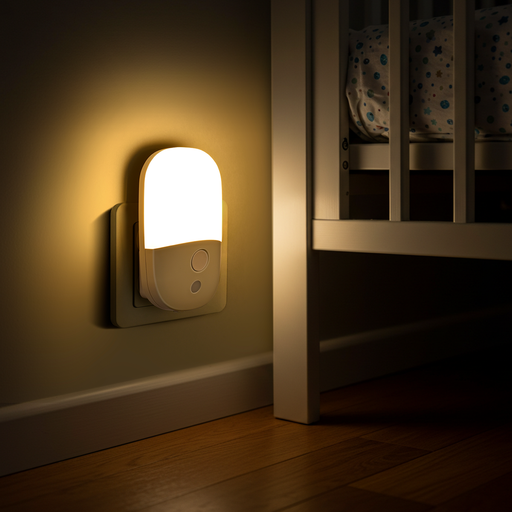
A night light with a motion sensor may seem like a straightforward purchase. In practice, however, reliable models quickly distinguish themselves from those that cause more frustration than they solve. Incorrect brightness, unreliable sensors, or a short lifespan are common annoyances. This guide will help you identify the crucial features and make an informed choice for your needs, whether it's for a child's room, a hallway, or closet lighting.
Where Many Night Lights Fail in Practice
Before choosing a model, it's important to understand the typical weaknesses that often only become apparent after the purchase.
- The Unreliable Sensor: A poorly calibrated motion sensor is a frequent problem. It either reacts to the slightest movement and turns on constantly, disturbing sleep and wasting energy, or it's too sluggish and only activates after you've nearly tripped over something. This undermines the very purpose of an orientation light.
- Wrong Light Colour and Fixed Brightness: Many budget-friendly models use cool white light (over 5000 Kelvin). This light colour can inhibit the production of the sleep hormone melatonin, thus disrupting your sleep cycle. If the light is also not dimmable, it can feel glaring at night, especially when used as a children's room night light or when waking up in the middle of the night.
- Hidden Running Costs and Short Lifespan: In battery-powered models, inefficient electronics can lead to rapid battery drain. For rechargeable models, the capacity is often too low, requiring constant recharging. Even with a plug-in night light, high standby power consumption can drive up energy costs unnoticed.
Crucial Criteria for Your Selection
To avoid these pitfalls, you should focus on three key technical parameters. These determine the functionality and reliability in everyday use.
1. Sensor Technology: PIR vs. Dusk-to-Dawn Sensor
The type of sensor is critical for its function.
- PIR (Passive Infrared) Sensor: This sensor reacts to the heat radiation from moving bodies. It is ideal for areas that only need to be lit when someone is present, such as a stair light or closet lighting. Pay attention to the specified detection angle (often 120°) and range (typically 3–5 metres).
- Dusk-to-Dawn Sensor (Photocell): This sensor measures the ambient light and automatically switches the light on in the dark and off when it's bright. It is suitable for a permanent orientation light with a sensor that provides a basic level of brightness throughout the night.
- Combined Sensors: Many models combine both technologies. The light only activates when both darkness and motion are detected. This is the most energy-efficient solution.
2. Power Supply: Plug-in, Rechargeable, or Battery
The choice of power source depends on the location of use.
- Plug-in Night Light: These models are maintenance-free and offer constant power. They are ideal for hallways, kitchens, and children's rooms where a socket is permanently available. Their design should be compact to avoid blocking adjacent sockets.
- Rechargeable Models (USB-C): These offer maximum flexibility. They can be placed anywhere, even where there is no socket, such as in closets, drawers, or the basement. Pay attention to the battery capacity (given in mAh)—higher values mean longer run times.
- Battery-Powered Models: Similar in flexibility to rechargeable lights, but with the disadvantage of regular battery changes. They are a good option for places with very infrequent use, like battery-powered closet lighting in a guest wardrobe.
3. Light Quality: Dimmability and Colour Temperature
The light parameters are crucial for comfort and well-being.
- Colour Temperature: For sleeping areas and night-time orientation, a warm light colour of 2700K to 3000K is recommended. This warm white light has a calming effect and is less disruptive to the sleep cycle.
- Dimmability: A dimmable LED night light allows you to adjust the brightness to the situation. A low brightness is sufficient for orientation in the bedroom, while a higher level provides more safety in the hallway or on the stairs.
Our Selection for Different Needs
Here are some models tailored to specific use cases that meet the criteria mentioned above.
MATCH FOR: PARENTS & TODDLERS
Why This Fits Their Persona: Ideal for parents seeking safe and customisable lighting for a child's room or hallway. The combination of a motion and dusk-to-dawn sensor ensures on-demand activation without unnecessarily disturbing sleep.
How It Avoids the Trap
Sidesteps the pitfall of overly bright light with five dimming levels and a sleep-friendly 2700K warm white light colour. The dual sensor also prevents false activation in daylight.
Key Advantage & Pros
Combined motion and dusk-to-dawn sensor. Very low power consumption of 0.5W. Compact plug-in design.
MATCH FOR: ORGANISATION LOVERS & DIYERS
Why This Fits Their Persona: Perfect for flexibly illuminating closets, drawers, kitchen counters, or dark alcoves without complex wiring. The ultra-thin design and simple adhesive mounting allow for a discreet installation.
How It Avoids the Trap
Avoids the short battery life trap with a 1100mAh rechargeable battery. The choice between three colour temperatures (warm, neutral, cool) prevents the problem of an unsuitable light colour for different applications.
Key Advantage & Pros
USB-rechargeable for maximum flexibility. Tool-free installation using adhesive strips. Three selectable light colours for different moods.
MATCH FOR: SAFETY-CONSCIOUS HOMEOWNERS
Why This Fits Their Persona: A straightforward and reliable solution for anyone wanting to avoid night-time tripping hazards in hallways, stairwells, or bathrooms. The "plug-and-forget" principle makes it particularly attractive for seniors or safety-conscious individuals.
How It Avoids the Trap
Avoids the unreliable sensor trap by using a simple but effective dusk-to-dawn sensor (photocell) that ensures consistent automation. As a purely plug-in model, it also eliminates any maintenance for batteries or recharging.
Key Advantage & Pros
Adjustable brightness for individual comfort. Energy-efficient continuous operation directly from the socket. Warm white light (2700K).
Looking for more options?
We have compiled a complete, up-to-date list of products that fully meet these strict selection criteria and UK safety regulations.
Frequently Asked Questions (FAQ)
1. What are the electricity costs for an LED night light?
Most modern LED night lights are extremely energy-efficient. Plug-in models often have a power consumption of only 0.5 to 1 watt. With an electricity price of 30 pence per kilowatt-hour and a daily usage of 10 hours, the annual electricity costs amount to less than ?1 to ?2. Rechargeable and battery-powered models consume even less, as they only light up when needed.
2. Where is the best place to install a night light with a motion sensor?
The optimal placement depends on the room.
- Hallway and Stairs: Install the light at knee to hip height so that the floor is well-lit without shining directly into your eyes.
- Bedroom and Children's Room: Place it so that the light does not shine directly on the bed. A position under the bed or behind a piece of furniture creates a soft, indirect light.
- Closet: Mount the light in the upper front area of the closet so that the light cone illuminates the contents well as soon as the door is opened.
3. What is the difference between a PIR sensor and a dusk-to-dawn sensor?
A PIR (Passive Infrared) sensor is a motion detector. It reacts to the heat emitted by people or animals and switches the light on when movement occurs within its detection range. A dusk-to-dawn sensor (also called a photocell) is a brightness sensor. It measures the ambient light and only activates the night light when it is dark enough. Many devices combine both sensors to save energy: they only turn on in the dark AND when motion is detected.