
Lieferung heute & morgen

Qualitätsgarantie

Willkommens-Angebote freischalten: KOSTENLOSE Lieferung | Bis zu 80 % RABATT | Kostenlose 30-Tage-JoyPlus-Testphase
App herunterladen
Night-time leaks, wet bedding or uncertainty about sizing can make buying night-time nappies a practical balancing act. Not every nappy advertised as particularly absorbent will automatically suit every child or everyday situation. With adult nappies and incontinence nappies, fit, fastening and absorbency also determine whether they are genuinely suitable.
As a Joybuy Product Recommendation Officer, I filter through the most important product information and explain what parents, family members and carers should look for when buying.
Age ranges such as “4–7 years” are intended only as a guide. Children of the same age can differ significantly in build and weight. A night-time nappy that is too small may be too tight around the legs or tummy. A size that is too large can leave gaps, increasing the risk of leaks.
The most important factors are therefore weight range, fit around the waist and fit around the legs. Some products have overlapping weight categories. In such cases, freedom of movement and body shape may be decisive.
Phrases such as “for the whole night” or “Leak Protection” describe the intended use or the manufacturer’s claims. They are not a guarantee for every sleeping position, fluid intake or individual situation. Even leak-proof nappies can leak if the fit is unsuitable or the leg cuffs have not been pulled out fully.
You should therefore check specific features: absorbent core, leak guards, elasticated waistband, back barrier and correct fit.
Pull-up nappies and Pyjama Pants are put on like underwear. They are particularly suitable for children who move around a lot during changing or are becoming more independent. Classic disposable adult nappies with hook-and-loop fastenings, on the other hand, can usually be adjusted more precisely when lying down and when care is required.
The product design should suit the intended use: active children benefit from an easy pull-up design, while adjustable tabs are often more practical for adults or when caring for someone with limited mobility.
Use the information on the packaging as a guide and compare it with the person’s actual body weight. With night-time nappies for babies and night-time nappies for children, the nappy should fit comfortably around the tummy without digging in. The leg openings must lie flat against the skin. With pants, it is also important that the waistband does not roll down after they have been put on.
One example from the selection:
The weight ranges overlap in some cases. The deciding factor is then which option fits the body without gaps or pressure points.
High absorbency is important for night-time nappies, but it is not the only factor. Liquid should be drawn away from the skin-contact area as quickly as possible. An absorbent core, moisture barrier and side leak guards work together to achieve this.
For bedwetting, bedwetting pants with a discreet underwear-style appearance may be a sensible choice. For adults who need support at night, products with adjustable tabs and a core designed for overnight use are often more suitable. The manufacturer’s information should be treated as guidance for the intended use.
Pay attention to material details, fragrances and information about skin compatibility. If the skin is sensitive, the nappy should be checked regularly and changed when wet or soiled. If redness or discomfort occurs, stop using the product and seek medical advice if necessary.
Disposable products are not washable and must not be reused. Used nappies should be disposed of in household waste, not flushed down the toilet. Packaging should be kept out of children’s reach because of the potential risk of suffocation or strangulation.
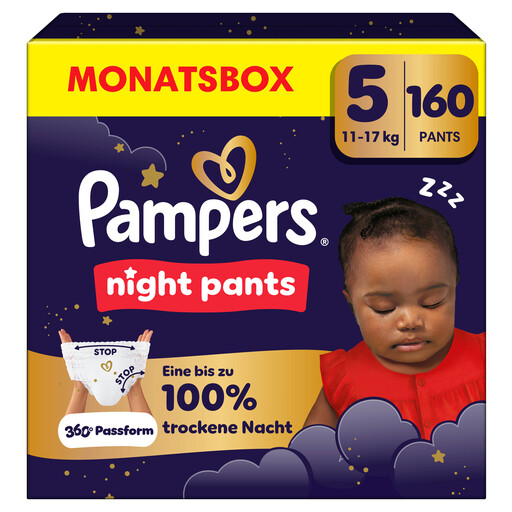
Why this product suits the profile: The large pack of 160 pants is ideal for families who regularly need night-time nappies for children and want a clearly stated weight range.
The 11–17 kg weight range makes choosing easier. According to the product description, the 360-degree waistband and side leak guards are designed to cope with movement during the night.
Pull-up design, tear-away side seams and adhesive strips for rolling up and disposal; dermatologically tested and certified to OEKO-TEX STANDARD 100, according to the manufacturer.
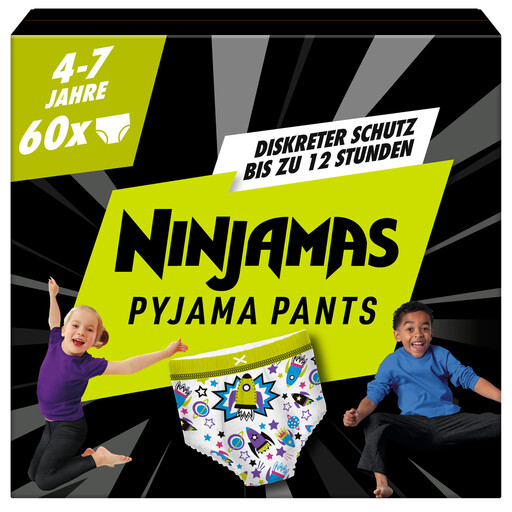
Why this product suits the profile: For children weighing 17–30 kg, this model combines an underwear-style appearance with features designed for overnight use and a flexible 360-degree FormFit waistband.
The specific weight range prevents a choice based solely on age. The product description also mentions quiet material and an adaptable waistband.
60 disposable pants, a super-absorbent core according to the manufacturer, a 360-degree waistband and OEKO-TEX-STANDARD-100 certification according to the product data.
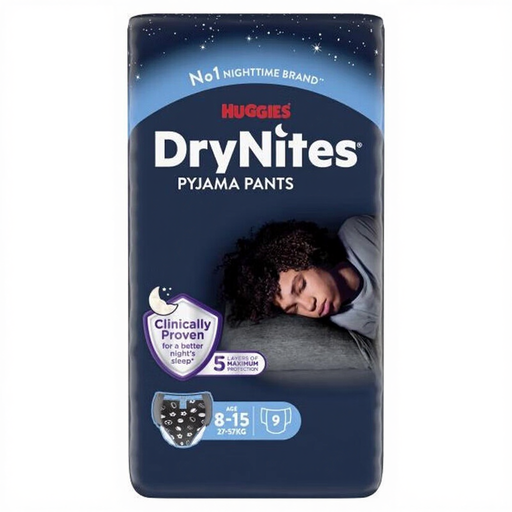
Why this product suits the profile: This option is designed for older children and teenagers weighing 27–57 kg and is described as a discreet alternative to underwear.
The age- and weight-specific labelling reduces the risk of choosing a children’s size that is too small. According to the product data, five protective layers and elasticated sides are included.
9 nappies per pack, a gender-specific absorbency zone according to the product description and low-noise material.

Why this product suits the profile: These disposable nappies are described for adults of all genders and for overnight use. The tabs allow for adjustable positioning.
The XL size and information about an adjustable fit help with sizing. When choosing, you should also check waist measurements and individual fit.
Hook-and-loop tabs, soft non-woven material according to the product description and intended overnight use as a disposable product. According to the supplier, this product is not a medical device.
We have put together a complete, regularly updated list of products that fully meet these strict selection criteria and the safety regulations applicable in the EU.
Before first use, pull the leg cuffs outwards and smooth the waistband into position. Pants are put on standing up or lying down, just like underwear. A traditional adult nappy with tabs should be fastened so that it fits securely without digging in.
The pack price is not the only factor affecting costs. Compare the price per nappy and consider how often the product needs to be changed. A smaller pack can be useful for an initial fit test. For regular use, a larger quantity may reduce the price per item, but it also ties up more budget and storage space.
First check body weight, followed by waist and leg measurements. The nappy should fit closely without causing pressure points. If leaks occur despite the correct weight range, it may be worth trying a different model, repositioning the cuffs correctly or adjusting the size.
How long it can be worn depends on the product, the amount of fluid and the individual situation. A wet or soiled nappy should be changed promptly. The manufacturer’s intended-use information and the instructions on the packaging are the key points to follow.
Children’s night-time nappies and Pyjama Pants are usually designed as pull-up underwear and sized according to children’s age or weight. Adult nappies often have side tabs, allowing for greater adjustability when lying down. For adults with incontinence, particular attention should be paid to fit, changing intervals and checking the skin.