
Lieferung heute & morgen

Qualitätsgarantie

Willkommens-Angebote freischalten: KOSTENLOSE Lieferung | Bis zu 80 % RABATT | Kostenlose 30-Tage-JoyPlus-Testphase
App herunterladen
A nightstand is more than just a place for your smartphone or a glass of water. It's a central element that contributes to the functionality and atmosphere of your bedroom. However, the sheer number of choices can quickly become overwhelming. Online listings often look promising but turn out to be a disappointment after purchase. To help you avoid buyer's remorse, we'll highlight the most common pitfalls and show you which criteria truly matter.
Many buyers focus primarily on design, overlooking crucial functional flaws that only become apparent in daily use.
To avoid these problems, you should check three core areas before buying. These objective parameters will help you realistically assess a model's quality and suitability.
The choice of material significantly influences stability and lifespan. Pay attention to the following specifications:
Consider what you want to store by your bed. This will determine the ideal configuration.
Before you buy, carefully measure the available space and the height of your bed.
Based on the criteria mentioned, we have identified a few models that are suitable for different needs and interior styles.
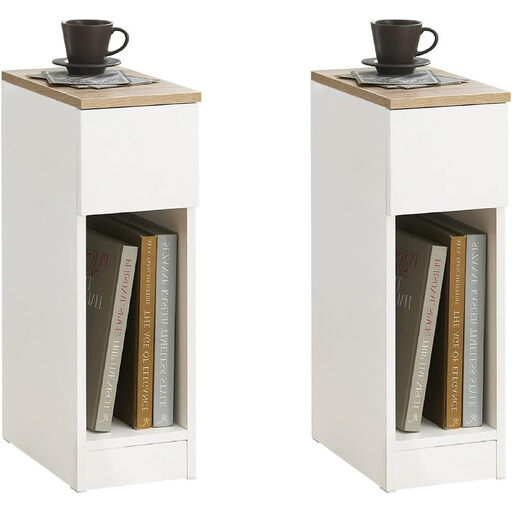
Why This Fits Their Persona: Ideal for anyone living in urban apartments or smaller bedrooms who needs to make the most of every inch. This set solves the problem of tight spaces next to the bed without sacrificing storage.
This model bypasses the "Proportion Problem" with its intentionally narrow design. The construction from E1-class MDF and particleboard provides a solid base, avoiding the instability typical of very slim furniture.
At just 20 cm wide, it fits into the tightest gaps. The combination of a drawer for private items and an open shelf for quick access is extremely practical.

Why This Fits Their Persona: Perfect for users who appreciate a clean setup and want to charge their devices like smartphones, tablets, or smartwatches right at the bedside without a tangle of cables and power adapters.
This model is more than just a surface. It integrates useful technology directly into the furniture, offering real added value instead of just dazzling with a trendy design. The features are tailored to modern daily life.
Integrated USB-A and USB-C ports for charging devices. The soft, touch-controlled LED lighting creates a pleasant atmosphere and serves as a night light.
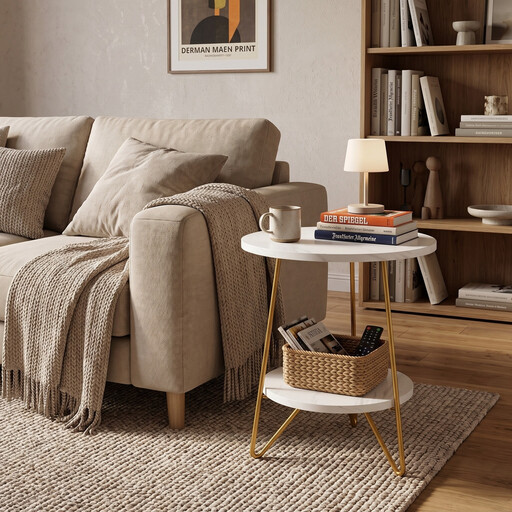
Why This Fits Their Persona: For anyone looking to elevate their bedroom with an elegant piece of furniture that functions as both a bedroom side table and a nightstand. The design adds a modern, luxurious accent.
This table avoids the "Stability Trap" through a thoughtful design: the powder-coated metal base with its triangular structure ensures a secure footing. The faux marble surface is also scratch-resistant and easier to care for than delicate real marble.
The two-tier design offers double the surface area for decor and essentials. The combination of a white marble look and a gold frame is a visual highlight.
We have compiled a complete, up-to-date list of products that meet these strict selection criteria and applicable regulations.
1. How high should a nightstand be? A good rule of thumb is that the top of the nightstand should be about the same height as the top of your mattress. For a standard bed (approx. 50-60 cm high), a nightstand with a height of 50-65 cm fits well. For taller box spring beds (often 60-70 cm), the nightstand should also be correspondingly taller to ensure easy access.
2. What is the difference between a nightstand and a bedside chest? Although the terms are often used interchangeably, there is a slight difference. A nightstand is typically a smaller, lighter piece of furniture, often with open shelves or a single small drawer. A bedside chest is usually a bit larger and more robustly built, featuring multiple drawers, similar to a small chest of drawers. It offers more enclosed storage space.
3. How do you securely mount a floating nightstand? Secure installation is crucial here. Always use anchors and screws that are appropriate for your wall type. For solid concrete or brick walls, expansion anchors are suitable. For drywall (plasterboard), special hollow-wall anchors are required to ensure sufficient load-bearing capacity. Before drilling, use a cable/pipe detector to check if there are any electrical or water lines at the chosen location.