
Lieferung heute & morgen

Qualitätsgarantie

Willkommens-Angebote freischalten: KOSTENLOSE Lieferung | Bis zu 80 % RABATT | Kostenlose 30-Tage-JoyPlus-Testphase
App herunterladen
A no-drill clip-fit pleated blind can provide privacy and shade for windows and doors without the need for wall plugs, screws or drilled holes. This makes it particularly appealing for rented homes. However, fitting methods, fabric properties and measurements can vary considerably. If you focus only on colour or a low price, you could end up with a blind that doesn’t fit your window frame or provide the light control you want.
The terms “opaque”, “light-dimming” and “blackout pleated blind” aren’t always used consistently in product descriptions. An opaque pleated blind can reduce prying eyes while still allowing daylight through. You should also check the specific fabric description rather than relying on the term “blackout”. Some models mention that they let in diffused light, despite using this term.
That’s why it’s important to distinguish between a light-filtering pleated blind, light-dimming fabric and a fabric that blocks as much light as possible, particularly in bedrooms. Light can also come through at the sides if the blind is narrower than the glass.
A pleated blind with clamp brackets is usually attached to the window sash. Before buying, check the frame thickness, rebate and any protruding window handles. Some systems are only suitable for specific parts of the frame. For example, according to its product information, the WOLTU honeycomb pleated blind is designed for frame thicknesses of 10 to 23 mm.
For adhesive fitting, the surface must be clean, dry and as smooth as possible. Rough, uneven or very dirty surfaces can affect adhesion. So “no drilling” doesn’t mean that every type of fixing will work on every surface.
A common mistake is to use only the width of the glass. For several Dream-seeker models, a width of around 4 cm more than the glass width is recommended. The height should be based on the full window height, including the frame. However, this recommendation isn’t the same for every system.
Always follow the specific product’s measuring instructions before placing your order. For doors, balcony windows and larger glass surfaces, also check that handles or fittings won’t obstruct the blind.
A clip-fit pleated blind is secured to the frame using adjustable clamp brackets. This is often a good option for rented homes, provided the frame thickness and design are suitable. In many cases, the fixings can be removed later.
With an adhesive-fit pleated blind, the brackets are stuck to the cleaned frame or another suitable surface. This option is useful when clamp brackets aren’t suitable. Prepare the surface as instructed before fitting. Once the blind is in place, check that all the brackets are secure.
A light-filtering pleated blind is often enough for a living room or home office: it diffuses daylight and reduces direct views into the room. A more light-dimming fabric may be a better choice for a bedroom. For kitchens and bathrooms, check whether the product is described as moisture-resistant. Moisture-resistant doesn’t automatically mean waterproof.
Also consider how the blind works: some models are raised and lowered using a pull cord, while others have handles on the top or bottom rail. In homes with children, keep cords and moving parts out of their reach.
Many of the models covered here are made from polyester. They can usually be cleaned with a soft, slightly damp cloth. Harsh cleaning products and abrasive sponges can damage the fabric and its coating.
When choosing a blind for a window or door, consider where you plan to use it. According to their product descriptions, some models aren’t suitable for sloping roof windows, wooden windows or sliding windows. So a pleated blind for windows and doors won’t necessarily suit every type of window.
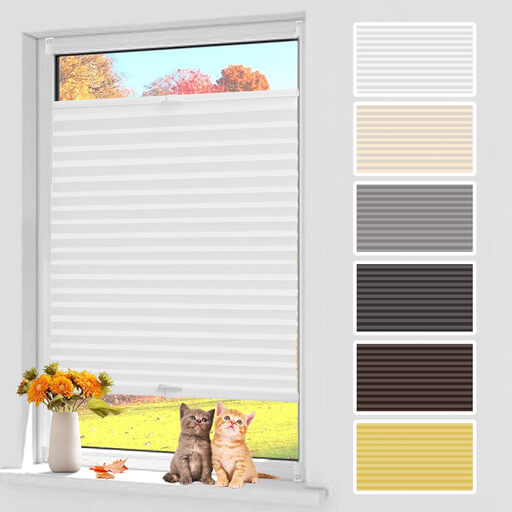
Why it suits this type of buyer: Its compact size is ideal for smaller standard windows. This model can be fitted without drilling using clip-fit brackets or mounts, and is described as suitable for indoor windows and doors.
The product information specifically states that it can be fitted using tool-free clamps. Even so, check that your frame thickness is compatible with the clamp mechanism before buying.
60 × 100 cm, polyester fabric, white, with adjustable light and privacy control.
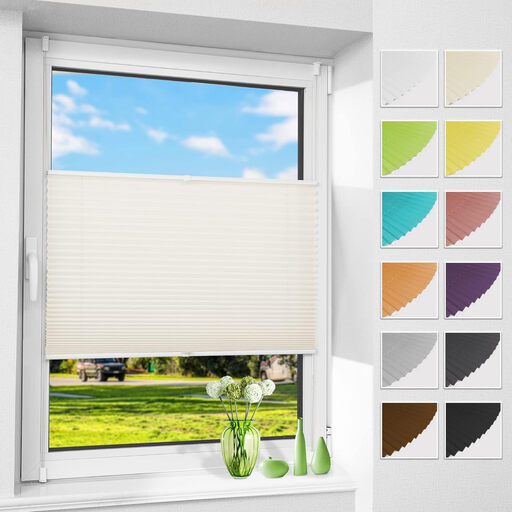
Why it suits this type of buyer: The system has adjustable brackets for frame thicknesses of 10 to 23 mm, as well as handles on the top and bottom. This makes it easy to adjust the blind to control the light.
The recommended frame thickness is clearly specified. This reduces the risk of ordering a clip-fit pleated blind that won’t suit your window frame.
90 × 100 cm, polyester with an aluminium rod, described as suitable for humid rooms, with adjustable clamp brackets.

Why it suits this type of buyer: This honeycomb blind is designed for rooms where you want greater light control and flexible positioning, such as a bedroom, office or living room.
The product information specifies a suitable frame range of 10 to 23 mm and notes that this model isn’t designed for roof windows.
Honeycomb structure, 50 × 130 cm, clip-fit installation, top and bottom handles, and polyester fabric described as reducing light.
We’ve put together a complete, regularly updated list of products that meet these strict selection criteria and fully comply with the safety regulations in force in the EU.
How well it holds depends on the frame shape, material, load and whether it’s fitted correctly. Check regularly that the clamp brackets are secure. For adhesive brackets, a smooth, clean surface and allowing the adhesive to set for the specified time are essential.
Many models are described as suitable for windows and doors. However, check the door handle, opening direction and available frame space before buying. A blind with adjustable positioning can be useful on balcony or patio doors.
Not every pleated blind described as “blackout” will create complete darkness. The fabric may block light, but light can still come through at the sides or through small gaps. To make the room as dark as possible, consider the fabric, the width of the blind and where it will be fitted.