
Lieferung heute & morgen

Qualitätsgarantie

Willkommens-Angebote freischalten: KOSTENLOSE Lieferung | Bis zu 80 % RABATT | Kostenlose 30-Tage-JoyPlus-Testphase
App herunterladen
A no-drill clip-fit pleated blind can be a practical solution for rented homes, offices and frequently changing living situations. It attaches to the window frame without requiring wall plugs or screws and, depending on the design, can be used as privacy screening, sun protection or a light-filtering pleated blind.
Despite the simple installation, buyers often make mistakes in three areas: taking the wrong measurements, confusing “opaque” with complete blackout, or choosing clip fittings that do not suit the window frame. Checking these points before buying can significantly narrow down your options.
With a clip-fit pleated blind, the product width may refer to the width of the entire blind or the width of the fabric, depending on the model. These measurements are not always identical. To ensure sufficient privacy, check whether the side sections of the frame will also be covered.
Some product specifications recommend choosing a pleated blind approximately 2 to 4 cm wider than the window pane. Other models are selected directly according to the width of the window sash. The specific measuring instructions for the product in question are therefore decisive.
A light-filtering pleated blind reduces visibility from outside and harsh glare while allowing daylight into the room. A dimming or blackout model blocks out more light. However, complete blackout is not automatically guaranteed, as side gaps and the fitting position also play a role.
A blackout pleated blind can be a sensible choice for bedrooms. For living rooms, kitchens or offices, a privacy pleated blind with diffuse light dispersion is often sufficient.
A pleated blind with clip fittings is hooked onto or clamped to the window sash. The frame thickness must fall within the specified range. With adhesive fitting, brackets are stuck to a clean, smooth surface. Rough, dusty or damp surfaces can reduce the adhesive’s grip.
Clean the window frame and allow it to dry completely before installation. In rented homes, you should also check whether adhesive residue can genuinely be avoided when the blind is later removed.
Measure the width at several points, as window frames can vary slightly. For the height, the entire height of the window sash, including the frame, is usually relevant. For doors and larger window areas, also check whether the construction is suitable for more frequent movement.
A 100 cm high pleated blind is suitable for many standard windows. Balcony or patio doors may require 120, 130, 140 or 200 cm. The products also differ in the widths available. Some versions come in fixed sizes, while others can be adjusted within a defined range.
With clip-fit systems, the rebate or frame thickness is a non-negotiable parameter. For example, the Allesin model specifies an adjustable range of 10 to 23 mm. The WOLTU model lists a recommended window rebate of 1.5 to 2.3 cm.
Not every pleated blind for windows and doors is suitable for roof windows, sliding windows, wooden frames or sloping windows. Such exclusions are stated in the relevant product information and should be checked before ordering.
Polyester is a commonly used material in the models mentioned. It can generally be cleaned with a damp cloth. However, moisture-resistant does not mean waterproof. For bathrooms or kitchens, you should therefore follow the specific care and usage recommendations.
Look for a clear description of the light effect:
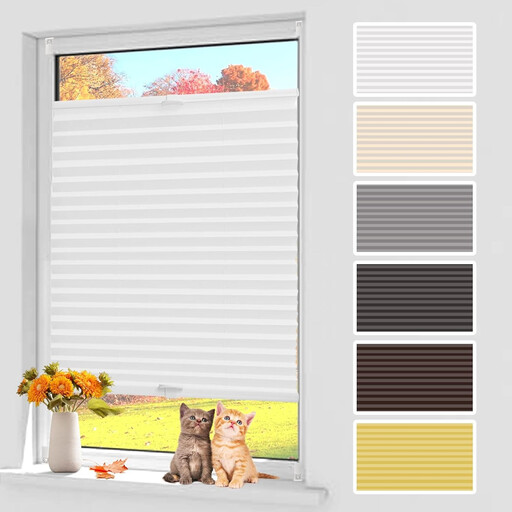
Why this product suits the profile: The fixed size of 65 × 100 cm and white finish are suitable for a standard window when you are looking for a straightforward solution offering privacy and sun protection.
The product details specify no-drill installation and cleaning with a damp cloth. Before buying, check the frame width and whether the adhesive or clip surfaces are suitable.
65 × 100 cm dimensions, polyester fabric, white colour and an adjustable position for light control.
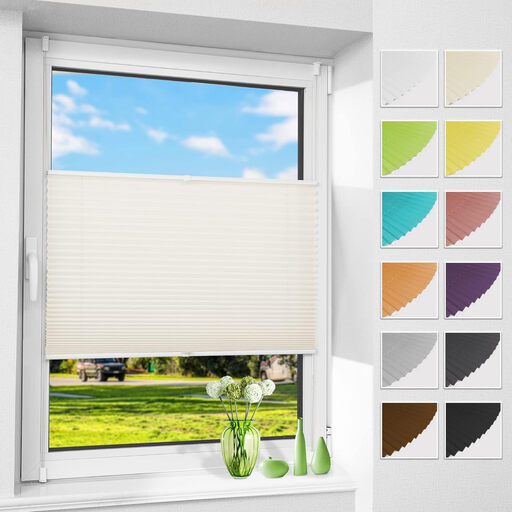
Why this product suits the profile: The adjustable brackets and stated suitability for frame thicknesses of 10 to 23 mm make it easier to adapt the blind to different standard windows.
The installation details clearly state the permitted frame range. This helps prevent ordering a clip-fit pleated blind for a frame that is too narrow or too wide.
90 × 100 cm, polyester with aluminium rod, adjustable clip fittings and cleaning with a damp cloth.
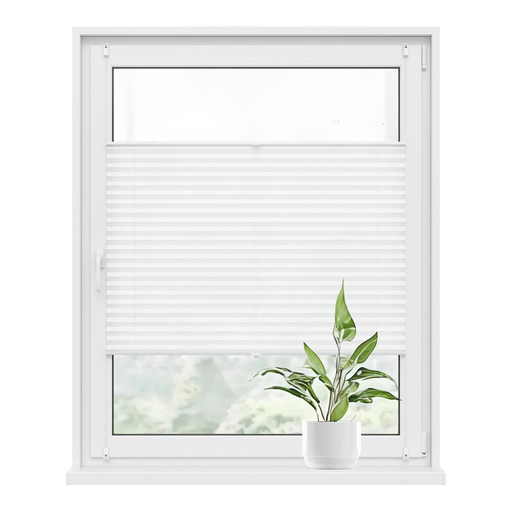
Why this product suits the profile: The stated adjustable widths of 45 to 120 cm and various height options make this model suitable for users who want to fit out several different-sized windows.
The description explicitly states that the fabric dims the room but does not provide complete blackout. This helps prevent false expectations of a blackout pleated blind.
100% polyester, aluminium profile, 20 mm pleat width and clip brackets for no-drill installation.

Why this product suits the profile: This model is described as having light-blocking fabric and is intended for interior windows and doors. It may therefore be worth considering for bedrooms or workspaces where less incoming light is preferred.
The product description explicitly mentions light blocking, while side sections and the installation position still need to be taken into account. “Blackout” should therefore not automatically be equated with complete darkness.
80 × 100 cm, polyester, installation with clip or adhesive brackets and suitability for windows and doors.
We have put together a complete, regularly updated list of products that fully meet these strict selection criteria and the safety regulations applicable in the EU.
Before fitting, the frame should be clean, dry and free from grease. Attach the brackets according to the instructions and check that the pleated blind is straight. With a tilt window, the product must not rub against moving parts.
A soft, slightly damp cloth is usually all that is needed for cleaning. Harsh cleaning products, abrasive cleaners and excessive pulling can damage the fabric, cords or brackets. For products with cords, follow the safety instructions; children should not have access to loose cords during installation or operation.
Depending on the model, it is either hooked onto the window sash with clip brackets or attached to the inside of the frame with adhesive brackets. The key requirements are a suitable frame thickness and a clean, dry surface. The installation instructions for the product in question take precedence.
How long it lasts depends on the material, frequency of use, frame shape and type of fitting. Clip brackets can be checked and readjusted regularly. With adhesive fitting, dust, moisture, heat and an unsuitable surface can affect the adhesive’s grip. Check the fittings particularly carefully on windows and doors that are opened frequently.
A mechanical pleated blind for windows does not require electricity and has no ongoing energy costs. Its effectiveness as sun protection depends on the fabric colour, light transmission, window orientation and installation. A pleated blind can reduce glare and direct incoming light, but it cannot replace individual room climate control.