
Lieferung heute & morgen

Qualitätsgarantie

Willkommens-Angebote freischalten: KOSTENLOSE Lieferung | Bis zu 80 % RABATT | Kostenlose 30-Tage-JoyPlus-Testphase
App herunterladen
A no-drill clip-on double roller blind is particularly suitable for rented homes, rooms that are used for different purposes, or windows whose frames you don’t want to alter permanently. The principle is simple: clip-on brackets attach to the window frame, while two layers of fabric with alternating sheer and opaque stripes let you control the amount of light.
Even so, vague product descriptions and incorrect measurements often lead to disappointing purchases. Check these three common pitfalls before you order:
First, measure the rebate depth or frame thickness where the clip-on brackets will sit. For the WOLTU models featured here, clip-on fitting is designed for frames between 13 and 23 mm, depending on the model. Another version specifies a range of 1.3 to 2 cm.
Also check that the window can still be fully opened and tilted with the double roller blind fitted to the window. The blind or fabric must not get in the way of the window handle. According to the product details, fitting is not suitable for roof windows or wooden frames. Optional screw fitting may be an alternative for suitable surfaces, but it does change the fitting requirements.
For effective privacy, the fabric should cover enough of the glass. Several models recommend choosing a width around 4 cm wider than the glass. The height is usually the same as the full height of the window frame.
For example, if the pane of glass is 46 cm wide, you might need to order a width of around 50 cm. Be sure to allow for window handles, protruding fittings and adjacent walls. The same basic rules apply to a balcony door or a roller blind for windows and doors, but you should also check the clearance and available room for movement.
A zebra blind, or day and night double roller blind, consists of two offset layers of fabric. The chain allows you to move the sheer and opaque stripes into position in stages. Depending on how you set it, you can have a light-filtering roller blind, partial privacy or a more opaque setting.
The models listed are mainly made from 100% polyester. Thermally or hot-cut edges can help reduce fraying. For kitchens and bathrooms, being able to clean the blind with a damp cloth or soft brush is useful. Check the individual product details to confirm whether a blind is suitable for humid rooms.
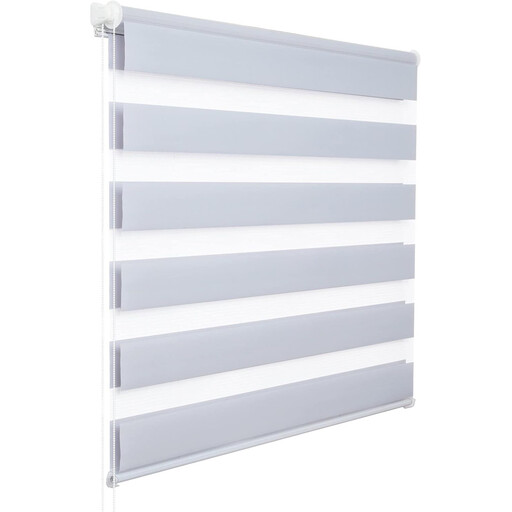
Why this product suits this type of buyer: This version combines a popular width with a height of 220 cm, making it suitable for many tall windows or interior doors.
The product details specify the compatible frame thickness of 13–23 mm and explain that the fabric is narrower than the overall width. This makes it easier to match your order to your actual window measurements.
Clip-on or screw fitting, a chain that can be fitted on the left or right, and polyester fabric with a wipe-clean surface.
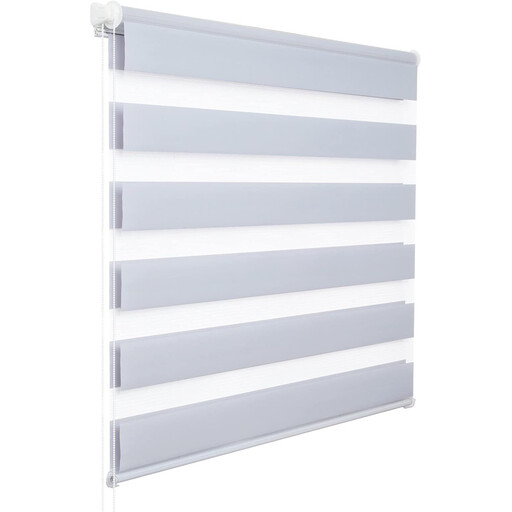
Why this product suits this type of buyer: This version has a chain mechanism for stepless adjustment and can be used in a range of indoor spaces.
The fitting requirements, its unsuitability for roof windows and the alternative screw-fitting option are all clearly stated.
100% polyester, a chain that can be fitted on the left or right, damp cleaning, and suitability for rooms such as bedrooms, kitchens and bathrooms.

Why this product suits this type of buyer: For bedrooms, media rooms or spaces where you need to block out more light, the solid fabric offers a different function from a traditional zebra blind.
This version doesn’t rely on alternating stripes. The product details specify clip-on fitting for frames measuring 16–22 mm and a separate handle-operated mechanism with no chain.
Handle operation, coated backing, wipe-clean polyester, and clip-on or screw fitting for windows and doors.
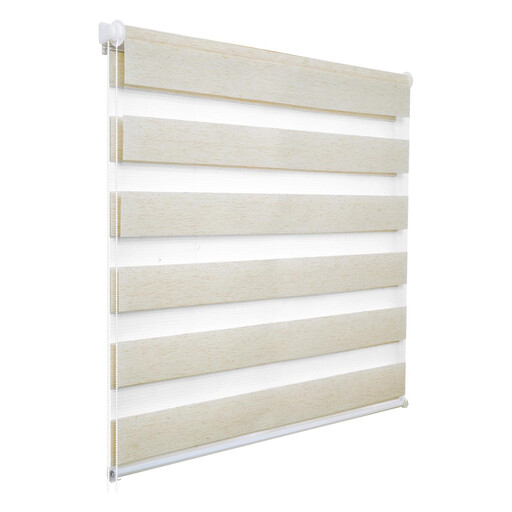
Why this product suits this type of buyer: This wider version combines clip-on fitting with a wood-effect finish, making it a good match for living or work spaces with warm colour schemes.
The product details specify that the fabric is around 4 cm narrower than the stated width, as well as the compatible frame range of 1.3 to 2 cm.
Chain operation, 100% polyester, clip-on and screw fitting, and easy cleaning with a damp cloth.
We’ve put together a complete, regularly updated list of products that meet these strict selection criteria and fully comply with the safety regulations in force across the EU.
For chain-operated models, keep the operating chain out of reach of young children. Use the child safety device supplied, if there is one, and check the fitting regularly.
A chain-operated clip-on blind attaches to the top of the window frame using clip-on brackets. The frame thickness, window shape and clearance for movement all need to be suitable. The blind can only be fitted without drilling if the frame meets the specified measurements.
Its lifespan depends on the material, how often it’s used, how it’s fitted and how well it’s cared for. A correctly sized clip-on bracket, pulling the chain evenly and cleaning with suitable products can all help extend its useful life. It’s not possible to give a general lifespan without specific product details and information about how it will be used.
No. A manually operated double roller blind doesn’t need an electrical connection. You adjust the amount of light mechanically using the chain or, on certain models, a handle. This means there are no ongoing energy costs while it’s in use.