
Lieferung heute & morgen

Qualitätsgarantie

Willkommens-Angebote freischalten: KOSTENLOSE Lieferung | Bis zu 80 % RABATT | Kostenlose 30-Tage-JoyPlus-Testphase
App herunterladen
A no-drill clip-on double roller blind can give windows and doors privacy while letting you control the amount of light that comes in, without making holes in the frame or wall. This type of fitting is especially practical in rented homes. However, double roller blinds can vary considerably in frame compatibility, fabric width and operation.
If you focus only on the colour or low price, you could end up with a blind that won’t stay on the window frame, gets in the way of the handle or doesn’t darken the room as much as you expected. The points below can help you avoid common buying mistakes.
For many double roller blinds, the stated width includes the brackets. The fabric is often around 4 to 5 cm narrower. This can let light in at the sides. To get the right level of privacy, measure the glass width before buying, rather than just the overall window width.
As a guide, several WOLTU models can be ordered at around 4 cm wider than the glass. However, the blind or bracket must not obstruct the window handle.
Clip-on brackets require a specific frame thickness. Depending on the model, they may be designed for frames measuring 13 to 23 mm or 1.3 to 2 cm. If the frame is too thin or too thick, the blind may not fit securely.
Many models are also unsuitable for roof windows, wooden windows or certain sliding windows. Before ordering, check the window type, frame thickness and position of the handle.
A zebra blind has alternating transparent or light-filtering stripes and opaque stripes. A side chain lets you move the stripes against each other, giving you different levels of daylight and privacy.
A light-filtering, opaque blind can darken a room considerably, depending on how you position it. However, light can still come in at the sides, so bear this in mind if you want to keep your bedroom as dark as possible. If you need more even blackout, consider a suitable blackout blind with an appropriate fitting.
First, check whether the window opens inwards or tilts open, and whether there’s enough room on the frame for the clip-on bracket. The WOLTU double roller blinds featured here are often specified for a frame thickness of 13 to 23 mm. According to the product details, the wood-effect model in 120 × 150 cm is suitable for frames measuring 1.3 to 2 cm.
The blinds are fitted without drilling, using clamp brackets. Depending on the model, a screw set may also be included for a more permanent fitting. Clamp brackets are particularly useful in rented homes, but make sure they’re secure before using the blind for the first time.
Make a note of:
The stated height also matters when choosing a double roller blind for windows and doors. For patio doors or tall windows, a 220 cm option may be more suitable than a shorter standard size.
The WOLTU models listed are made from 100% polyester. Some have heat-cut edges to help reduce fraying. A soft cloth or brush is usually recommended for cleaning. Depending on the model, harsh cleaning products and washing in water are not suitable.
On several models, the chain-operated blind can be fitted with the chain on either the left or right. The operating chain must be secured out of children’s reach. A safety device supplied with the blind can help, but it doesn’t replace careful fitting and use.
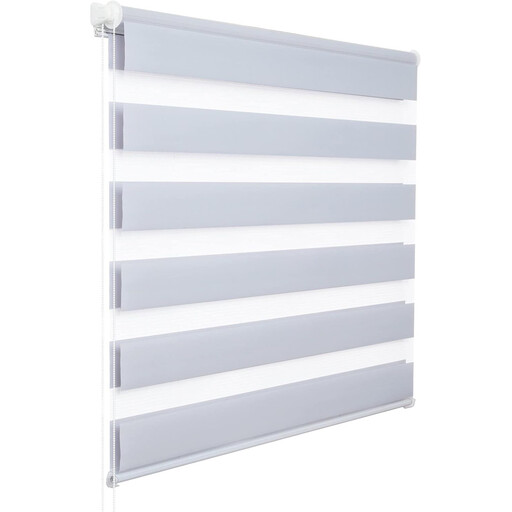
Why this product suits you: Its narrow width and 220 cm height make it suitable for tall windows or doors, provided the frame is 13 to 23 mm thick.
The product details clearly state the frame thickness, fabric width and that it is not suitable for roof or wooden windows.
100% polyester, chain can be fitted on the left or right, and cleaning with a soft brush or damp cloth.

Why this product suits you: The option of clip-on or screw fitting gives you more choice when deciding how to install it.
The measuring guidance takes account of the glass width, frame height and distance from the window handle.
Alternating fabric stripes, a chain that can be fitted on either side, and a stated frame thickness of 13 to 23 mm.
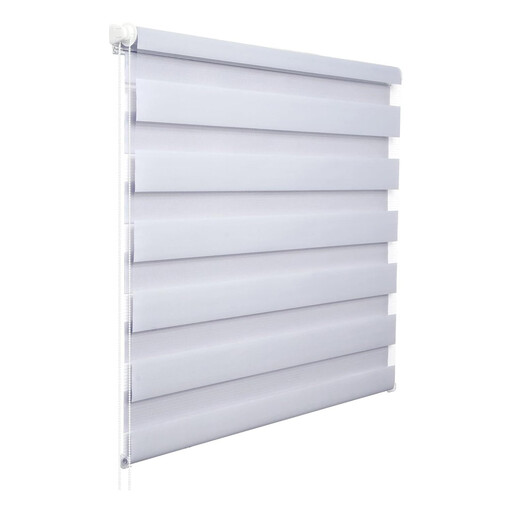
Why this product suits you: Its wider size is suitable for broader windows, provided the measured glass area and frame allow for it.
The product description points out that the fabric is narrower and specifies the required frame thickness.
Heat-cut polyester edges, suitable for humid rooms, and a chain that can be operated from the left or right.

Why this product suits you: Its opaque, cordless design may be a good choice for bedrooms and home offices as an alternative to a traditional chain-operated blind.
The product details specify a frame thickness of 16 to 22 mm, the fabric width and that it is not suitable for roof windows.
Cordless operation using a handle, clip-on or screw fitting, and polyester fabric that can be wiped clean with a damp cloth.
We’ve put together a complete, regularly updated list of products that meet these strict selection criteria and fully comply with the safety regulations in force in the EU.
That depends on the frame thickness, brackets and correct fitting. Many models are designed for frames between 13 and 23 mm thick. If your frame measurements differ, a clip-on fitting may not be suitable. Several of the products listed are not suitable for roof or wooden windows.
First, measure the width of the glass and the height of the entire window frame. Bear in mind that the fabric panel may be narrower than the overall ordered width. As a product-specific guide, the recommended ordered width is often around 4 cm wider. Make sure the handle is outside the blind’s operating area.
There’s no set lifespan. It depends on how the blind is fitted and used, as well as sunlight exposure and cleaning. Pulling the chain smoothly without using excessive force, securing the blind properly and following the manufacturer’s care instructions can all help prolong its life.