
Lieferung heute & morgen

Qualitätsgarantie

Willkommens-Angebote freischalten: KOSTENLOSE Lieferung | Bis zu 80 % RABATT | Kostenlose 30-Tage-JoyPlus-Testphase
App herunterladen
A no-drill clip-on pleated blind can quickly provide privacy or shade in rented flats, homes and offices. It is usually fitted directly to the window sash or door frame, leaving walls and frames largely undamaged. However, not every clip-on pleated blind will suit every window.
Three common causes of a poor purchase are inaccurate measurements, misjudging how much light the fabric lets through, and choosing unsuitable clamp brackets. Check these points before you buy to narrow down your options.
For many products, the stated width is the overall measurement, including the brackets. This means the fabric itself may be narrower. To find a suitable window privacy blind, first measure the glass, then check the available width of the frame.
Depending on the design, a blind around 4 cm wider than the window pane is often recommended. This is not a rule that applies to every window, though. The blind must not obstruct handles, seals or protruding fittings.
A light-filtering pleated blind softens daylight and reduces visibility from outside, while still letting light into the room. A blackout pleated blind may be a better choice for bedrooms or rooms with computer workstations. Check claims such as ‘blackout’ or ‘light-blocking’ against the specific product description and the fabric construction.
A light grey or white pleated blind can offer privacy during the day, but it will not necessarily provide complete privacy when the lights are on in the evening.
A pleated blind with clamp brackets needs a suitable window rebate. The permitted frame thickness varies by model. Product details may specify ranges such as 10–23 mm, 13–23 mm or 16–22 mm.
Before you buy, check:
Depending on the model, there may be restrictions for roof windows, sloping windows, wooden frames or sliding windows. Suction-cup fittings, on the other hand, need smooth, clean surfaces such as glass or tiles.
Measure the width of the glass, the width of the window sash and the full height, including the frame. For doors and patio doors, also make sure the pleated blind will not block the handle.
Product details should clearly distinguish between overall width, fabric width and fitting width. For some roller blinds, the fabric is around 4 to 5 cm narrower than the overall measurement. Made-to-measure pleated blinds are measured differently from ready-made standard sizes.
A no-drill pleated roller blind is often a good choice for a living room, kitchen or office, as it filters daylight and reduces glare. A room-darkening fabric may be more suitable for a bedroom. A day-and-night blind, also known as a zebra blind, has alternating sheer and opaque stripes, allowing you to adjust the light gradually.
Moisture-resistant materials are practical for bathrooms and kitchens. However, moisture-resistant does not automatically mean waterproof. Avoid direct and prolonged contact with water unless the manufacturer specifically states that the product is suitable.
Keep cords, chains and small fitting parts out of children’s reach. With clip-on products, make sure the brackets are securely attached before use. Models with a handle rail can be convenient if you adjust the blind often. For chain-operated roller blinds, check whether a chain tensioner is included.
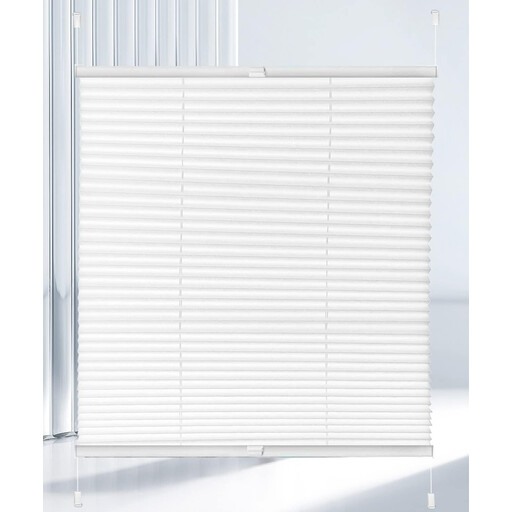
Why it suits this type of buyer: This white, light-filtering pleated blind is a simple option for windows or doors where you want to let in natural light. According to the product description, it fits with clip-on brackets, without drilling.
The product details give the dimensions as 80 × 200 cm, state the fitting method and confirm that it is suitable for windows and doors. You will still need to check the width of your own frame before ordering.
Polyester fabric, white finish, light-filtering design and height-adjustable operation.

Why it suits this type of buyer: The double honeycomb structure, metal frame and adjustable clip-on brackets will appeal to anyone who pays close attention to materials and wants to check frame compatibility carefully.
The suitable frame thickness of 10–23 mm is clearly stated. This helps you avoid choosing clamp brackets for a frame that is too narrow or too deep.
Polyester honeycomb blind, top and bottom operating handles, and a design for privacy, sun protection and light control.

Why it suits this type of buyer: With a choice of clip-on or drilled fitting, this blind is designed for bedrooms, offices and other rooms where greater light control is needed.
The details specify a frame thickness of 16–22 mm and note that the fabric is narrower than the overall width. This helps you plan the coverage more realistically before ordering.
Clip-on fitting without drilling, operation using a bottom handle rail and a coated backing, according to the product description.

Why it suits this type of buyer: Alternating sheer and opaque fabric stripes let you adjust daylight and privacy as needed.
You can adjust the light without being limited to a single fixed fabric position. The product details also state the required frame thickness of 13–23 mm.
Clip-on or drilled fitting, a chain that can be fitted on the left or right, and polyester fabric that can be cleaned with a damp cloth.
We’ve put together a complete, regularly updated list of products that meet these strict selection criteria and fully comply with the safety regulations in force in the EU.
With clip-on fitting, adjustable clamp brackets are attached to the window sash. Depending on the model, adhesive brackets or suction cups may also be available. The frame must be clean and dry, and suitable for the specified fittings. Check that everything is secure before use.
Its lifespan depends on the fabric, fittings, exposure to sunlight and how it is operated. Pulling too hard, prolonged exposure to high humidity and rubbing against window handles can all put strain on the material and mechanism. Many polyester fabrics can be cleaned carefully with a soft or slightly damp cloth.
A passive privacy or sun blind does not need electricity. A light-filtering pleated blind can reduce direct sunlight in a room, but it is not a substitute for individual heating, ventilation or air-conditioning controls. Its actual performance depends on the window, its aspect, the fabric and how the blind is fitted.