
Lieferung heute & morgen

Qualitätsgarantie

Willkommens-Angebote freischalten: KOSTENLOSE Lieferung | Bis zu 80 % RABATT | Kostenlose 30-Tage-JoyPlus-Testphase
App herunterladen
As a Joybuy Product Recommendation Officer, I see people searching for flexible solutions for their living spaces every day. A no-drill clothes rail system is a practical alternative to a permanently installed wardrobe, especially in rented apartments, student housing, or for those who move frequently. However, the market is flooded with products of widely varying quality. Before you make a decision, it's crucial to understand the common weaknesses that can quickly turn a supposed helper into a source of frustration.
Many buyers are drawn in by appealing product images but overlook critical design flaws. These three points often lead to disappointment:
To avoid the problems mentioned above, you should check three technical features before buying. These define the stability and longevity of a system.
The stability of a clothes rack is directly dependent on the material and the diameter of the rods. Look for systems made of powder-coated steel or robust iron tubes. These are significantly more resistant to bending than thin-walled aluminium rods. A larger tube diameter provides additional rigidity, which is particularly important for wider and more heavily loaded systems. A sturdy clothes rack is always built on a solid material foundation.
Check the maximum load capacity specified by the manufacturer. Consider what you plan to hang: an average winter coat weighs about 1.5 to 2 kg, while a suit is around 1 kg. Factor in a safety margin of at least 20%. A system for a single person should be able to hold at least 25 kg, whereas models with a capacity of 60 kg or more are more suitable for couples or families. This ensures that the adjustable clothes rack remains stable even when fully loaded.
The heart of any extendable clothes rail is the tension mechanism that secures it between the floor and ceiling. Systems with an integrated spring in the upper section are often advantageous as they ensure constant pressure and compensate for minor unevenness. The end caps should be made of a non-slip, soft material (e.g., rubber) and have the largest possible contact area to distribute pressure optimally and protect surfaces.
Based on the criteria above, we have identified several models suitable for different user profiles and room situations.
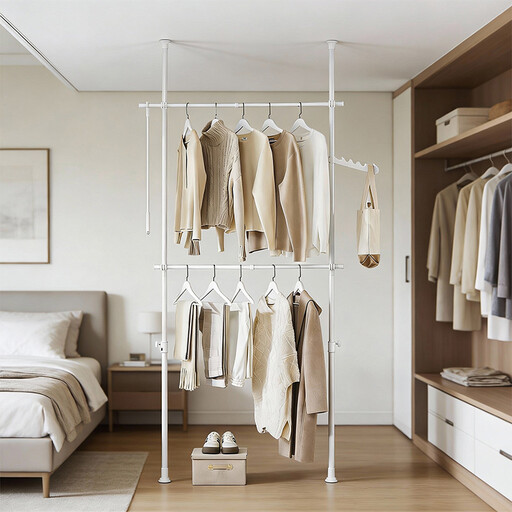
Why This Fits Their Persona: Ideal for a first apartment, student room, or as a supplement in the bedroom. It offers a solid basic setup for one person without breaking the budget.
The clearly defined load capacity of up to 25 kg (according to the manufacturer) is realistic for a single wardrobe and prevents overloading. The iron tube construction is more stable than simple aluminium alternatives.
High flexibility in height (200–295 cm) and width (75–126 cm) allows it to be adapted to small rooms and niches. Assembly is straightforward.
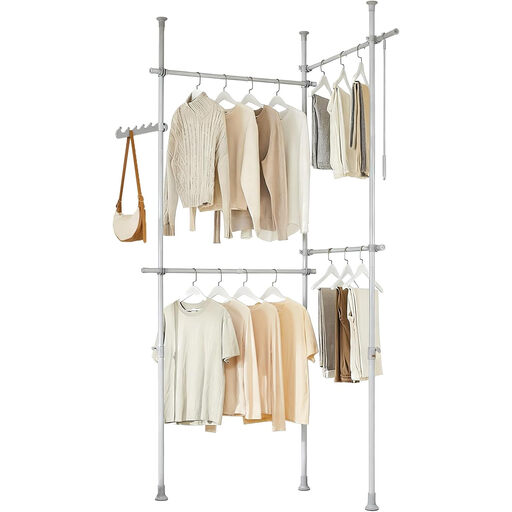
Why This Fits Their Persona: Suitable for couples, small families, or individuals with a large clothing collection who need a robust, high-capacity solution as a fully-fledged **open wardrobe**.
With a stated load capacity of up to 65 kg and three vertical rods, the weight is distributed effectively, preventing the crossbars from sagging. This provides the necessary stability for heavy clothing like coats and suits.
With four crossbars, the system offers an enormous amount of space. The wide adjustability (124–226 cm) makes it a scalable solution that can grow with your needs.
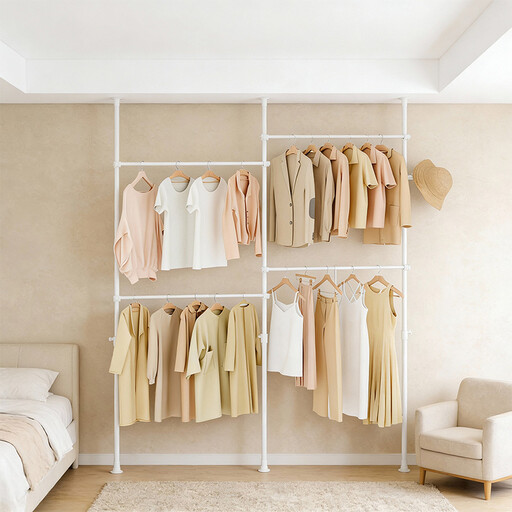
Why This Fits Their Persona: Perfect for home and apartment owners who want to optimally equip unused niches, alcoves, or a walk-in closet without expensive and permanent custom-built solutions.
This system solves the problem of standard racks that never fit perfectly into niches. Its flexible width adjustment avoids wasted space and provides a custom-fit look without the cost and effort of a permanent installation.
The ability to adjust to widths from 124 cm to 226 cm makes it an ideal **wardrobe system for niches**. The open design ensures good air circulation and a clear overview.
We have compiled a complete, up-to-date list of products that fully meet these strict selection criteria and UK safety regulations.
Stability largely depends on three factors: material quality (steel is more stable than aluminium), tube diameter, and correct installation. A system held by tension between the floor and ceiling must be perfectly vertical and secured with the correct pressure. Models with a higher stated load capacity (e.g., 65 kg) and multiple vertical rods generally offer significantly greater stability than lighter versions.
No, these systems are generally not designed for that purpose. They require two parallel, horizontal surfaces (floor and ceiling) for a secure footing. The tension cannot be correctly established on a slope, which would make the system unstable and liable to tip over. For rooms with sloped ceilings, wall-mounted shelving systems or specially designed solutions are required.
Read the manufacturer's assembly instructions carefully. Ensure the end caps are clean and free of dirt. Position the system and extend the telescopic rod until it makes firm contact with the ceiling. Then, apply the final tension according to the instructions—this is often done via a spring mechanism or by twisting a section of the rod. Do not overtighten the system, to avoid damaging the ceiling. Check the tension after a few days and at regular intervals as needed.