
Lieferung heute & morgen

Qualitätsgarantie

Willkommens-Angebote freischalten: KOSTENLOSE Lieferung | Bis zu 80 % RABATT | Kostenlose 30-Tage-JoyPlus-Testphase
App herunterladen
A no-drill double roller blind is a practical solution for rental properties and for anyone who wants to avoid damaging their window frames. Installation using clamp brackets is straightforward and quick. However, the market offers a confusing variety of options, and not every product lives up to its promises. Before you make a decision, it's crucial to understand the common weaknesses that often only become apparent after the purchase.
As your Joybuy Product Recommendation Officer, I'm here to help you separate the wheat from the chaff. This guide focuses on the three most common pitfalls when buying and shows you what to look for to find a durable and functional solution for your windows.
Many products advertise easy installation and a modern design, but the devil is often in the details. These three points most frequently lead to dissatisfaction:
To avoid the problems mentioned above, you should carefully check three technical parameters before buying. These largely determine the quality and longevity of your new privacy screen.
The mounting mechanism is the heart of any no-drill roller blind. Look for adjustable clamp brackets designed for a specific range of window frame thicknesses. A common and reliable range is, for example, 13 to 23 mm. Check the product description for this specification. Higher-quality systems often use more robust plastic compounds or metal-reinforced parts that ensure a permanently secure attachment. Such a no-drill window blind remains firmly fixed to the window sash even with daily use.
A Duo Blind, often called a Zebra Blind for windows, consists of alternating transparent and opaque fabric panels. A chain pull (side pull) allows these panels to be shifted against each other to seamlessly regulate the amount of light—from light-filtering to a complete privacy window blind.
The material of choice here is typically 100% Polyester. It is dimensionally stable and easy to care for. An important quality feature is the finishing of the edges: thermal cutting technology effectively prevents the fabric from fraying.
The most common reason for a bad purchase is choosing the wrong size. Note the following rule: The fabric width is always narrower than the specified total width (order width). The difference is usually about 4 to 5 cm, as the mechanism on the sides requires space.
How to measure correctly:
Based on the criteria above, we have compiled a selection of products suitable for different needs and user profiles.
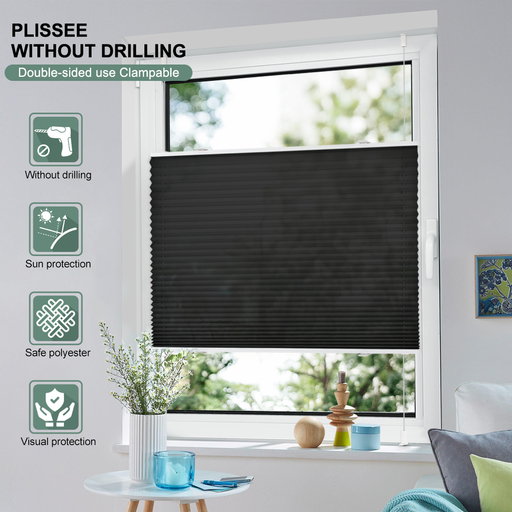
Why This Fits Their Persona: Ideal for renters seeking a simple, tool-free, and residue-free removable solution. This no-drill pleated blind provides effective privacy and sun protection without damaging the window frame, which is crucial when moving out.
The product relies on a pure clip-on system specifically designed for drill-free installation, bypassing the trap of rigid, ill-fitting brackets.
Opaque fabric for privacy while still allowing light to filter through; easy height adjustment via the folding mechanism.
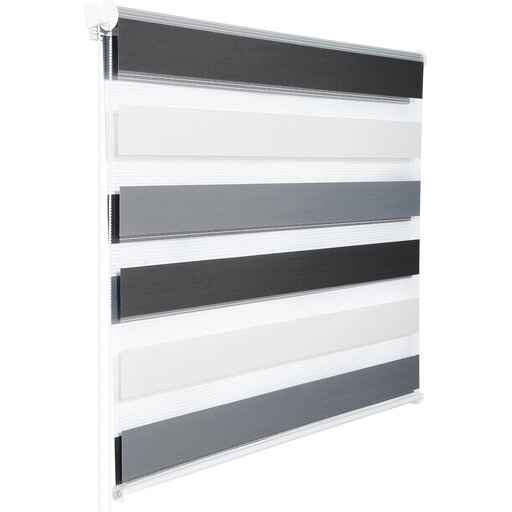
Why This Fits Their Persona: For users who value modern aesthetics. The tri-colour design blends seamlessly into contemporary living concepts, while the duo-blind function offers full control over light and privacy.
According to the manufacturer, the polyester fabric is processed with thermal cutting technology, which prevents the edges from fraying and ensures a clean look long-term.
Infinitely variable light control thanks to the zebra structure; modern, multi-coloured look; chain pull can be mounted on the left or right.
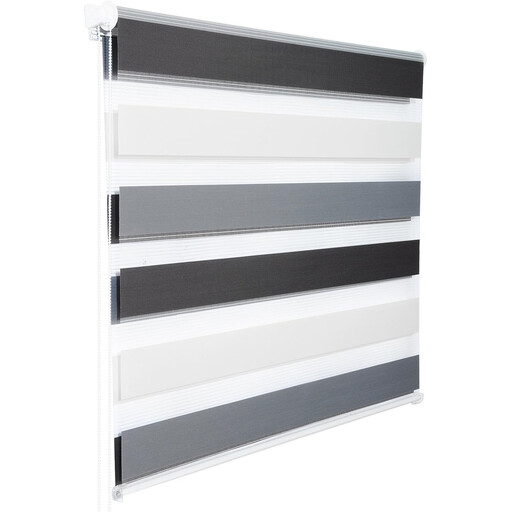
Why This Fits Their Persona: With its height of 150 cm, this model is a great choice for taller, narrow windows or a blind for a balcony door. It demonstrates that no-drill solutions are not limited to standard windows and are also available for more specific dimensions.
The manufacturer provides a clear measuring guide that explains the difference between fabric and order width. This helps to avoid the pitfall of incorrect measurements.
Suitable for window frame thicknesses of 13-23 mm; versatile for various room types, including humid environments like bathrooms.
Explore our carefully curated selection that meets modern design standards and offers practical solutions for your home.
Yes, a high-quality clip-on side-pull roller blind holds reliably when installed correctly. The adjustable clamp brackets are placed onto the window sash and tightened. They apply pressure that ensures a secure hold without scratching the surface or leaving dents. The prerequisite is that your window frame's thickness falls within the range specified by the manufacturer.
First, measure the width of the glass pane. Then, add about 2 cm on both sides to prevent light gaps. The result is your order width. Ensure that the window handle can still move freely. For the height, measure the entire window sash from top to bottom. This is your order height.
The main difference lies in their functionality. A double roller blind (Duo Blind) consists of two parallel fabric panels with alternating transparent and opaque stripes. By shifting the panels, you can regulate the light. A no-drill pleated blind consists of a single, folded (pleated) fabric panel. It is collapsed or expanded like an accordion and can often be positioned flexibly on the window to cover only the top, bottom, or middle section.