
Lieferung heute & morgen

Qualitätsgarantie

Willkommens-Angebote freischalten: KOSTENLOSE Lieferung | Bis zu 80 % RABATT | Kostenlose 30-Tage-JoyPlus-Testphase
App herunterladen
A no-drill double roller blind can combine privacy and light control without permanently damaging window frames or walls. That makes this type of installation particularly practical for rental flats, children's rooms, bedrooms, offices and balcony doors. However, not all clamp brackets fit every window. Terms such as "blackout", "thermal" or "opaque" should also be carefully understood before you buy.
With many roller blinds, the measurement includes the brackets. The actual fabric can be several centimetres narrower. With the WOLTU double roller blind, the product description notes that the fabric width is approximately 4 to 5 cm less than the total width. If you only measure the window pane and ignore this detail, you may end up with light gaps at the sides.
Clamp-fit roller blinds are attached to the window sash. For this, the frame thickness must match the clamp bracket. Depending on the model, this could be, for example, 10 to 23 mm, 13 to 23 mm or 16 to 22 mm. Seals, window handles and protruding fittings can also affect installation.
A roller blind with clamp brackets is generally suitable for opening window sashes. According to product information, the systems offered are not intended for roof windows, wooden frames or certain sliding windows.
A zebra blind or classic double roller blind works with alternating transparent and opaque stripes. This allows you to finely adjust the light intake. However, it does not automatically create complete darkness. For bedrooms where you want as little residual light as possible, a no-drill blackout roller blind with a dense coating is the more suitable product type.
First, measure:
For the best possible side closure, several products recommend ordering a width approximately 4 cm wider than the glass width. However, always check the specific manufacturer's information, as the total and fabric measurements can differ.
For doors or floor-to-ceiling windows, you should also check that the blind doesn't catch on the handle or the reveal when opening, tilting or moving. A double roller blind for windows and doors is only practical if the operation remains freely accessible.
A clamp roller blind is fitted onto the window sash without drilling. This is attractive for tenants and can often be removed when you move. Some models also offer a permanent screw-fix option.
Adhesive brackets are an alternative if clamp brackets don't fit. However, they require a clean, smooth and grease-free surface. On rough, uneven or delicate surfaces, adhesion may be limited.
A privacy roller blind made from light-permeable polyester reduces visibility but still lets daylight into the room. This can be useful for living rooms, kitchens or offices. A coated polyester fabric with an opaque backing is more suitable for bedrooms or rooms with stronger sunlight.
When you see the term thermal roller blind, pay attention to the specific construction. A reflective backing can, according to product descriptions, reduce heat gain in summer and limit heat loss in winter. However, this does not replace structural insulation and does not represent a guaranteed energy saving.
Why it fits: The compact width is ideal for smaller windows in rental flats, kitchens or home offices where flexible stripe adjustment is needed.
Before ordering, you need to compare the glass width, the total blind width and the frame thickness. This prevents you from ending up with a privacy screen that is too narrow.
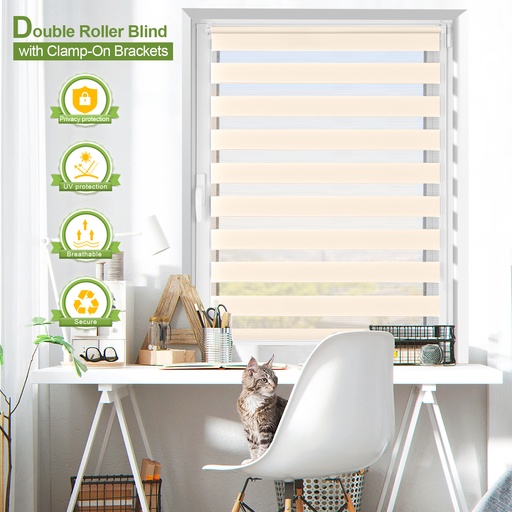
Double roller blind with clamp brackets; beige as a subtle colour option; intended for windows and doors according to the product name.

Why it fits: For bedrooms, children's rooms or rooms with direct sunlight, an opaque fabric with a silver-coated backing is provided according to the product description.
The stated frame thickness for clamp installation is 16 to 22 mm. Also, the fabric width is approximately 4 cm smaller than the external measurement according to the description.
Opaque polyester, handle operation without a pull cord, wipe-clean surface and clamp or screw installation.
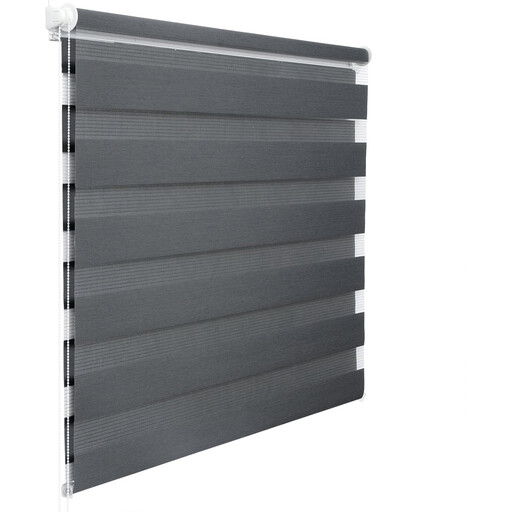
Why it fits: The alternating transparent and opaque stripes allow stepless adjustment between daylight and stronger privacy.
The clamp brackets are designed for frames of 13 to 23 mm according to the product description. Roof windows and wooden frames are not intended.
Cord operation can be fitted on the left or right; wipe-clean polyester; also suitable for damp rooms according to the product description.
For a different design, a no-drill pleated blind could also be an option. The WOLTU Honeycomb pleated blind is designed for frame thicknesses of 10 to 23 mm according to the product description and is operated via top and bottom handles. If you need permanent blackout, you can also find suitable pleated blinds with opaque fabric or a thermal roller blind with a coating.
In the full selection you will find various models for windows, doors and balcony doors with different sizes, installation types and light levels.
Durability depends on the frame thickness, installation, weight and operation. Before installation, the frame and clamp brackets should be clean. Pull chains or operating handles evenly and check regularly that the brackets are still secure. Product information on lifespan or warranty should be checked directly with the specific model.
A zebra blind regulates light but does not completely close side gaps. For stronger darkening, choose a model explicitly described as blackout or no-drill blackout roller blind. Even then, light gaps can remain at the sides if the blind is ordered narrower than the glass area.
A manual clamp roller blind does not require electricity to operate. Therefore, there are no ongoing energy costs from using it. Any possible influence on room temperature depends on the window, orientation, fabric, coating and installation, and should not be understood as a guaranteed saving on heating or cooling costs.