
Lieferung heute & morgen

Qualitätsgarantie

Willkommens-Angebote freischalten: KOSTENLOSE Lieferung | Bis zu 80 % RABATT | Kostenlose 30-Tage-JoyPlus-Testphase
App herunterladen
A no-drill, clip-on double roller blind can quickly add privacy and sun protection to windows and doors in rented homes, owner-occupied properties or offices. But choosing one involves more than just colour and price. The key things to get right are the clip brackets, accurate measurements and a control system that suits how you use the room.
Many products are described as duo blinds, zebra blinds or day and night blinds. They usually feature alternating sheer and opaque fabric strips. Moving the layers lets you adjust how much light comes in. However, how well the blind works in practice depends on its design, your window frame and how it’s fitted.
‘No-drill’ doesn’t mean every window is automatically suitable. According to the product details, several WOLTU double roller blinds are designed for frame thicknesses of 13 to 23 millimetres. Other models may have different requirements.
Before ordering, check:
Don’t fit a clip-on blind under tension if your frame is outside the manufacturer’s specified range. This could affect its stability and how smoothly it operates.
For a double roller blind, the listed width often refers to the overall width, including the brackets. Depending on the model, the fabric itself may be around 4 to 5 centimetres narrower. If you only use the width of the glass, you may end up with gaps at the sides that let light through.
As a practical guide, several WOLTU models recommend:
Check this advice against the details on the relevant product page. For doors and patio doors, also make sure the blind has enough clearance when you open or tilt the door.
A duo blind with sheer and opaque strips lets you adjust the amount of light coming in. But it isn’t automatically a complete blackout blind. Gaps at the sides and the light-filtering strips can still let light into the room.
For bedrooms or media rooms, a closed, coated light-filtering blackout blind or a traditional blackout blind may be a better choice. A double roller blind is often enough for living rooms, kitchens or bathrooms if you want flexible privacy while still letting in daylight.
Many models are made from 100 per cent polyester. The products mentioned here are described as easy to care for and can be cleaned with a soft cloth or soft brush. For kitchens and bathrooms, also check whether the manufacturer specifically recommends the blind for use in humid rooms.
Harsh cleaning products, abrasive cleaners and vigorous rubbing can damage the surface or coating. Polyester blinds can usually be cleaned gently, either dry or with a damp cloth, in line with the care instructions.
A blind with a side chain can usually be adjusted to any height. On the double roller blinds mentioned here, the chain can be fitted on either the left or right, depending on the model. This is handy if your window handle is on a particular side.
Keep chains and pull cords out of reach of young children and pets. Some products include a chain tensioner. This doesn’t replace correct fitting or safe positioning in the room.
A double roller blind for windows and doors is suitable for many vertical indoor surfaces. The models listed here are specifically not suitable for roof windows. Wooden frames, sliding windows and fixed-glazed windows may also be unsuitable, depending on the product.
For a blind in a rented home, clip-on fitting is a good option if you want to avoid leaving marks. If you’re looking for a more permanent fit or need extra stability, some versions can also be installed with the screws provided.
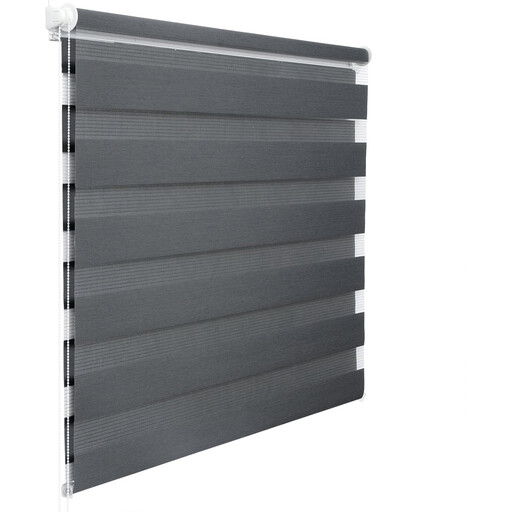
Why it suits this type of buyer: Its compact size is a good fit for smaller standard windows, and the clip-on brackets are suitable for frames 13 to 23 millimetres thick.
The product details specify the suitable frame thickness and point out that the fabric is narrower than the overall width. This makes it easier to check whether the blind will fit before you buy.
100 per cent polyester, chain can be fitted on the left or right, and easy to clean with a soft brush or damp cloth.
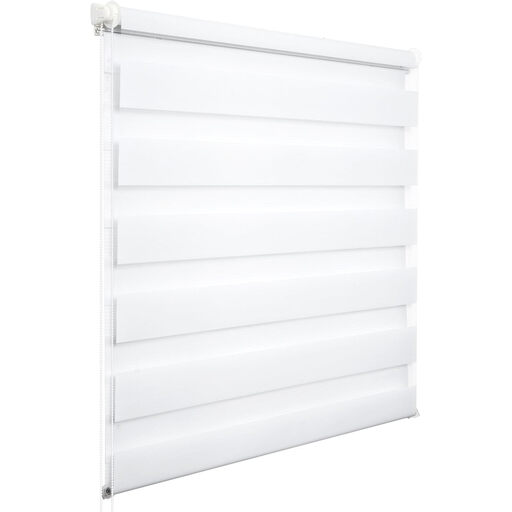
Why it suits this type of buyer: The extra height makes this a good option for tall windows or doors where you need continuous privacy and light protection.
The product description explains the difference between the overall width and fabric width, and specifies that it’s designed for frames 13 to 23 millimetres thick.
Alternating sheer and opaque strips, a chain pull that can be fitted on either side, and optional accessories for screw fitting.

Why it suits this type of buyer: For bedrooms or windows that get a lot of sun, a solid blind with a coating may be more suitable than a traditional zebra blind.
This cordless version is operated using a bottom rail, according to the product description. That means fewer loose control elements are left hanging.
Clip-on fitting for frames 16 to 22 millimetres thick, cordless operation and polyester-based fabric with a coated backing, according to the product details.
We’ve put together a complete, regularly updated list of products that meet these strict selection criteria and fully comply with the safety regulations in force in the EU.
The clip brackets attach to the top of the window frame. Then place the blind in the brackets and adjust it until it’s straight. The exact frame thickness and fitting steps are in the relevant instructions. This system isn’t designed for roof windows or unsuitable frames.
Its lifespan depends on the material, how it’s fitted and operated, and how much sun it gets. Polyester fabric can be easy to care for if cleaned regularly. Avoid yanking the chain and check the brackets from time to time to make sure they’re still firmly in place.
No. A manually operated duo blind with a chain or handle doesn’t need electricity, so there are no ongoing energy costs. When choosing one, you should still consider how you want to control the light, the fabric width and whether it’s suitable for the room.