
Lieferung heute & morgen

Qualitätsgarantie

Willkommens-Angebote freischalten: KOSTENLOSE Lieferung | Bis zu 80 % RABATT | Kostenlose 30-Tage-JoyPlus-Testphase
App herunterladen
A no-drill clip-on double roller blind is ideal for rented homes, offices and rooms where you don’t want to make permanent changes to window frames or walls. The offset fabric layers let you adjust the amount of light coming in using a chain mechanism. Depending on the setting, the blind can let light through, provide partial privacy or offer greater screening.
To make sure your blind works well day to day, don’t just focus on colour and price. The key factors are the frame thickness, the difference between the overall and fabric widths, and the level of light control you want.
Clip-on brackets need a suitable window rebate. Depending on the model, the permitted frame thickness may be 13 to 23 mm or 13 to 20 mm, for example. If the frame is too narrow or too wide, the brackets may not fit securely. Before ordering, measure the frame thickness without the seal, or with it if the manufacturer’s instructions specify this.
Many models are also unsuitable for roof windows, skylights or wooden windows. The fitted blind must not obstruct the window handle either.
For a duo roller blind, the stated width often includes the entire assembly, including the brackets. Depending on the model, the fabric is approximately 4 to 5 cm narrower. If you order based only on the glass width, you may not get enough privacy or protection from the sun at the sides.
As a practical guide for several WOLTU models: ordered width = glass width plus around 4 cm. This doesn’t replace the fitting instructions, but it can help you narrow down your options.
A day and night blind with alternating transparent and opaque stripes lets you adjust the amount of light coming in. However, it doesn’t automatically provide complete blackout. Light may still enter the room through gaps at the sides and the light-filtering sections of the fabric.
For a bedroom where you want to minimise residual light, a privacy blind with a coated backing is a better choice. A classic double roller blind is particularly suitable for privacy and flexible control over the light in a room.
A clip-on blind is usually attached to the top of the window sash. Before buying, check the following:
Some products can also be fitted to the wall, ceiling or window using screws. This provides a secure alternative, although it may not always be suitable for rented homes.
The fabric of a double roller blind typically combines transparent or semi-transparent sections with opaque sections. The chain mechanism shifts these stripes against one another. Depending on the setting, this creates a light-filtering blind, partial privacy or a more closed surface.
For bathrooms and bedrooms, the product description should clearly distinguish between ‘light-filtering’, ‘blackout’ and ‘opaque’. A sun blind can reduce direct sunlight, but it won’t necessarily block out all the light.
The double roller blinds featured here are mainly made from 100% polyester. Heat-cut edges can help prevent fraying. To clean the blind, use a soft cloth or soft brush, or a vacuum cleaner if the manufacturer recommends it. Avoid harsh cleaning products and machine washing unless the manufacturer specifically says they are suitable.
Blinds with a chain mechanism should have a suitable child-safety device fitted. Secure the chain and operating mechanism out of reach of young children.
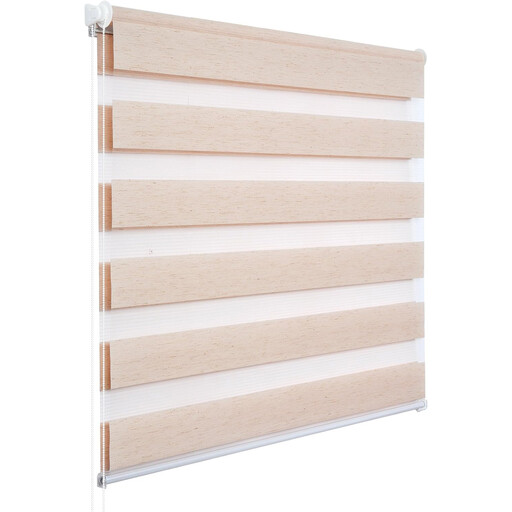
Why this product suits this profile: This model combines clip-on fitting with the option of screw fitting. The chain mechanism can be fitted on the left or right, making it suitable for different rooms around the home.
The product details specify a frame thickness range of 13 to 23 mm and point out that the fabric is narrower than the overall width. This makes it easier to check that it will fit before you buy.
100% polyester, wipe-clean with a damp cloth, and listed as suitable for several types of room, including humid spaces.

Why this product suits this profile: If you want more consistent light control in a bedroom or home office, this model offers coated, opaque fabric rather than striped fabric, and is operated using a bottom rail.
The description clearly distinguishes between clip-on and screw fitting, and specifies a required frame thickness of 16 to 22 mm. This model is not designed for roof windows.
200 g/m² polyester with a silver-coated backing, cordless operation and a surface that can be wiped clean with a damp cloth.
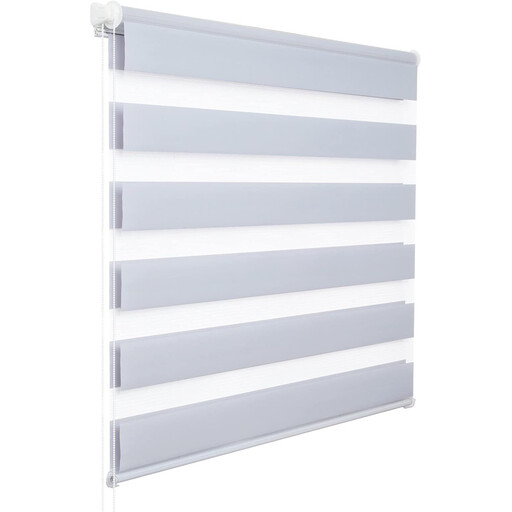
Why this product suits this profile: The greater available drop makes this a good option for balcony and patio doors, as well as tall windows. The chain mechanism can be fitted on the left or right.
The product details specify the required frame thickness of 13 to 23 mm and state that the blind is not suitable for roof or wooden windows. This helps reduce the risk of ordering the wrong blind for specialist window types.
100% polyester, heat-cut edges, and easy cleaning with a damp cloth or soft brush.
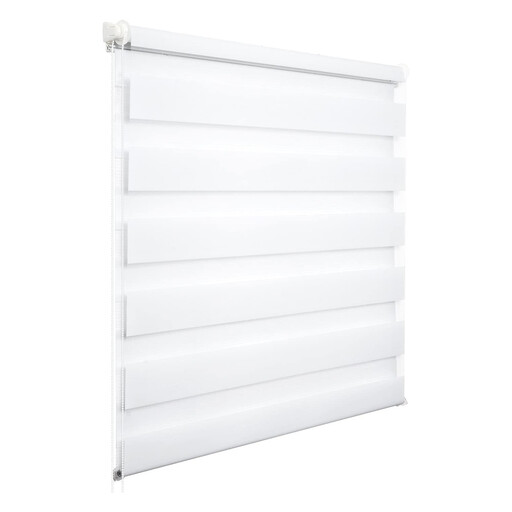
Why this product suits this profile: Cordless operation using the bottom rail is a good option for households looking to avoid a freely hanging pull chain.
The description clearly identifies unsuitable window types and says the blind must be secured safely before use. The required frame thickness for the clip-on brackets is 13 to 23 mm.
Cordless operation using the bottom rail, with GRS and OEKO-TEX standards stated in the product description.
We’ve put together a complete, regularly updated list of products that meet these strict selection criteria and fully comply with the safety regulations in force in the EU.
This depends on the frame thickness, fitting surface, weight and correct installation. A suitable frame thickness and evenly fitted brackets are essential. If the blind is fitted to a frequently used balcony or patio door, check that it remains secure regularly.
First, measure the visible width of the glass. For many duo roller blinds, the recommended ordered width is the glass width plus around 4 cm. Bear in mind that the fabric may be narrower than the overall width. The blind must not cover the window handle.
Yes, if adjustable privacy and light control are all you need. If you want to block out as much light as possible, a blind specifically described as opaque or blackout, with a suitable coated backing, is a better choice than a light-filtering zebra blind.