
Lieferung heute & morgen

Qualitätsgarantie

Willkommens-Angebote freischalten: KOSTENLOSE Lieferung | Bis zu 80 % RABATT | Kostenlose 30-Tage-JoyPlus-Testphase
App herunterladen
A no-drill pleated blind is a practical choice for rented homes, newly decorated rooms and windows whose frames you don’t want to damage permanently. However, not every model will suit every window. Most unsuitable purchases are not down to the blind itself, but to inaccurate measurements, the wrong fitting method or unrealistic expectations about light filtering and blackout performance.
This buying guide explains what to look for when choosing a Klemmfix pleated blind, a no-drill roller blind or a model for windows and doors.
Many buyers measure only the visible glass or use the old blind as a guide. Depending on the model, however, the width you order may need to be slightly greater than the width of the glass. For several Dream-Seeker pleated blinds, the recommended guide is the glass width plus around 4 cm. The exact requirements can vary depending on the fitting method and frame.
So make sure you measure:
For doors and large windows, also check that the blind has enough room to move when the door or window is opened or tilted.
A privacy blind prevents people from seeing in, but it won’t necessarily make the room completely dark. Light-filtering pleated blinds soften daylight and reduce glare, depending on the fabric. A blackout pleated blind with a coated or denser fabric lets less light through. However, light can still enter around the sides, even with an opaque fabric.
Dense fabrics or those described as blackout are often a good choice for bedrooms. In a living room, kitchen or office, a light-filtering blind may be more suitable if you want to keep the room bright.
A Klemmfix pleated blind is usually attached to the window sash using adjustable clamp brackets. Adhesive fitting, on the other hand, uses adhesive holders or strips. Clamp brackets need a compatible frame and may not be suitable for certain types of windows. Adhesive holders may not stick reliably to rough, dusty or uneven surfaces.
Before buying, check whether the model you want can be:
A no-drill pleated blind is especially useful in rented homes, as it usually avoids permanent drill holes. However, the window frame still needs to be suitable for the chosen fitting method. For example, the WOLTU double roller blind is specified for clamp brackets that fit frames 13 to 23 mm deep. According to its product description, the WOLTU honeycomb pleated blind is designed for frames 10 to 23 mm deep.
Check the product details before ordering. Some models are specifically listed as unsuitable for roof windows, sliding windows, fixed glazing and certain wooden windows. Several Dream-Seeker models are also unsuitable for sloping roof windows.
Here’s what the different descriptions mean in practice:
For a desk with a screen, the level of blackout isn’t the only thing to consider. It’s also important to check whether the blind reduces glare from the side and reflections on your monitor.
Models with a handle rail can usually be adjusted smoothly from the top, the bottom or both. If you choose a model with a cord or chain, follow the safety guidance. Keep cords and chains out of children’s reach. Also check regularly that clamp brackets or adhesive holders are still secure.
For rooms with higher humidity, check the material details. Some polyester fabrics are described as moisture-resistant, but they are not waterproof. In a bathroom, avoid exposing the blind to persistent splashes or high levels of moisture.
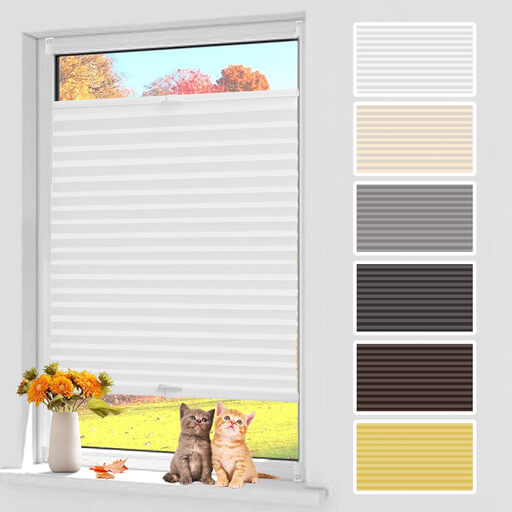
Why this product suits this profile: The 60 × 100 cm size is suitable for smaller standard windows. Its tool-free clamp fitting is a good option if you’re looking for an easy way to improve privacy and protect your room from the sun.
The stated dimensions and Klemmfix fitting make it easier to choose the right blind. You’ll still need to check that your frame width is compatible with the clamp mechanism.
60 × 100 cm, white polyester fabric and an adjustable position for windows and doors.

Why this product suits this profile: Its honeycomb structure, metal frame and adjustable top and bottom handles will appeal if you value a well-built blind with flexible operation.
The specified frame depth is 10–23 mm, making it easier to check before buying whether the clamp brackets will fit your window.
Polyester honeycomb pleated blind, Klemmfix fitting and two-way adjustment using handles.

Why this product suits this profile: This double roller blind is for anyone who wants to adjust daylight and privacy levels throughout the day. It’s designed for windows and doors with a compatible frame.
The product details specify a suitable frame depth of 13–23 mm and list exclusions such as roof windows and sliding windows. This helps prevent orders for windows the blind won’t fit.
Two fabric layers, no-drill clamp fitting and a control chain that can be fitted on the left or right.

Why this product suits this profile: This model is designed for anyone looking for a denser roller blind with a handle rail instead of a cord.
The product details specify a frame depth of 16–22 mm and note that the fabric may be around 4 cm narrower than the overall width.
80 × 150 cm, cord-free operation, clamp or screw fitting and coated backing, according to the product description.
We’ve put together a complete, regularly updated list of products that meet these strict selection criteria and fully comply with the safety regulations in force in the EU.
Clean the window frame before fitting and allow it to dry completely. A smooth, clean surface is particularly important when using adhesive holders. Press the holders into place as instructed, then check that the blind is straight before using it for the first time.
For many polyester fabrics, a soft, slightly damp cloth is all you need. Abrasive products, harsh cleaners and vigorous rubbing can damage the pleated fabric or its coating. In rooms with higher humidity, ventilate regularly to prevent moisture from building up behind the blind.
Depending on the model, you can fit it using clamp brackets, adhesive holders or both. Klemmfix systems hook onto or clamp to the window frame. Adhesive models need a smooth, grease-free surface. Check the specified frame depth and fitting instructions before buying.
How securely it stays in place depends on the frame surface, clamping force, how it’s operated and the weight of the fabric. Check the holders regularly and operate the blind smoothly, without sudden movements. With adhesive fittings, temperature, dust and moisture can affect how well the adhesive holds.
Measure the glass width and the full height of the frame. Some pleated blinds are recommended at a width of around 4 cm more than the glass; others are sized by the overall width, including the holders. Always follow the measurements given for the specific product. Also check that the window handle won’t catch on the blind.