
Lieferung heute & morgen

Qualitätsgarantie

Willkommens-Angebote freischalten: KOSTENLOSE Lieferung | Bis zu 80 % RABATT | Kostenlose 30-Tage-JoyPlus-Testphase
App herunterladen
As a Joybuy Product Recommendation Officer, I see the vast number of options available for window treatments every day. A no-drill pleated blind is a particularly sought-after solution, especially for renters and anyone who wants to avoid damaging their window frames. However, the market is flooded with products of widely varying quality. Before you make a decision, it's crucial to understand the common pitfalls that can lead to frustration and unnecessary expense.
This guide will help you separate the wheat from the chaff. We'll focus on the objective features that define a high-quality drill-free folding blind and show you what to look for to find a durable and functional solution for your home.
Many products promise simple installation and perfect functionality, but the reality is often different. Pay special attention to these three weak points:
To avoid the problems mentioned above, you should check three core parameters before buying. These largely determine the functionality and longevity of your new privacy screen.
Drill-free installation is mainly achieved through two systems. The choice depends on your window type and your preferences.
The function of your pleated blind is determined by the fabric. Understand the differences to make the right choice for every room.
Precision is key here. Always measure directly on the window where the pleated blind will be installed. A common recommendation is:
Based on the criteria above, we have identified some products that are suitable for specific use cases.
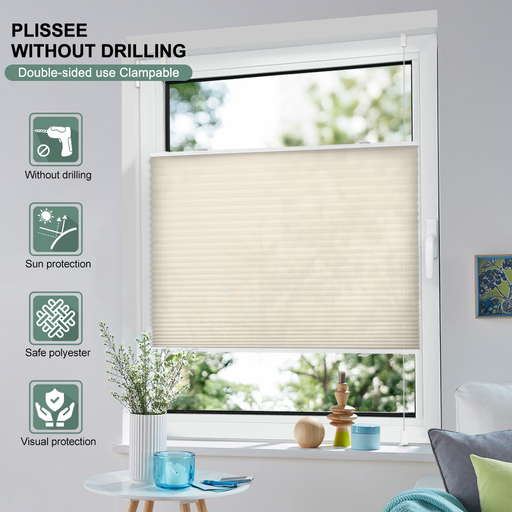
Why it's a good fit: A straightforward and functional solution for standard windows in rental properties. It offers a solid balance of privacy and light filtering for living spaces without breaking the bank.
The product uses a standardised clamp-fit system designed for common uPVC window frames, ensuring a stable, wobble-free installation.
The opaque fabric provides reliable privacy without completely darkening the room. The installation is tool-free and straightforward.

Why it's a good fit: For anyone who needs to reliably darken a room, whether for sleep or for focused, glare-free work on a screen.
This blind is explicitly described as "Blackout." It avoids the trap of merely "opaque" fabric and ensures an effective light blockade.
Offers both clamp-fit and adhesive mounting options, increasing its flexibility for different window types. The blackout function is its clear focus.

Why it's a good fit: For users looking for more than just privacy. The honeycomb structure creates an air cushion that can contribute to thermal insulation in winter and heat protection in summer.
Instead of just promoting the fabric, the focus is on the honeycomb construction. This offers objectively measurable benefits in insulation and soundproofing that go beyond a simple pleated blind.
According to the manufacturer, the honeycomb blind provides a thermal-insulating and sound-dampening effect. The blackout function is also provided by the opaque polyester fabric.
Choosing a pleated blind is a very personal decision. If you need other sizes, colours, or specific blackout levels, you'll find a wider selection in our full collection.
1. How do you clean a no-drill pleated blind? Most pleated blind fabrics can be gently cleaned with a feather duster or the brush attachment of a vacuum cleaner on the lowest setting. For light stains, a slightly damp cloth may help. Avoid harsh cleaning agents, as they could damage the coating or the fabric.
2. Does a clamp-fit pleated blind also work on wooden or aluminium windows? The clamp-fit system is primarily designed for uPVC windows with a standard frame rebate. For many wooden or aluminium windows, the frame is either too narrow, too wide, or has a shape that doesn't provide a secure grip for the clamps. In such cases, adhesive mounting is often the better alternative. Always check the compatible frame thickness specified by the manufacturer.
3. What is the difference between an opaque and a blackout pleated blind? An opaque blind protects against prying eyes but still allows some residual light into the room. You cannot see details inside from the outside, but the brightness is maintained. A blackout pleated blind is equipped with a special layer that almost completely blocks light from entering, darkening the room and making it ideal for bedrooms.