
Lieferung heute & morgen

Qualitätsgarantie

Willkommens-Angebote freischalten: KOSTENLOSE Lieferung | Bis zu 80 % RABATT | Kostenlose 30-Tage-JoyPlus-Testphase
App herunterladen
A no-drill pleated blind is ideal for rented flats, owned homes and rooms where you want to keep the window frame as untouched as possible. Depending on the design, it can be fitted as a clamp-fit pleated blind, a clip-on pleated blind or one with adhesive mounting. However, before you buy, there are several details you need to check. Otherwise, the blind may not fit your window, may not be securely attached, or may not provide the darkness you want in the bedroom.
With many products, the width refers to the entire blind including the brackets. This means the usable fabric width can be smaller. For a precise fit, you should therefore first measure the glass width and then the width of the entire window sash.
For several Dream-seeker models, it is recommended to choose a blind width roughly 4 cm wider than the glass width. The height should match the height of the entire window sash including the frame. This recommendation is not a universal measurement for every model. Always check the details on the individual product page.
A light-filtering pleated blind lets daylight through and reduces direct glare depending on the fabric. However, it usually does not create complete darkness. A privacy pleated blind protects against prying eyes but can still let light into the room.
If you want the bedroom to stay as dark as possible, a fabric described as a blackout pleated blind or blackout model is more suitable. For the kitchen, living room or office, a light-filtering fabric can be a good choice because the room is not completely darkened while still offering privacy. Read product descriptions carefully: in some listings, terms like "blackout" and "light filtering" are used alongside each other.
A pleated blind with adhesive mounting needs a clean, dry and as smooth a surface as possible. On rough, uneven, dusty or very damp surfaces, adhesion may be compromised. A clamp-fit system also requires a suitable window frame. For a model with adjustable clip brackets, for example, a frame thickness of 10 to 23 mm is specified.
Before installation, you should check:
For an internally fitted pleated blind, first measure the glass width, the frame width and the overall height. Note the width and height in the order W × H. So a model measuring 70 × 140 cm is 70 cm wide and 140 cm high.
For balcony and patio doors, the height is especially important. A blind that is too short will leave a visible gap; one that is too wide may clash with the handle, seal or wall.
A clip-on pleated blind is usually attached to the window sash without drilling into the wall or frame. This is practical for rented flats and can work well for frequently used windows. However, the frame thickness must be compatible with the brackets.
With adhesive mounting, brackets or adhesive strips are attached to the frame. This option is useful if clips do not fit or the window sash is particularly narrow. Clean the surface before installation and avoid applying excessive force when adjusting the blind.
Polyester is a commonly mentioned material for the pleated blinds listed. Cleaning is usually done with a soft, slightly damp cloth. Abrasive cleaning products and sharp objects can damage the fabric.
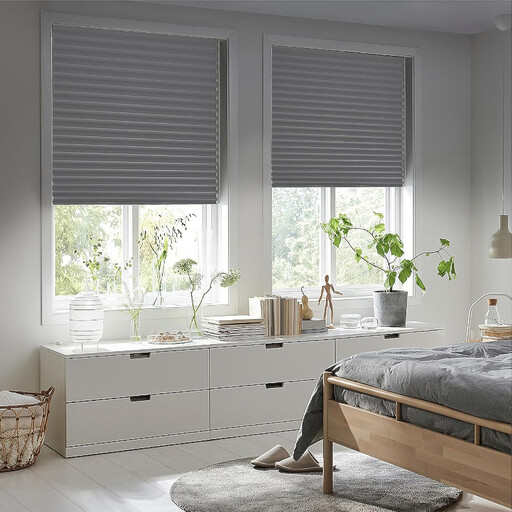
Why this product suits the profile: The 70 × 140 cm light grey pleated blind is ideal for users looking for straightforward privacy and light control for windows or doors. The product description mentions clamp-fit and adhesive mounting without drilling.
The design is explicitly described as light-filtering and not fully blackout. This makes it easier to set expectations for light control.
Light grey colour, 70 × 140 cm, polyester and flexible mounting options without drilling.

Why this product suits the profile: This roller blind is aimed at households that need stronger light-blocking privacy and sun protection for bedrooms, living rooms or offices.
The product details specify the suitable frame thickness of 16–22 mm and note that the fabric width may be about 4 cm less than the overall width.
Clamp mounting without drilling, cordless operation via handle, polyester with 200 g/m² and coated back according to the product description.
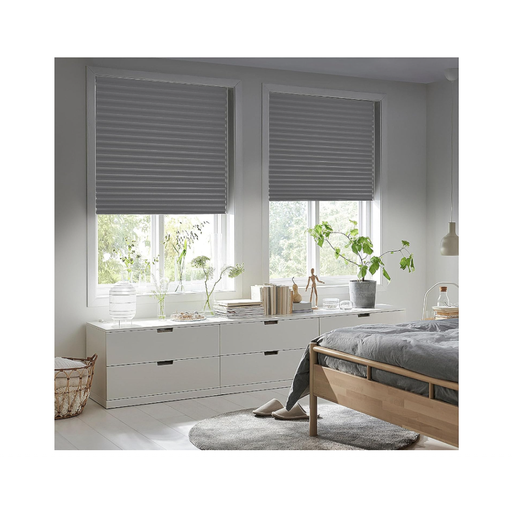
Why this product suits the profile: The compact size and adjustable position make it suitable for individual windows in the kitchen, office, children's room or bathroom, provided the frame and room humidity are compatible.
The product description notes that the fabric is moisture-resistant but not waterproof. For permanently wet areas, a different solution should be considered.
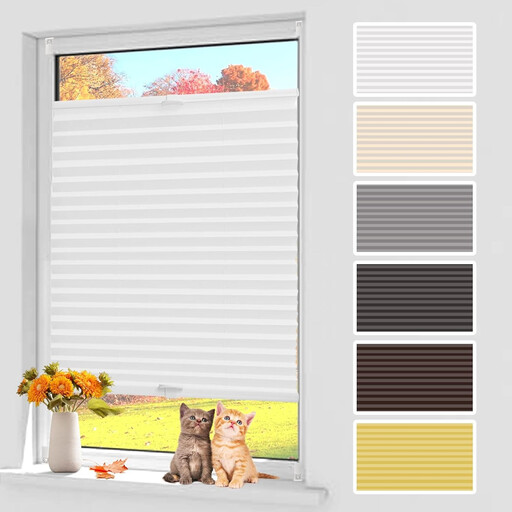
Why this product suits the profile: The white version is intended for smaller windows in bedrooms, offices or living spaces where privacy and stronger light control are needed.
The dimensions of 65 × 100 cm limit the choice to suitable smaller windows. Before buying, check whether your actual glass and frame width match.
Adhesive mounting without drilling, polyester fabric, suitable for windows and doors according to the product description.
We have put together a full, regularly updated list of products that fully meet these strict selection criteria and the safety regulations in force in the EU.
For products with cords, observe the safety distances and the manufacturer's instructions. Small mounting parts should be kept out of the reach of children.
Durability depends on the mounting method, frame, surface condition, weight and how it is used. Clips are less dependent on adhesive strength but must match the frame thickness. For adhesive mounting, a smooth, dry surface and correct preparation are crucial. Check the brackets regularly.
Many of the models mentioned are described as suitable for windows and doors. Before buying, check the width, height, door movement and the available space on the frame. For balcony and patio doors, sufficient operating height is also important.
In use, there are usually no electricity costs because the blind is adjusted manually. Costs may arise from replacement parts, damaged adhesive brackets or a later replacement. Choosing the right size, careful operation and cleaning with a soft cloth help to avoid unnecessary follow-up costs.