
Lieferung heute & morgen

Qualitätsgarantie

Willkommens-Angebote freischalten: KOSTENLOSE Lieferung | Bis zu 80 % RABATT | Kostenlose 30-Tage-JoyPlus-Testphase
App herunterladen
A no-drill pleated blind is a practical solution for rental properties and for anyone who wants to avoid damaging their window frames. Tool-free installation not only saves effort but also prevents potential disputes when moving out. However, the selection of models, fabrics, and mounting types is vast. This guide serves to help you navigate the options and find the perfect pleated blind for your needs. We will introduce various systems and provide specific product recommendations based on functionality and ease of use.
Before making a decision, you should consider a few fundamental criteria. These will help you narrow down the selection and find a product that is both functional and a perfect fit.
The most common method for a no-drill pleated blind is installation using clamp brackets. A clamp-fix pleated blind is clamped directly onto the window sash.
The fabric determines the function of your pleated blind. Consider what its primary purpose will be.
A perfectly fitting pleated blind is crucial for flawless function and appearance. Measure precisely before you order.
Here is a selection of products that meet different requirements for installation and function.

Why it stands out: This model combines the benefits of a honeycomb shade with a simple clamp-fix installation. The honeycomb structure provides effective thermal and sound insulation, while the opaque fabric ensures a complete blackout effect.
Advantages:
Who is it for? Ideal for bedrooms, children's rooms, or offices where both a complete blackout pleated blind and improved room temperature regulation are desired.
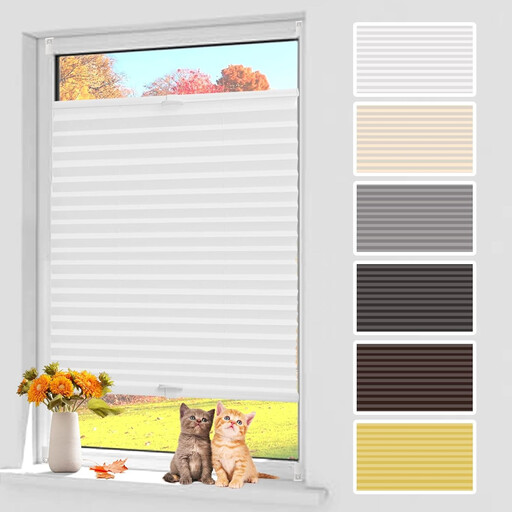
Why it stands out: The Dream-seeker pleated blind uses adhesive mounting, making it a solution for windows where clamp brackets cannot be used, such as fixed glass elements.
Advantages:
Who is it for? A great option for renters and homeowners looking for a drill-free solution for fixed windows or doors and who need straightforward blackout functionality.

Why it stands out: This roller blind is not a classic pleated blind, but as an alternative, it also offers a drill-free installation. Its special feature is the silver-coloured thermal coating on the back, which provides high light reflection and insulation.
Advantages:
Who is it for? Recommended for rooms that require maximum blackout, such as home cinemas or bedrooms for shift workers. The thermal function also makes it attractive for energy-conscious households.
If the models presented don't exactly match your needs or if you're looking for more advanced solutions, there are other alternatives to explore. For added convenience, you might consider automated systems.
Discover a wider selection, including Motorised Blackout Roman Blinds, to find the perfect solution for your home.
1. How does a no-drill pleated blind stay in place? A no-drill pleated blind is primarily secured in two ways: either with clamp brackets (clamp-fix), which are clamped onto the top and bottom edges of the window sash, or with adhesive mounts, which are stuck directly onto the window pane or frame. Both methods avoid damaging the window.
2. Can a clamp-fix pleated blind be installed on any window? No, a clamp-on pleated blind is designed for window sashes that can be opened. It is not suitable for fixed (non-opening) windows or skylights. Additionally, the thickness of the window frame must be compatible with the clamp brackets, typically between 10 and 25 mm.
3. What is the difference between a honeycomb shade and a regular pleated blind? A regular pleated blind consists of a single, zigzag-folded fabric panel. A honeycomb shade, on the other hand, is made of two fabric panels bonded together to form a honeycomb-shaped chamber structure. These air pockets provide insulation against heat and cold and also dampen sound, making it a thermal pleated blind with added benefits.