
Lieferung heute & morgen

Qualitätsgarantie

Willkommens-Angebote freischalten: KOSTENLOSE Lieferung | Bis zu 80 % RABATT | Kostenlose 30-Tage-JoyPlus-Testphase
App herunterladen
As a Joybuy Product Recommendation Officer, I see customers searching for practical solutions for their living spaces every day. A recurring need, especially in rental apartments, is effective privacy and sun protection that works without drilling and wall plugs. A no-drill pleated blind seems to be the ideal solution here. However, the market is flooded with products of widely varying quality.
Before you make a decision, it is important to know the most common pitfalls that can lead to a purchase you'll regret.
To avoid these problems, you should focus on three objective core parameters. These will help you realistically assess a product's functionality and durability.
The mounting system is the heart of any drill-free setup. A clip-on pleated blind is clamped directly onto the window sash. Pay attention to the following features:
The choice of fabric determines how well the blind fulfils its role as a no-drill window privacy screen. The terms are not always self-explanatory:
The right size is crucial for both function and appearance. Proceed as follows:
Note that the specified fabric width is often 3–4 cm narrower than the specified total width of the product.
Based on these objective criteria, we have identified several products that are suitable for different user profiles and requirements.
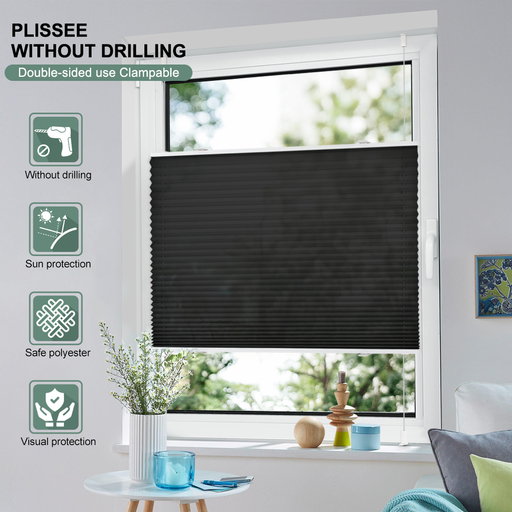
Why This Fits Their Persona: Ideal for renters seeking a straightforward, cost-effective solution for basic privacy in living rooms or offices. The installation is tool-free and leaves no marks.
The product focuses on its core function: an opaque clip-on pleated blind. It avoids exaggerated claims and offers a standardised clip-on system for common window frames.
Tool-free clip-on installation; opaque fabric for reliable privacy; simple design in neutral colours.

Why This Fits Their Persona: Perfect for bedrooms or south-facing rooms. Users who value sleep quality and a comfortable room climate will benefit from its insulating and blackout properties.
This product solves the problem of misleading fabric claims. Its honeycomb structure creates an air pocket that demonstrably contributes to thermal and sound insulation, ensuring effective blackout performance.
Honeycomb structure for thermal and sound insulation; high-performance blackout capability; robust metal brackets for a stable fit.
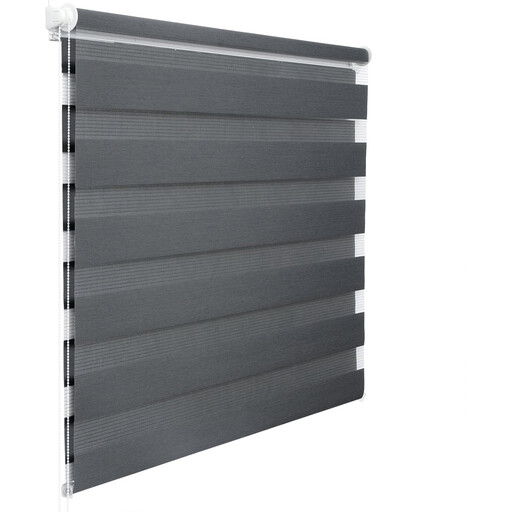
Why This Fits Their Persona: For anyone who wants more than just "open" or "closed." This no-drill roller blind is ideal for living rooms and offices where light conditions vary throughout the day and require flexible adjustment.
It bypasses the trap of choosing the wrong fabric by combining two fabric types in one product. You do not have to decide between translucent and opaque; instead, you can seamlessly adjust the light level.
Infinitely adjustable light and privacy control; modern look with alternating fabric strips; chain pull can be mounted on the left or right.
We have compiled a complete, up-to-date list of products that fully meet these strict selection criteria and comply with German regulations.
Stability largely depends on the quality of the clamp brackets and correct installation. Models with adjustable metal brackets that are firmly clamped to the window sash and additionally tensioned offer a very secure hold for everyday use, even with frequently tilted windows. However, for very large or heavy window fronts, a screwed-in version may offer more stability.
A thermal pleated blind can contribute to energy efficiency. In the summer, the reflective coating on the back reflects some of the sun's thermal radiation, which can reduce room heating. In the winter, the air layer within the blind (especially with honeycomb blinds) forms an additional insulating barrier that slightly reduces heat loss through the window pane. The effect is measurable, but it is not a substitute for modern window glazing.
The terms are often used interchangeably. Technically, a pleated blind is a folding shade with pre-made, permanent pleats (an accordion effect). A folding blind is a more general term for a fabric that folds up as it is raised. In common usage and retail, pleated blind and no-drill folding blind now usually refer to the same product: a tensioned, folding shade that is mounted directly on the window.