
Lieferung heute & morgen

Qualitätsgarantie

Willkommens-Angebote freischalten: KOSTENLOSE Lieferung | Bis zu 80 % RABATT | Kostenlose 30-Tage-JoyPlus-Testphase
App herunterladen
As a renter or homeowner, you know the problem: you need effective privacy and sun protection but don't want to drill into your window frames. The concern about unsightly holes, disputes with your landlord, or losing your security deposit is completely valid. A no-drill pleated blind seems like the perfect solution. However, the market is flooded with products of widely varying quality.
Many buyers fall into common traps that lead to frustration and unnecessary expense. Before you make a decision, you should be aware of the three most common pitfalls:
This guide will help you navigate these issues and make an informed choice that meets your needs for both function and durability.
To find the right no-drill privacy blind for your window, you should check three core technical parameters. These determine the blind's functionality, durability, and fit.
The installation method is crucial for stability and residue-free removal.
The choice of fabric depends directly on its intended purpose.
An incorrectly measured blind won't fit properly and will fail to serve its purpose. Follow this simple rule:
Instead of presenting an overwhelming list, we've selected products for specific use cases.
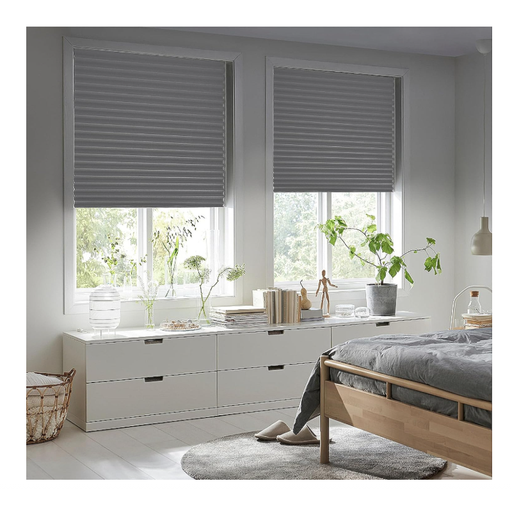
Why It's a Good Fit: A straightforward and budget-friendly solution for renters seeking reliable privacy and glare control for living rooms or offices, without needing to make any structural changes.
The product is clearly described as light-filtering (opaque), avoiding any false promises of a blackout effect. The clamp-fit system is designed for quick and simple installation.
It offers two mounting options (clamping and adhesive) in one package, increasing its flexibility for different types of windows.

Why It's a Good Fit: Perfect for families and anyone who values a dark bedroom and high safety standards. The cordless design eliminates the risk of strangulation for children and pets.
The silver-coated backing provides a true blackout effect, not just opacity. Its cordless design is a deliberate safety feature, not just a stylistic choice.
Combines 100% blackout with thermal insulation and child-safe, cordless operation. The material is also certified according to the OEKO-TEX Standard.
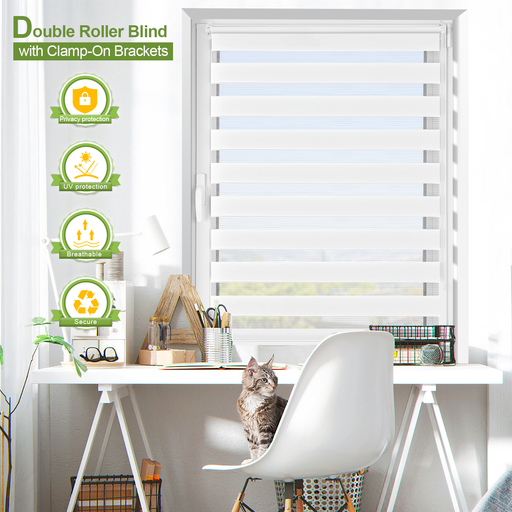
Why It's a Good Fit: For users in living or work areas who need seamless control over light and privacy. A no-drill dual roller blind offers more flexibility than a standard pleated blind.
Instead of a single function, this blind's dual fabric layers offer clear, intuitive functionality. The clamp brackets are designed for a simple installation without unstable parts.
The alternating transparent and opaque stripes allow for precise light control—from nearly sheer to full privacy—with a single adjustment.
We have compiled a complete, up-to-date list of products that fully meet these strict selection criteria and safety standards.
The stability of a clamp-fit system depends heavily on the quality of the brackets and correct installation. Models with adjustable brackets made of metal or reinforced plastic, designed for your specific window frame thickness, provide a very secure hold for daily use. It's important to tighten the brackets firmly, but not with excessive force, to avoid damaging the frame.
Yes, many models are also suitable for balcony or patio doors. For glass doors that open, a clamp-fit pleated blind is a great option. For large, fixed glass panes, models with adhesive brackets or suction cups can be used. For doors, pay special attention to ensuring the blind is firmly tensioned (at both the top and bottom) so it doesn't swing or dangle when the door is opened and closed.
A pleated blind for windows (also called a cellular shade) consists of a single, folded piece of fabric that collapses like an accordion. It is often tensioned and can be adjusted from both the top-down and the bottom-up. A no-drill dual roller blind (also known as a zebra blind) consists of two parallel layers of fabric with alternating transparent and opaque stripes. By shifting the layers relative to each other, you can seamlessly adjust the amount of light coming through.