
Lieferung heute & morgen

Qualitätsgarantie

Willkommens-Angebote freischalten: KOSTENLOSE Lieferung | Bis zu 80 % RABATT | Kostenlose 30-Tage-JoyPlus-Testphase
App herunterladen
A no-drill pleated blind is a stylish and practical solution for many homes. For renters or in freshly renovated spaces, drill-free installation offers a simple way to add sun and privacy protection without damaging the window frame. However, the market is crowded, and not every product delivers on its promise.
Many buyers are frustrated by unstable brackets, unsightly light gaps, or low-quality fabrics. This guide will show you the critical features to look for to find a durable and functional solution, and introduce you to several excellent options for different needs.
Before you make a purchase, you should be aware of the typical flaws that often only become apparent after installation or a few months of use.
To avoid these pitfalls, focus on the following three technical parameters. They are the key to a satisfying purchase.
The most common drill-free method is the Klemmfix roller blind. With this system, brackets are clamped directly onto the window sash. Pay attention to the following details:
The fabric determines how well your no-drill sun protection for windows performs. The most common types are:
Careful measurement is essential. Follow these steps to minimise light leakage from the sides:
Here are a few recommendations tailored to different needs and living situations.
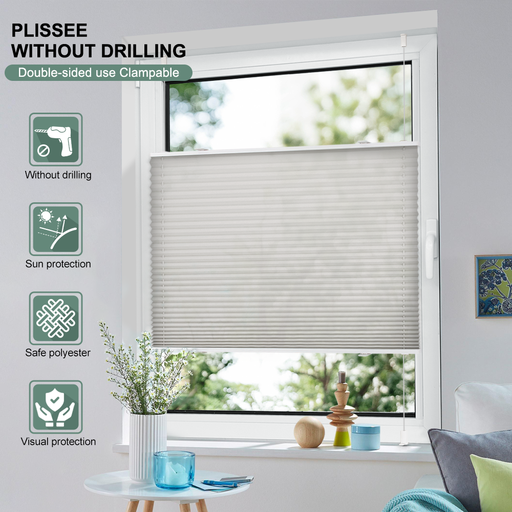
Why This Fits Their Persona: A straightforward and functional solution for standard tilt-and-turn windows in rental properties, where quick installation and reliable privacy are key.
The Klemmfix system is designed for common frame thicknesses and can be mounted without tools, preventing damage to the window frame. The opaque fabric blocks unwanted views.
Tool-free installation; opaque fabric for instant privacy; infinitely adjustable via top and bottom rails.

Why This Fits Their Persona: Ideal for children's rooms or bedrooms where complete darkness and safety are top priorities. The cordless operation is a key feature for households with small children.
The silver coating provides reliable blackout performance that won't peel. The cordless design eliminates the strangulation hazard posed by control cords, a common concern with traditional blinds.
Cordless operation for enhanced child safety; 100% blackout thanks to the coating; thermal properties for temperature regulation.

Why This Fits Their Persona: Perfect for rooms that need to stay cool in the summer and warm in the winter, or for windows facing busy streets. The focus is on energy efficiency and sound insulation.
The honeycomb structure is dimensionally stable and, unlike simple pleated blinds, offers a measurable insulating effect against heat, cold, and sound. The fabric quality is designed for durability and functionality.
Honeycomb structure for thermal insulation and sound dampening; can help reduce energy costs; blackout function for undisturbed sleep.
We have compiled a complete, up-to-date list of products that fully meet these strict selection criteria and safety standards.
The stability of a Klemmfix system depends heavily on the quality of the clamp brackets and correct installation. High-quality brackets, often with a metal core, provide a very secure hold when properly adjusted to the frame's thickness. When installed correctly, they can easily withstand daily use, including tilting the window.
Some models are designed to be shortened in width. However, this is not the case for all products and often requires special tools and some DIY skill. Read the manufacturer's product description carefully. An incorrect cut can render the blind unusable. When in doubt, it's best to order the correct width from the start.
A standard pleated blind consists of a single, zigzag-folded panel of fabric. A honeycomb blind, on the other hand, is made of two fabric panels joined in the middle to form a honeycomb structure. These cells trap air, creating an insulating layer that helps with temperature regulation and sound dampening, which is not a feature of a simple pleated blind.