
Lieferung heute & morgen

Qualitätsgarantie

Willkommens-Angebote freischalten: KOSTENLOSE Lieferung | Bis zu 80 % RABATT | Kostenlose 30-Tage-JoyPlus-Testphase
App herunterladen
As a Joybuy Product Recommendation Specialist, I see daily how many people are looking for a practical privacy and sun protection solution that won't violate their lease agreement. A no-drill pleated blind is often the top choice. But the market is flooded with options, and not every product delivers on its promise. Before you make a decision, it's crucial to know the most common pitfalls that can lead to a purchase you'll regret.
This guide will show you what to look for to find a functional and durable solution for your windows.
Many buyers focus only on colour and price, overlooking crucial technical details. This often leads to frustration and unnecessary expense.
To avoid these mistakes, you should carefully examine three technical features. These will determine the functionality and perfect fit of your new privacy screen.
The most common method is the clamp-fit pleated blind. Here, adjustable brackets are clamped directly onto the window sash. It's a stable and residue-free removable solution, ideal for rental apartments.
The choice of fabric determines how much light enters the room and how well the no-drill window privacy screen works.
To avoid light gaps on the sides, precise measurement is essential.
Based on these criteria, we have identified some products that are suitable for different needs and living situations.
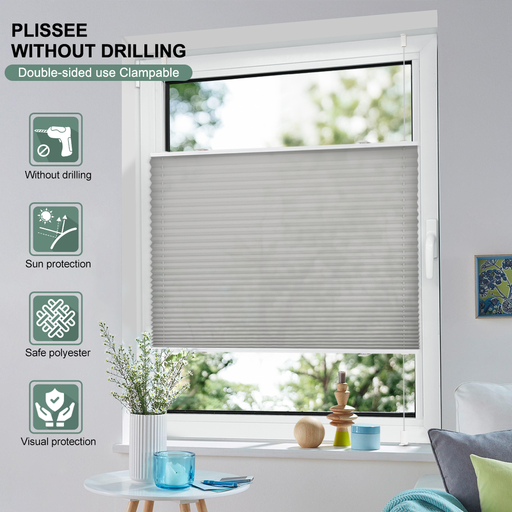
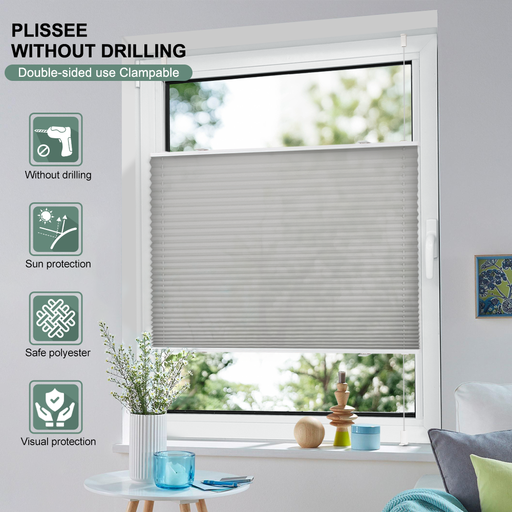
Why it's a match: Ideal for standard windows in student flats, kitchens, or home offices. It offers a functional and affordable solution for creating privacy without much effort. The narrow width is well-suited for many common window sizes.
The clamp-fit system is designed for common window frames and ensures a stable hold when installed correctly. The fabric, described as opaque, provides reliable privacy and avoids the "shadow theatre" effect.
Tool-free installation; opaque polyester fabric; infinitely adjustable.
Why it's a match: The modern anthracite colour and more generous width are perfect for living rooms or offices that require stylish yet functional sun protection for the window. It makes a clear visual statement.
The product description clearly states the overall dimensions, which helps to avoid the measurement error between fabric and order width. The opaque fabric meets the privacy requirements for living spaces.
Modern colour (anthracite); suitable for wider windows; made of PVC and polyester fibre.
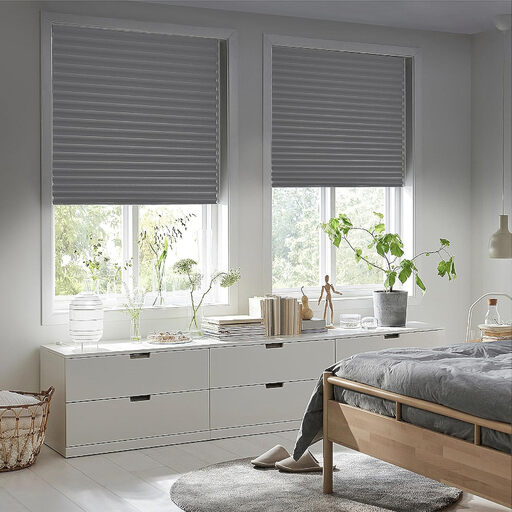
Why it's a match: This folding blind offers maximum flexibility with two mounting options (clamping and adhesive). It is suitable for users who are looking for a secure solution for different window types or are unsure about their frame thickness.
The explicit measuring guide ("glass width + 4 cm") directly helps to prevent the most common measurement error. The dual mounting option provides an alternative if the clamp brackets do not fit optimally.
Two mounting methods included (clamp/adhesive); clear measuring instructions; moisture-resistant fabric.
We have compiled a complete, up-to-date list of products that meet these strict selection criteria.
Measure the width of the glass pane (from gasket to gasket) and add 2 cm on both sides to minimise the light gap. Therefore, the order width is the glass width plus 4 cm. For the height, measure the entire height of the window sash.
Yes, especially tensioned pleated blinds that are secured with four clamp brackets (top and bottom) are ideal for tilt-and-turn windows. The side tension cords keep the blind parallel to the window, so it doesn't swing freely into the room.
Yes, that is the main advantage of clamp-fit systems. The brackets are only clamped onto the window frame and can be easily removed for a move or a change, without leaving behind drill holes or adhesive residue. This makes them an ideal solution for tenants.