
Lieferung heute & morgen

Qualitätsgarantie

Willkommens-Angebote freischalten: KOSTENLOSE Lieferung | Bis zu 80 % RABATT | Kostenlose 30-Tage-JoyPlus-Testphase
App herunterladen
The search for no-drill pleated blinds often starts with a clear goal: a stylish and functional window covering that leaves the window frame undamaged. This is especially a necessity in rental apartments. However, the market is flooded with products whose descriptions promise more than they deliver. Many buyers only realise after installation that the brackets are wobbly, the fabric doesn't truly darken the room, or the blind leaves unsightly light gaps at the sides.
As your Joybuy Product Recommendation Officer, I'm here to help you navigate these pitfalls. We'll focus on the objective features that define a quality product and ignore exaggerated marketing claims. Here are the three most common problems and how you can make an informed decision.
To avoid a bad purchase, you should focus on three core technical aspects. These determine the functionality and longevity of your new privacy screen.
Drill-free installation is usually done with clamp brackets that are fitted onto the window sash. Pay attention to two critical details here:
The choice of fabric depends directly on your needs. Here are the common categories and their applications:
The type of operation affects both convenience and safety.
Here are some product recommendations tailored to specific use cases and the quality criteria mentioned above.
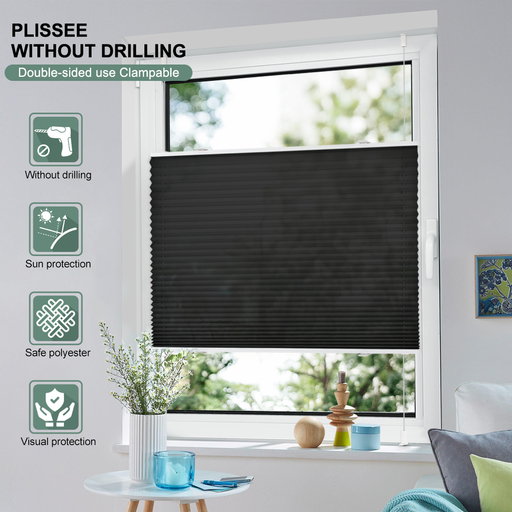
Why This Fits Their Persona: A straightforward and reliable solution for rental apartments. The tool-free installation protects the window frame, and the opaque fabric provides solid privacy and sun protection for living spaces or the home office.
The product relies on a proven clamp-fit system designed for common window frame thicknesses, thus avoiding the trap of wobbly or ill-fitting brackets.
Tool-free clamp-fit installation; opaque fabric for good privacy while still allowing light to filter through.

Why This Fits Their Persona: Ideal for bedrooms and children's rooms where darkness and safety are priorities. The cordless design eliminates the hazard of loose cords, and the special coating ensures effective room darkening.
This blind solves the problem of misleading fabric descriptions. The silver coating on the back is a clear, technical feature for a 100% blackout function, not just a vague description.
Cordless design for enhanced child safety; effective blackout and thermal insulation due to the coating.

Why This Fits Their Persona: For anyone looking not just for privacy, but also to reduce their energy bills. The honeycomb structure creates an air pocket that insulates against cold in the winter and heat in the summer.
Instead of a generic "thermal" claim, this product offers a specific, physically effective design. The honeycomb shape is a verifiable feature for improved insulation properties.
Honeycomb structure for effective thermal and sound insulation; infinitely adjustable via handle for precise light control.
We have compiled a complete, up-to-date list of products that fully meet these strict selection criteria and German safety regulations.
Correct measurement is crucial. Measure the width of the glass pane (including the rubber seals). For good coverage and to minimise side light gaps, it is recommended to add about 2 cm to each side of the measured glass width. However, the resulting order width should not interfere with the window handle. For the height, measure the height of the entire window sash and choose the next largest available standard height.
Yes, a high-quality clamp-fit pleated blind with securely fitted and correctly installed brackets will also hold safely on a tilted window. Many pleated blinds are additionally tensioned at the top and bottom. These side guide cords ensure that the folding blind sits snugly against the window and does not swing.
A standard pleated blind consists of a single, zigzag-folded piece of fabric. A honeycomb blind, on the other hand, consists of two fabric panels that are joined in the middle to form a honeycomb-like, cellular structure. These honeycombs trap air, creating an insulating layer that provides significantly better thermal and sound insulation than a standard pleated blind.