
Lieferung heute & morgen

Qualitätsgarantie

Willkommens-Angebote freischalten: KOSTENLOSE Lieferung | Bis zu 80 % RABATT | Kostenlose 30-Tage-JoyPlus-Testphase
App herunterladen
A no-drill pleated blind is a good choice for rented homes, owner-occupied properties and rooms where you don’t want to make permanent changes to window frames or walls. However, not every model will automatically be the right fit. Common problems include measuring windows incorrectly, choosing unsuitable adhesive surfaces or being unclear about how much light the fabric lets through.
If you’re thinking of buying a clamp-fit pleated blind or a pleated blind with clamp brackets, consider the fitting method, measurements and fabric properties separately. This helps avoid problems later, such as the blind not staying in place, obstructing the window handle or letting in too much light for the room.
‘No drill’ can mean clamp-fit mounting, adhesive mounting or a combination of the two. Clamp brackets attach to the window frame and need to be suitable for its thickness. Adhesive brackets, on the other hand, only stick reliably to smooth, clean and dry surfaces.
Adhesive brackets can come loose from rough, dusty or uneven frames. Before fitting, remove any grease, dust and residue. If you live in a rented home, also consider whether adhesive residue could be an issue when you remove the brackets later.
A privacy pleated blind prevents people from seeing in, but it won’t necessarily make a room completely dark. A light-filtering pleated blind still lets daylight through, making it a good option for living rooms or home offices. A model described as a blackout pleated blind, by contrast, is intended for bedrooms, children’s rooms or other spaces where you need greater light protection.
The actual effect also depends on gaps at the sides. Even opaque fabric can let light through around the edges if you haven’t chosen the right width.
When choosing a pleated blind for a window or door, you need to establish the correct width and height. Take account of the opening window sash, glass, frame and any protruding handles. A blind that’s too wide can get in the way of opening the window, while a model that’s too narrow will let in more light and allow more visibility at the sides.
For some Dream-seeker models, the product details recommend choosing a width around 4 cm wider than the glass and measuring the height against the entire window frame. Check this recommendation against the fitting method and your specific window before buying.
Measure the intended fitting area in at least two places. If the measurements differ, use the smaller one as a guide to ensure a good fit. Also check:
Many models are available in several sizes. For example, according to the product details, the Dream-seeker range includes widths such as 35, 55, 60, 65, 70, 75 and 80 cm, as well as different heights. However, not every size will suit every type of frame.
Polyester is widely used for roller blinds and pleated blinds. A polyester pleated blind can usually be cleaned with a slightly damp cloth. Even so, check the product details, as water resistance doesn’t automatically mean waterproof.
These terms can help you choose:
These descriptions shouldn’t be taken as a guarantee of a particular room temperature or complete darkness.
Depending on the model, you can adjust a pleated blind using a handle, cord or another operating mechanism. Before buying, check that you’ll be able to reach and use it easily on your particular window.
For products with cords, follow the safety instructions. Keep operating and fixing components out of reach of young children, and check that the blind is securely in place after fitting.
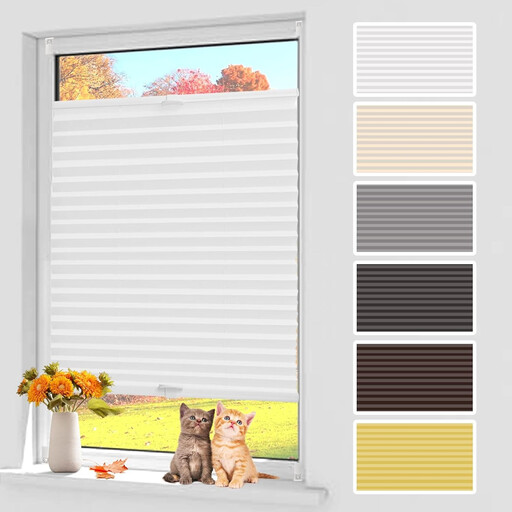
Why this product suits this profile: Its compact size and white finish make it a good option for smaller standard windows in living rooms, home offices or bedrooms. According to the product details, it can be fitted without drilling using clamp and adhesive brackets.
The dimensions are clearly stated. Before buying, check the window width, the frame area the blind will sit against and the available adhesive surface.
65 × 100 cm, white polyester pleated blind, described as light-filtering and offering privacy.

Why this product suits this profile: This honeycomb pleated blind is aimed at shoppers looking for privacy and sun protection, as well as a sturdy metal frame and clearly specified frame requirements. According to the product details, it’s suitable for frame thicknesses of 10–23 mm.
The compatible frame thickness is specified, so you can check in advance whether the clamp brackets will fit your window or door.
100% polyester according to the product details, honeycomb structure, clamp-fit mounting and a size of 50 × 130 cm.
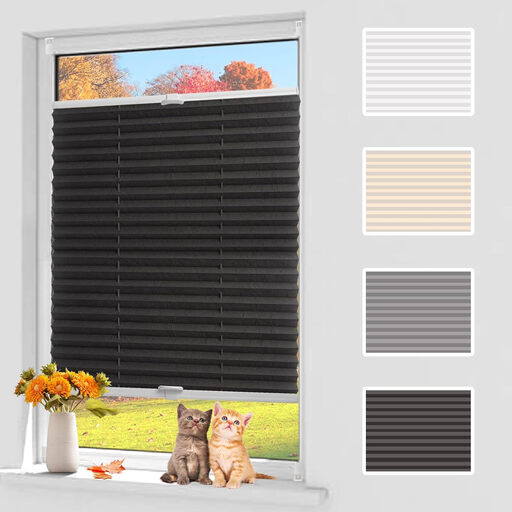
Why this product suits this profile: This anthracite pleated blind is a good fit for larger windows in living rooms, kitchens, bathrooms or home offices. According to the product description, you can adjust the height by moving the handle.
The product details describe it as moisture-resistant, but also note that the material isn’t waterproof. This distinction matters in areas that get very wet.
70 × 140 cm, anthracite polyester fabric, clamp-fit mounting and adjustable height.

Why this product suits this profile: The white finish and blackout description make this an interesting option for rooms where reducing light and maintaining privacy matter more than letting daylight through unobstructed.
The product is described as blackout. For a darker result, still check the width, the area of the frame the blind will sit against and any potential gaps at the sides.
70 × 130 cm, white polyester fabric, clamp and adhesive brackets, with blackout and privacy functions according to the product details.
We’ve put together a complete, regularly updated list of products that meet these strict selection criteria and fully comply with the safety regulations in force in the EU.
Depending on the model, it’s attached to the inside of the window frame using adjustable clamp brackets, adhesive brackets or a combination of both. For adhesive mounting, the surface must be smooth, clean and dry. Before buying, measure the frame thickness and the available area for the brackets.
Its lifespan depends on factors including the material, how often you use it, exposure to sunlight and moisture, and whether it’s fitted correctly. There’s no single lifespan that applies to every blind. Check the fixings regularly and avoid pulling too hard on the operating mechanism.
A no-drill pleated blind doesn’t normally need electricity, so it won’t add to your energy bills. The main costs are the initial purchase and, if needed, replacement brackets or a new blind. Price depends mostly on size, fabric type, fitting accessories and light-protection features.