
Lieferung heute & morgen

Qualitätsgarantie

Willkommens-Angebote freischalten: KOSTENLOSE Lieferung | Bis zu 80 % RABATT | Kostenlose 30-Tage-JoyPlus-Testphase
App herunterladen
A no-drill pleated blind with clamp brackets can provide privacy and shade in rented homes, owned properties and temporary living spaces without leaving holes in the window frame or wall. However, choosing in a hurry can easily lead to buying the wrong product. It’s not just colour and price that matter: window measurements, fitting method, light transmission and operation are all key considerations.
Depending on the model, the stated width may refer to the overall width, the fabric or the brackets. Some pleated blinds are supplied with the recommendation to add around 4 cm to the glass width. Other products are selected according to the frame width.
Before buying, measure:
A pleated blind in a range of sizes will not necessarily fit every window. For doors or particularly tall windows, you should also check that the stated height is sufficient.
An opaque privacy blind prevents people from seeing in, but may still let daylight through. A light-filtering pleated blind is often a good choice for living rooms and home offices, while a blackout pleated blind may be more suitable for bedrooms or rooms exposed to direct sunlight.
Descriptions such as “blackout”, “room darkening” or “light-filtering” should always be considered alongside the product description and fabric construction. Depending on the material, light-coloured fabrics such as a beige pleated blind or light grey pleated blind may diffuse more light than darker options.
A pleated blind with clamp brackets is usually attached to the movable window sash. The frame must be thick enough and accessible for the brackets to fit. Clamp-fit systems are not suitable for every roof window, wooden window or sloping window surface.
Adhesive brackets require a clean, dry and smooth surface. Dust, moisture or textured finishes can affect how well they stick. After fitting, check regularly that the brackets remain secure.
A clamp-fit pleated blind attaches to the window frame without a drill. Some models also offer adhesive brackets or optional screw-fixing accessories. The permitted frame thickness must match the product specifications. For example, various WOLTU day and night blinds are listed as suitable for frame thicknesses of 13 to 23 mm, while the stated range for the WOLTU honeycomb pleated blind is 10 to 23 mm.
Also make sure the blind does not cover the window handle, seal or opening mechanism. According to their product descriptions, several of the models mentioned here are not designed for roof windows or sloping windows.
The product descriptions for Dream-Seeker models state that their woven polyester fabric is easy to care for and moisture-resistant, but not waterproof. This may make it suitable for kitchens or bathrooms, provided the fabric is not in continual contact with water.
Day and night blinds have alternating sheer and opaque fabric stripes. Slide the stripes to adjust the amount of light entering the room. A traditional pleated blind, by contrast, is usually positioned using a handle, cord or top and bottom rails.
Keep cords and operating chains out of children’s reach. For chain-operated blinds, use the supplied safety device as instructed. Cordless models operated by a handle avoid the need for an operating chain, but still need to be securely fitted.
Polyester fabrics can usually be cleaned with a soft, dry or slightly damp cloth. Harsh cleaning products, vigorous rubbing and prolonged exposure to high levels of moisture can damage the material and its coating.
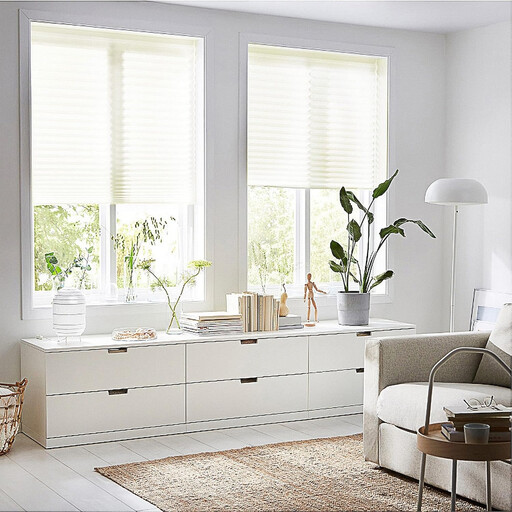
Why this product suits this profile: This compact clamp-fit pleated blind is suitable for smaller interior windows and doors. Its beige colour works with a wide range of décor styles, while the no-drill fitting makes it a good option for rented homes.
The dimensions of 75 × 100 cm are clearly stated. Before ordering, however, compare the glass width and frame height with the fitting instructions.
The product information specifies polyester fabric, clamp or adhesive fitting, and cleaning with a damp cloth.

Why this product suits this profile: Its double-layer pleated design and metal frame will appeal to anyone looking for a well-defined construction and flexible positioning.
The stated frame range of 10 to 23 mm makes it easier to check compatibility before buying. The product description says this model is not designed for roof windows.
The product description specifies 100% polyester, clamp-fit installation and top and bottom handles for flexible positioning.

Why this product suits this profile: This model is designed for rooms where stronger light protection and chain-free operation are important, such as bedrooms, children’s rooms or home offices.
Check in advance that your frame thickness falls within the suitable range of 16 to 22 mm. The product information says this model is not suitable for roof windows.
Product details specify handle operation without a chain, polyester fabric with a silver-coated backing, and clamp or screw fitting.

Why this product suits this profile: Alternating sheer and opaque stripes let you adjust privacy and daylight in stages, making it suitable for living rooms, bedrooms and home offices.
The recommended frame thickness of 13 to 23 mm is stated. Also make sure the chain does not sit over the window handle and is secured out of children’s reach.
Product details list two layers of fabric, a chain that can be fitted on the left or right, and clamp or screw fitting.
We’ve put together a complete, regularly updated list of products that meet these strict selection criteria and fully comply with the safety regulations in force in the EU.
Measure the width of the glass and the height of the entire window sash. For many clamp-fit pleated blinds, the recommended width is the glass width plus around 4 cm. Also check the instructions for the specific product, as the stated measurement may include the brackets or refer to the fabric width, depending on the model.
Its lifespan depends on how it is fitted and operated, as well as sun exposure and cleaning. Checking regularly that the brackets are secure can help ensure the blind remains safe to use. Move the handle and cord without using excessive force, and replace any loose adhesive brackets.
Some polyester fabrics are described as moisture-resistant and can be used in well-ventilated bathrooms. However, moisture-resistant does not mean waterproof. Avoid direct contact with water, a build-up of steam and fitting the blind in wet areas.