
Lieferung heute & morgen

Qualitätsgarantie

Willkommens-Angebote freischalten: KOSTENLOSE Lieferung | Bis zu 80 % RABATT | Kostenlose 30-Tage-JoyPlus-Testphase
App herunterladen
A no-drill pleated blind with clamp fittings can quickly provide privacy and sun protection for rented homes, owner-occupied properties and office windows. Depending on the model, it can be fitted using clamp brackets, adhesive brackets or suction cups. This means you can keep your walls and window frames largely free of drill holes.
Even so, it’s worth checking the product details carefully. Not every type will suit every window, and some terms are used inconsistently by retailers. The following points can help you avoid buying the wrong product.
For some products, ‘blackout’ describes a fabric that’s opaque or blocks out a lot of light. Other versions still let diffused daylight through. Gaps at the sides can also let light in if the blind is narrower than the glass.
So look for specific descriptions such as light-filtering, opaque, room-darkening or light-blocking. For bedrooms, it’s also important to check whether the blind covers the entire glass area.
A common mistake is to use only the width of the glass when measuring. For several Dream-Seeker models, the recommended width is around 4 cm wider than the glass. You should also measure the full height of the window, including the frame.
However, a blind that’s too wide may touch window handles, seals or other protruding parts. For doors, check that there’s enough clearance for the blind when opening and closing them.
A pleated blind with clamp brackets sits in the window recess and needs to suit the frame thickness. A pleated blind with adhesive fittings, on the other hand, needs a clean, dry and preferably smooth surface. Suction cups only hold securely on suitable smooth surfaces such as glass or tiles.
Many models aren’t suitable for sloping roof windows, wooden windows, sliding windows or uneven frames. Check these restrictions before you buy.
Measure the width of the glass in several places. For models where an overlap is recommended, use these measurements:
Other systems may have different requirements. For example, WOLTU specifies frame thicknesses of around 1,5 to 2,3 cm for certain clamp brackets. The Allesin model is listed with adjustable brackets for frame thicknesses of 10 to 23 mm.
A light-filtering pleated blind softens daylight as it enters the room and can help reduce glare and prevent people from seeing in. This option works well in living rooms, kitchens, studies or children’s rooms when you want to keep the space bright.
A more opaque fabric may be a good choice for a bedroom. However, ‘opaque’ shouldn’t automatically be taken to mean complete darkness. Check the description of the specific product and look out for gaps at the sides.
Many of the models listed here are made from polyester. The fabric can usually be cleaned with a slightly damp cloth. For some Dream-Seeker versions, the material is described as moisture-resistant but not waterproof.
So, for kitchens and bathrooms, avoid exposing the blind to direct or prolonged contact with water. A pleated blind is designed to provide sun protection for windows and privacy, not to act as a shower screen. Sharp objects, harsh cleaning products and excessive force can damage the fabric or operating mechanism.

Why this product suits this type of buyer: The 60 × 120 cm size works for many standard windows. The clamp and adhesive brackets let you fit it without a drill.
The product details specifically mention light filtration and privacy, rather than making a general claim that it blocks out all light.
Polyester fabric, 60 × 120 cm size, no-drill fitting and an adjustable position.

Why this product suits this type of buyer: Its polyester honeycomb structure and metal frame are designed for greater room-darkening, making it a good option for a bedroom or office.
The specified frame thickness of 10–23 mm and suitability for interior windows and doors make it easy to check compatibility before ordering.
Honeycomb structure, no-drill clamp fitting and infinitely adjustable positioning using the top and bottom handles.
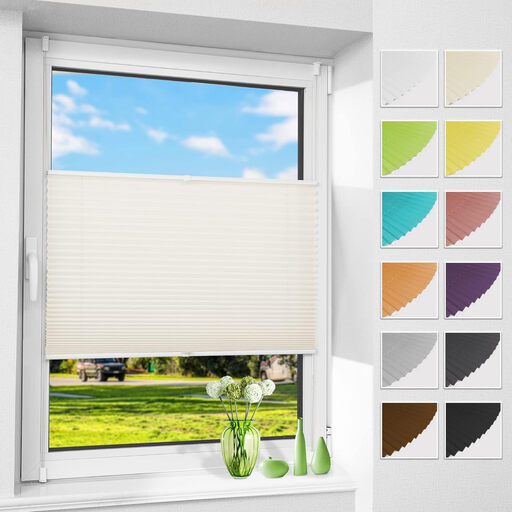
Why this product suits this type of buyer: The adjustable brackets and top and bottom handles make it practical for frequently used windows in kitchens, bathrooms or offices.
The manufacturer clearly states where it shouldn’t be used: it isn’t suitable for roof windows, wooden windows or sliding windows. Checking this helps you avoid an unsuitable fitting.
Polyester fabric, wipe-clean care with a damp cloth and brackets for frame thicknesses of 10–23 mm.
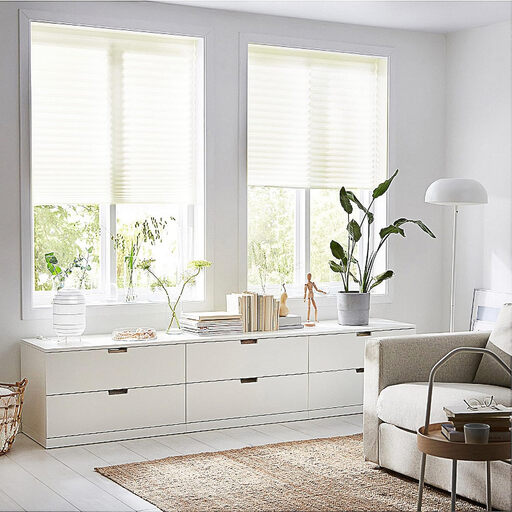
Why this product suits this type of buyer: The longer design is suitable for tall windows, balcony doors or patio doors, provided the frame measurements and fitting surface are right.
The product description explains that the fabric filters light rather than making the room completely dark. This sets realistic expectations for its sun protection.
75 × 200 cm size, four adhesive brackets included and a choice of beige, white, light grey or anthracite.
We’ve put together a complete, regularly updated list of products that meet these strict selection criteria and the safety regulations in force in the EU.
It depends on the design and the window frame. Models with suitable clamp brackets can stay attached to the frame when the window is tilted open. Check the frame thickness first, and make sure the blind won’t hit the wall or handle.
This depends on the adhesive, the surface and how long the brackets have been in place. A clean, smooth surface improves adhesion, but doesn’t guarantee residue-free removal in every case. Follow the manufacturer’s instructions and remove the brackets carefully.
White pleated blinds create a bright, neutral look, but may show dirt more easily. Beige pleated blinds often work well with warm interior colours. Anthracite pleated blinds create more contrast and can suit modern interiors. What matters most is the fabric, the measurements and how much light passes through—not just the colour.