
Lieferung heute & morgen

Qualitätsgarantie

Willkommens-Angebote freischalten: KOSTENLOSE Lieferung | Bis zu 80 % RABATT | Kostenlose 30-Tage-JoyPlus-Testphase
App herunterladen
A no-drill pleated blind is ideal for rented homes, offices and rooms where window frames or walls need to remain undamaged. Depending on the model, installation is carried out using adjustable clamp brackets or adhesive holders. However, not every pleated blind is suitable for every window. Incorrect measurements, an unsuitable frame or the wrong level of light transmission can cause the product to sit crookedly, swing when the window is tilted or fail to provide the desired privacy.
That is why the Joybuy Product Recommendation Officer selection focuses on clear, practical criteria: installation method, frame thickness, dimensions, fabric properties and intended use.
With a 60x120 cm pleated blind or an 80x120 cm pleated blind, the first number usually indicates the width and the second the height. However, it is important to check whether the measurements refer to the fabric size, the product size or the area of window that needs to be covered.
Before placing your order, you should therefore check the following:
Some models are selected according to the width of the glass, while others require an allowance of several centimetres. The specifications are not identical for every product.
A honeycomb thermo pleated blind can affect light and heat transmission differently from a simple light-filtering pleated blind. However, this does not automatically mean complete blackout. Side gaps between the fabric and the window frame may still allow light through.
If you want to keep a bedroom as dark as possible, look specifically for a blackout pleated blind with opaque fabric. For living rooms, kitchens or offices, a semi-transparent sun protection pleated blind is often sufficient. It allows daylight into the room while reducing glare.
Many clamp-fit systems are designed for a specific range of frame thicknesses. Several of the models listed here are suitable for frame thicknesses of 10–23 mm. If the frame is narrower or wider, the clamp brackets may not sit securely.
Installation is often straightforward on uPVC windows. However, depending on the product, there may be restrictions for timber windows, roof windows, sliding windows or sloping surfaces. Before buying, read the product description and installation instructions.
A pleated blind with clamp brackets is attached directly to the window frame. This solution is particularly suitable for tenants because it normally requires no drilling. The clamp brackets should be adjustable and compatible with the frame thickness.
Adhesive holders require a clean, dry and preferably smooth surface. Adhesion may be limited on rough, dusty or damp surfaces. For a pleated blind for doors, you should also check whether the fixing will remain secure when the door is opened and closed frequently.
The different descriptions should be understood in practical terms:
A light-coloured privacy pleated blind for an office can be a sensible choice if you want to keep the room bright. For a bedroom, however, an opaque or blackout model is usually more suitable.
Polyester is the predominant textile material among the products listed. It can usually be cleaned with a slightly damp cloth. Harsh cleaning products, abrasive sponges and excessive pulling can damage the fabric, coating or mechanism.
In homes with children or pets, operating cords should be kept out of reach. Do not pull the cord with excessive force. Also bear in mind that “water-repellent” does not mean that the product is suitable for continuous direct contact with water.
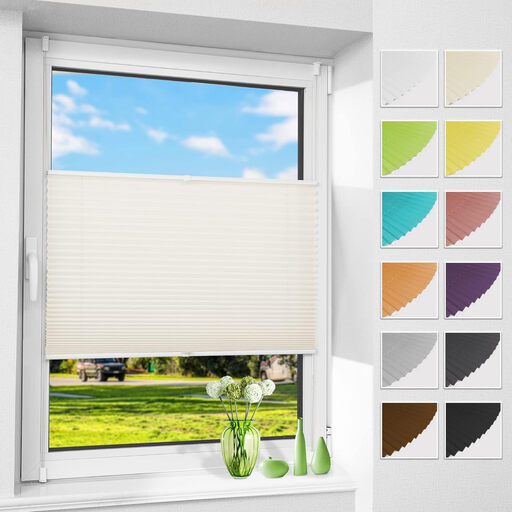
Why this product suits this profile: This light-filtering model is designed for rectangular tilt-and-turn windows and can be installed without drilling using adjustable holders.
The product specifications clearly state the 10–23 mm frame range and identify unsuitable surfaces such as roof windows, timber windows and sliding windows.
Polyester fabric, aluminium bar, clamp and adhesive installation, plus cleaning with a damp cloth.
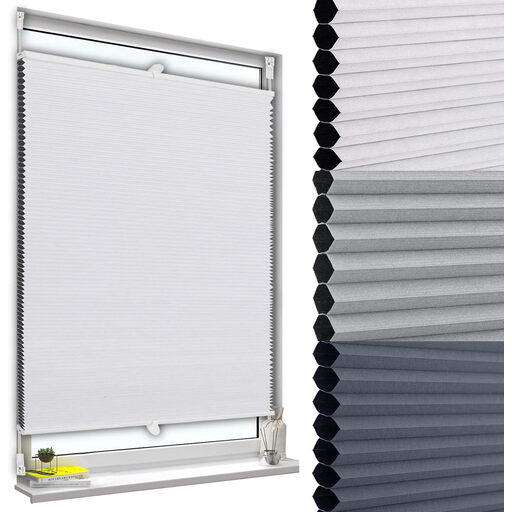
Why this product suits this profile: This double-layer honeycomb pleated blind is designed for opaque coverage and flexible light control, making it suitable for bedrooms, living rooms or offices.
The construction is described not merely as a “thermo pleated blind”, but specifically as featuring 100% polyester, a metal frame and a clamp-bracket range of 10–23 mm.
Opaque fabric, upper and lower operating handles, damp-cloth cleaning and installation on the window or door frame.
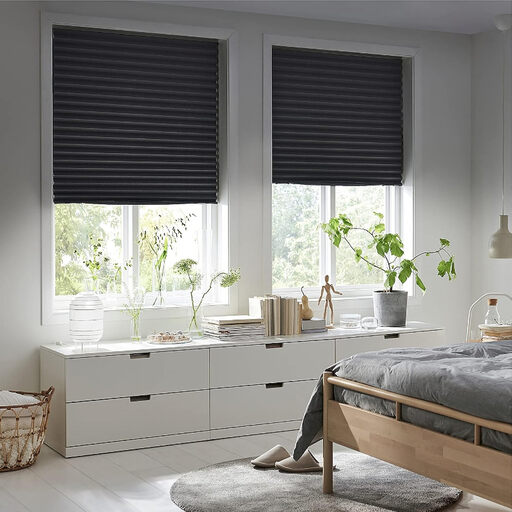
Why this product suits this profile: This model is designed for living rooms, kitchens, bathrooms, children’s rooms and offices, offering adjustable light and privacy control.
The available widths and heights are clearly listed. It also states that the product is not suitable for sloping roof windows.
Woven polyester fabric, metal frame, clamp-fit installation and operation via a sliding handle.
We have put together a complete, regularly updated list of products that fully meet these strict selection criteria and the safety regulations applicable in the EU.
For a made-to-measure pleated blind, it is particularly important to follow the manufacturer’s measurement instructions. An incorrectly ordered size cannot always be corrected by shortening or cutting it. For doors, you should also check the distance from handles and walking routes.
This depends on the installation system and the window frame. Adjustable clamp brackets can reduce swinging when they are fitted correctly and are suitable for the frame. Before buying, check whether the seller specifically states that the product can be used on tilt-and-turn windows.
There is no standard answer regarding its exact lifespan. It depends on the quality of the fabric, frequency of use, exposure to sunlight, moisture and the installation. Moving the handles gently, cleaning regularly with a damp cloth and avoiding pulling the cords can reduce mechanical strain.
A pleated blind itself does not require electricity. A thermo or honeycomb pleated blind can affect the amount of light and heat entering the room. The extent to which this affects room temperature or energy consumption depends, among other things, on the window size, glazing, orientation, fabric colour and ventilation habits. Marketing claims should therefore not be treated as a guarantee of energy savings.