
Lieferung heute & morgen

Qualitätsgarantie

Willkommens-Angebote freischalten: KOSTENLOSE Lieferung | Bis zu 80 % RABATT | Kostenlose 30-Tage-JoyPlus-Testphase
App herunterladen
By Joybuy, Joybuy Product Recommendation Officer
Are you looking for effective privacy and sun protection for your windows, but you don't want to—or aren't allowed to—drill holes into the window frames? This is a common challenge, especially in rental properties. A no-drill pleated blind offers a practical and damage-free solution. This system, often called a clamp-fit pleated blind, can be mounted directly onto the window sash without any tools.
This article will introduce you to how they work, key purchasing criteria, and a selection of models to help you make an informed decision.
Choosing the right model depends on your individual needs for light control, privacy, and ease of use. Three criteria are particularly important.
The effect a pleated blind has on a room is largely determined by its fabric properties. There are two main types:
The most common method for a no-drill pleated blind is installation using clamp brackets. This system is also known as a clamp-on pleated blind.
Precise measurements are crucial for an optimal fit and function.
Here is a collection of products that stand out for their drill-free installation and specific features.
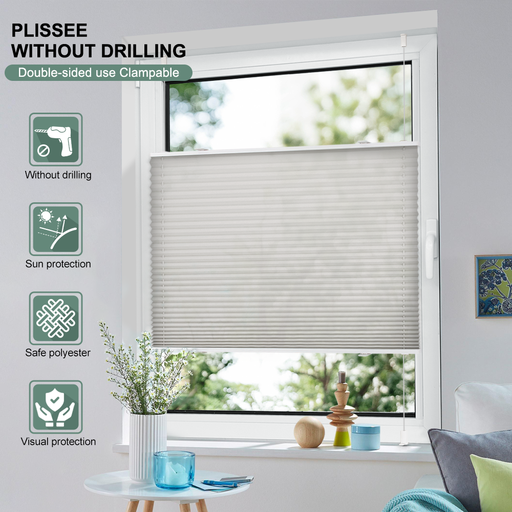
What makes it stand out: This model is designed for maximum light-blocking and privacy. The opaque fabric and clamp-fit installation make it a straightforward solution for rooms that need to be completely darkened.
Benefits:
Who it's for: Ideal for bedrooms, children's rooms, or media rooms where complete room darkening and reliable privacy are required.
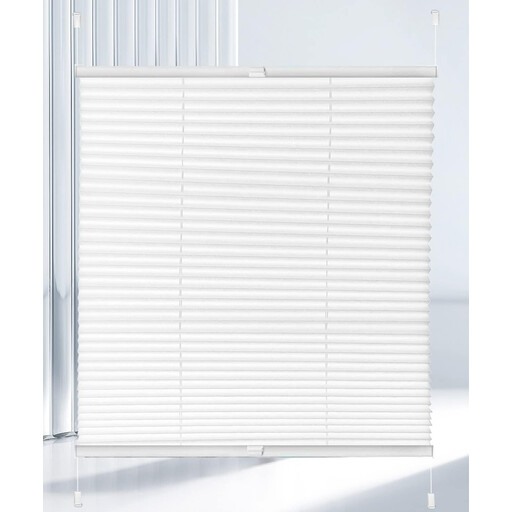
What makes it stand out: This pleated blind combines privacy with natural light. The white, light-filtering fabric creates a bright and pleasant atmosphere while shielding you from direct view.
Benefits:
Who it's for: A great choice for living areas, offices, or kitchens where privacy is desired, but the room should not be darkened.
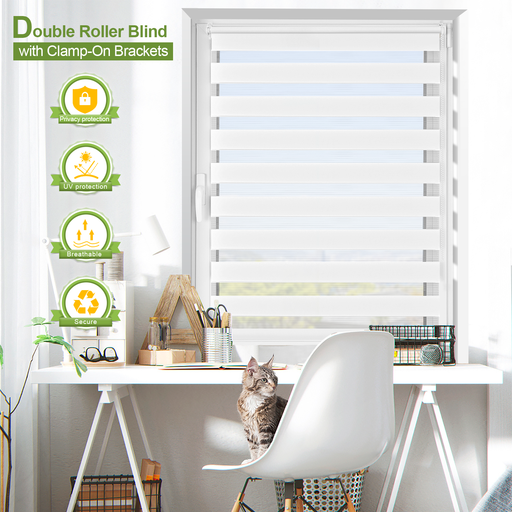
What makes it stand out: As an alternative to a classic pleated blind, this no-drill dual roller blind offers high flexibility in light control. It combines transparent and opaque fabric panels that can be adjusted against each other.
Benefits:
Who it's for: For users who want maximum control over light and privacy and are looking for a flexible solution for different times of day and situations.
Looking for a different size or a specific design? For example, if you prefer a wide selection of pure white models, you can find more products in our White Roller Blinds category.
A no-drill pleated blind is typically mounted using what are known as clamp brackets. These holders are placed over the top and bottom edges of the open window sash and secured with a tightening mechanism. The blind is then clipped into the brackets. This process is completely reversible and does not damage the frame or the seal.
When installed correctly on a suitable window sash (usually uPVC windows), clamp brackets provide a secure and stable hold for daily use. The brackets are designed to clamp firmly onto the frame. The window can still be tilted and opened as normal.
The main difference lies in their construction and light control. A pleated blind (also called a folding blind) consists of a single piece of fabric folded into pleats, which compresses like an accordion. A dual roller blind, on the other hand, consists of two parallel layers of fabric with alternating transparent and opaque stripes. By shifting these layers, you can precisely control the amount of light coming in, which is not possible with a standard pleated blind.