
Lieferung heute & morgen

Qualitätsgarantie

Willkommens-Angebote freischalten: KOSTENLOSE Lieferung | Bis zu 80 % RABATT | Kostenlose 30-Tage-JoyPlus-Testphase
App herunterladen
As a renter or homeowner, you often face the challenge of installing effective privacy and sun protection without damaging window frames or walls. The search for no-drill pleated blinds is therefore a logical next step. However, the market offers an overwhelming variety of products, and not all of them live up to their promises. Common shortcomings often lead to frustration and unnecessary expense. This guide will show you what to look for to make an informed decision.
The most common problems during selection are quickly identified:
no-drill blind advertised as "opaque" often still reveals silhouettes, while a so-called blackout blind doesn't completely darken the room.To avoid these pitfalls, you should check three core parameters before buying. These are crucial in determining the durability, functionality, and precise fit of your new privacy screen.
The drill-free installation, often referred to as Klemmfix, is the key feature. Here, the quality of the clamp brackets is critical. Look for adjustable clamp brackets that can adapt to different window frame thicknesses. Models made of metal or high-quality, reinforced plastic offer greater stability than simple plastic clips. Check the manufacturer's specified compatible frame thickness (e.g., 16–22 mm) and measure your window frame precisely beforehand to ensure the brackets fit without compressing the rubber seals. A no-drill blind or a pleated shade with a solid clamping system can be removed without a trace and reused.
The choice of fabric depends directly on your intended use. There are generally three levels of light transmission:
window privacy during the day but allows plenty of light into the room. In the evening, with the lights on, silhouettes are visible from the outside.blackout blind has a special coating on the back (often silver-coloured) that blocks almost all light.A thermal blind also features such a coating. In the summer, it reflects the sun's rays and acts as sun protection, while in the winter, it provides an additional layer of insulation against the cold.
A frequent mistake is confusing the order width with the fabric width. The fabric width is always narrower than the specified total or order width because the side brackets and mechanism require space. The difference is typically around 3 to 5 cm.
Pro Tip: Measure the width of the glass pane. To minimise light gaps on the sides, the fabric width should overlap the glass by about 2 cm on each side. Therefore, calculate: Glass Width + 4 cm = Recommended Fabric Width. Then, check which order width corresponds to this fabric width. Make sure the blind does not interfere with the window handle.
Based on the criteria mentioned, we have identified products that provide suitable solutions for specific user profiles.
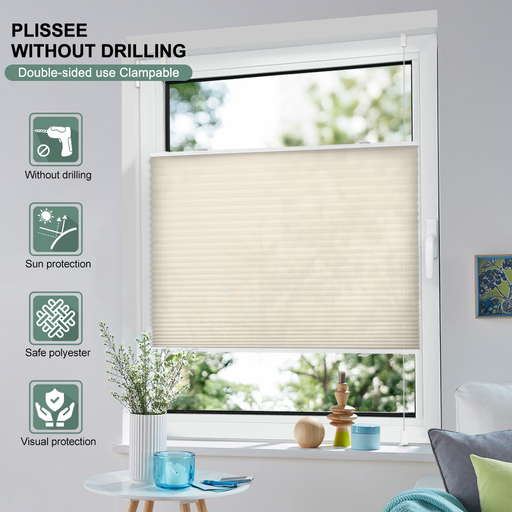
Why This Fits Their Persona: A straightforward and functional solution for standard windows in rental properties. It provides reliable privacy and sun protection without requiring permanent alterations to the window. The installation is tool-free and can be completed quickly.
The Klemmfix system is designed for damage-free installation, directly addressing renters' concerns about damaging the window frame. The fabric is classified as opaque, offering solid privacy.
Tool-free Klemmfix installation; opaque polyester fabric for good privacy while still allowing some light to filter through.
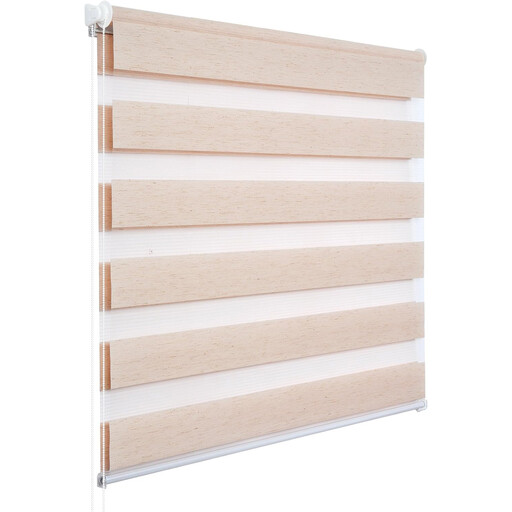
Why This Fits Their Persona: This `no-drill double roller blind` combines functionality with appealing aesthetics. The wood-look finish adds a warm accent, while the alternating fabric strips allow for flexible control over light and privacy—ideal for living rooms and home offices.
Instead of a rigid "all-or-nothing" solution, the duo-roller mechanism offers continuous adjustment. This avoids the common problem of simple blinds letting in either too much or too little light.
Infinitely variable light control via two parallel fabric panels; optional installation with or without drilling; chain pull can be mounted on either side.

Why This Fits Their Persona: This blind is designed for maximum light reduction and thermal insulation. It creates a dark, quiet environment that is highly valuable for bedrooms, children's rooms, or for shift workers who need to sleep during the day.
The silver-coated backing ensures nearly 100% blackout performance, going far beyond just being "opaque." This prevents the issue of blinds advertised as "blackout" still letting in disruptive light.
Effective blackout performance from a special silver coating; added thermal insulation to help regulate room temperature; OEKO-TEX certified polyester material.
We have compiled a complete, up-to-date list of products that fully meet these strict selection criteria and safety standards.
The lifespan heavily depends on the quality of the components. A model with sturdy clamp brackets made of metal or reinforced plastic and a tear-resistant polyester fabric can last for several years with normal use. Inexpensive models with simple plastic parts tend to become brittle after one or two seasons, especially with heavy sun exposure.
No. Most Klemmfix blind systems are designed for modern uPVC windows with a specific frame thickness (e.g., 10-23 mm). They are often not suitable for wooden windows, fixed-pane windows, or skylights. Always measure the thickness of your window sash (the movable part of the window) and compare it with the manufacturer's specifications before you buy.
Although the terms are often used interchangeably, there is a distinction. Every thermal blind is typically also a blackout blind, as the heat-reflective coating also blocks light. However, not every blackout blind is automatically a thermal blind. A simple blackout blind might be made of a thick, dark fabric that blocks light effectively but lacks special insulating properties. For effective temperature regulation, a model with an explicit thermal coating is the better choice.