
Lieferung heute & morgen

Qualitätsgarantie

Willkommens-Angebote freischalten: KOSTENLOSE Lieferung | Bis zu 80 % RABATT | Kostenlose 30-Tage-JoyPlus-Testphase
App herunterladen
Installing sun protection on windows and doors often presents a challenge for both renters and homeowners: drilling holes in window frames or walls is frequently undesirable or contractually forbidden. A no-drill pleated blind offers a practical and damage-free solution. This article serves as a guide to help you find the right option for your needs, from simple installation to specific features like blackout or thermal protection.
The selection is vast, but a few criteria are crucial for the functionality and longevity of your new privacy screen.
The most common method for drill-free installation is the clamp-fit pleated blind. This involves clamping adjustable brackets directly onto the window sash. This method is suitable for most uPVC windows that can be opened (tilt-and-turn windows). Pay attention to the specified compatible frame thickness, which is typically between 10 and 23 mm.
An alternative, especially for fixed glazing, skylights, or smooth surfaces on balcony doors, are pleated blinds with suction cup attachments. These are mounted directly onto the glass pane and offer high flexibility, but they depend on a smooth, clean surface.
Different fabrics are suitable depending on the room and your requirements.
Precise measurements are essential for the pleated blind to fit and function optimally. For clamp-fit systems, measure the width of the glass pane and add about 1.5 to 2 cm on each side to cover the side light gaps. The height should correspond to the entire height of the window sash. Always follow the specific measurement instructions provided by the manufacturer.
Here is a selection of models that cater to different needs—from complete blackout to flexible solutions for special windows.
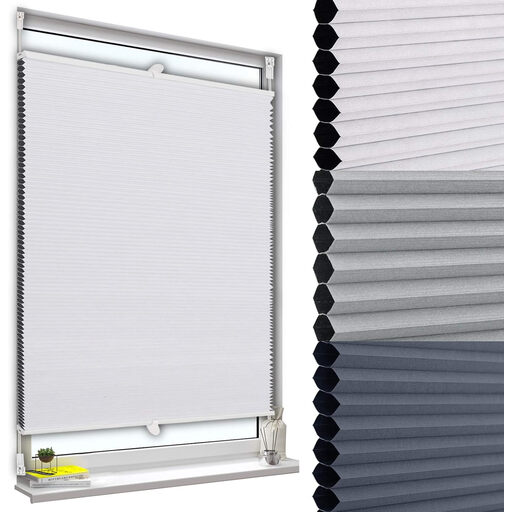
Why it stands out: This model combines multiple functions in one product. The honeycomb blind structure with an integrated aluminium coating provides a 100% blackout effect, according to the manufacturer, while also offering thermal and sound-insulating properties. The two-tone design (coloured inside, white outside) ensures a discreet exterior appearance.
Advantages:
Who is it for? Ideal for users who want complete darkness and improved room temperature control in bedrooms, children's rooms, or rooms with high sun exposure.
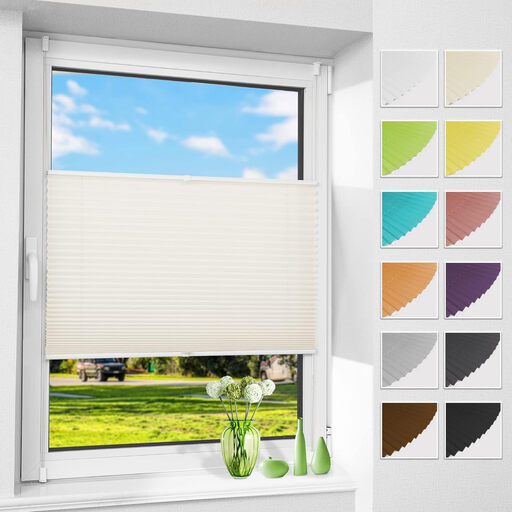
Why it stands out: The Allesin pleated blind focuses on quick, uncomplicated installation and effective privacy and glare protection without completely darkening the room. According to the manufacturer, its patented brackets allow it to be installed in just 60 seconds and removed just as easily without leaving any residue.
Advantages:
Who is it for? A great choice for living rooms, offices, or kitchens where privacy and glare protection are desired, but natural daylight should be preserved. Especially practical for renters due to its easy and residue-free removal.
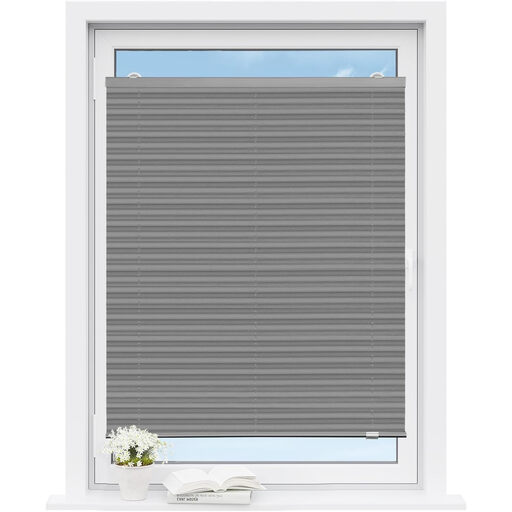
Why it stands out: This pleated blind for windows and doors solves a common problem: installation on windows that don't open or on unconventional glass surfaces. By attaching directly to the pane with strong suction cups, no frame is needed for installation.
Advantages:
Who is it for? The ideal solution for renters or homeowners with fixed-pane windows, conservatories, or sloped ceilings where a clamp-fit installation is not possible. It is also well-suited for temporary sun protection.
The products featured here cover common use cases. However, if you are looking for specific solutions for doors or other formats, you may find the right model in our broader selection.
Discover More Pleated Blinds for Doors and Windows
1. How does a no-drill pleated blind hold securely? A clamp-fit pleated blind is secured to the top and bottom of the window sash with adjustable brackets. The tension of the cords ensures that the blind stays in place even when the window is tilted. Models with suction cups adhere directly to the clean glass pane through a vacuum seal.
2. Can a clamp-fit pleated blind be installed on any window? No, clamp-fit systems are primarily designed for uPVC windows that can be opened (tilt-and-turn windows). They are generally not suitable for wooden windows, sliding windows, or fixed-pane windows. Always check the maximum frame thickness specified by the manufacturer.