
Lieferung heute & morgen

Qualitätsgarantie

Willkommens-Angebote freischalten: KOSTENLOSE Lieferung | Bis zu 80 % RABATT | Kostenlose 30-Tage-JoyPlus-Testphase
App herunterladen
By Joybuy Product Recommendation Officer, 28 July 2026
The search for the right privacy and sun protection for rented apartments or new builds often ends in a dilemma: drilling is discouraged or even forbidden, yet the windows urgently need covering. A no-drill clamp-fit pleated blind seems to be the ideal solution. It promises simple installation, effective protection, and a modern look without leaving permanent damage.
However, the market is flooded with products of widely varying quality. Before you make a hasty decision that ends in frustration and wasted money, it's crucial to know the most common pitfalls.
Many products promise more than they can deliver. Watch out for these three typical flaws to avoid a bad investment:
To avoid these problems, you should check three core parameters. These will help you identify a functional and durable product.
The mounting method is the heart of any drill-free system. The most common method is clamp-fit, where adjustable brackets are clamped onto the window sash.
The fabric largely determines the function. Choose it to match the room and your needs.
A good clamp-on pleated blind can be positioned flexibly. Most models are tensioned and can be moved freely using handles on the top and bottom rails. This allows you to place the privacy screen exactly where it's needed—whether just in the lower third of the window or in the middle. Alternatively, there is the no-drill dual roller blind, which is operated by a side chain mechanism and allows for infinitely variable light control through two opposing fabric panels.
Based on these criteria, we have identified several products that offer a suitable solution for different user profiles.
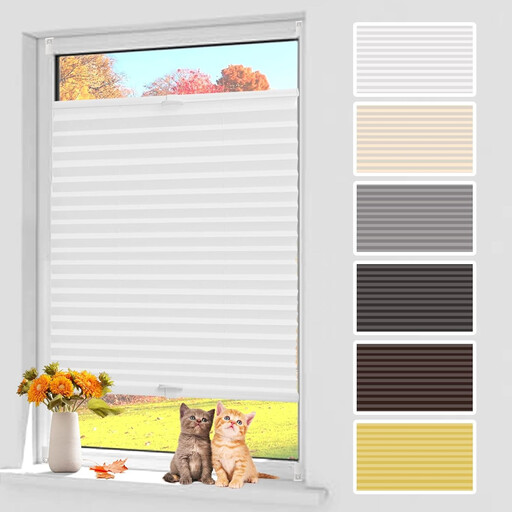
Why this product is a good fit: Ideal for students or a first apartment when a straightforward and cost-effective no-drill blackout solution is needed. The adhesive mount installation is simple and leaves no marks.
The product relies on a simple adhesive system, avoiding the complexity of potentially fragile clamp mechanisms. It focuses on one core function (blackout) and delivers it reliably.
Very low purchase price and a completely damage-free installation that is straightforward even for beginners.

Why this product is a good fit: Perfect for bedrooms and living rooms where thermal regulation and some noise reduction are important in addition to blackout functionality. The honeycomb structure offers tangible added value for home comfort.
The honeycomb blind design offers demonstrable thermal benefits, unlike simple fabrics with exaggerated marketing claims. The clamp-fit system is designed for a specific frame thickness range (10–23 mm), which minimises fitting issues.
Effective thermal insulation and sound dampening due to the honeycomb structure, combined with a reliable blackout function.
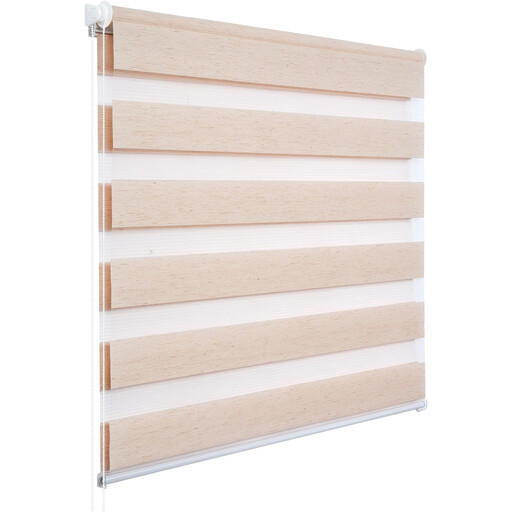
Why this product is a good fit: Provides the precise light control needed to prevent glare on screens while maintaining a bright workspace. The wood-look finish adds a warm atmosphere to the room.
This no-drill dual roller blind allows for granular light adjustment, bypassing the problem of simple fabrics that are often either too bright or too dark. The chain mechanism is a proven and reliable operating system.
Highly flexible light control via alternating transparent and opaque fabric strips, combined with a modern aesthetic.
We've compiled a complete, up-to-date list of products that fully meet these strict selection criteria.
Measure the width of the glass pane and add about 2 cm to each side to ensure an overlap and minimise light leakage from the sides. The resulting order width should not obstruct the window handle. For the height, measure the height of the entire window sash. Always follow the manufacturer's specific measurement instructions, as there can be variations.
The lifespan depends heavily on the material (metal is more durable than plastic) and the frequency of use. High-quality, adjustable clamp brackets mounted on a suitable window frame (usually with a thickness of 10–23 mm) can last for many years. However, they may reach their limits with very heavy or oversized installations.
Standard clamp-fit systems are primarily designed for modern uPVC windows. They often do not fit on older or very wide wooden window frames, or they may damage the surface. For wooden windows, a no-drill blind with a high-quality adhesive system is often the better and safer alternative.