
Lieferung heute & morgen

Qualitätsgarantie

Willkommens-Angebote freischalten: KOSTENLOSE Lieferung | Bis zu 80 % RABATT | Kostenlose 30-Tage-JoyPlus-Testphase
App herunterladen
A no-drill pleated blind with Clip-Fix fittings is particularly suitable for rented homes, children’s bedrooms or rooms where window frames and walls should remain permanently undamaged. Installation initially seems straightforward: attach the clip brackets, insert the pleated blind and adjust the height. In practice, however, problems are often caused by incorrect measurements, unsuitable frames or an unsuitable level of light transmission.
This buying guide explains what to look out for when shopping and which versions are suitable for different uses.
A common mistake is to use only the visible width of the glass. Depending on the installation method, the pleated blind needs to be slightly wider so that it provides sufficient privacy across the glass area. According to the product information, some Dream-seeker models recommend adding around 4 cm to the glass width. For glass measuring 51 cm wide, this would mean ordering a width of 55 cm.
Other systems are selected directly according to the frame width. That is why the relevant installation instructions are so important. There is no universal measurement formula for every Clip-Fix pleated blind for windows.
A light-filtering pleated blind filters daylight and can reduce glare and unwanted views. A blackout pleated blind, on the other hand, uses a denser fabric. Even so, light can still enter through gaps at the sides of the frame. Terms such as ‘light-filtering’, ‘dim out’ or ‘blackout’ should therefore be considered alongside the fabric, frame coverage and installation method.
For bedrooms and children’s rooms, a privacy fabric that cannot be seen through is usually more suitable. In a study or living room, a light-filtering pleated blind may be a sensible choice if you want to retain natural daylight.
Clip brackets require a suitable frame projection and the correct frame thickness. One Dream-seeker model with adjustable clip brackets, for example, specifies a frame thickness of 10 to 23 mm. According to the product description, the WOLTU honeycomb model is also designed for frame thicknesses of 10 to 23 mm.
Adhesive fittings have different requirements: the surface must be clean, dry, smooth and free from grease. Adhesion may be limited on rough, damp or uneven surfaces.
First measure:
For doors, check that the pleated blind will not catch on the handle when opening and closing. A pleated blind for doors also needs a secure fitting and must not extend over moving hardware.
Sloping or roof windows are not automatically suitable. Several of the models listed specifically exclude use on sloping surfaces.
A classic pleated blind with clip brackets is attached to the window rebate and can often be removed again. This is practical for tenants, but it requires a suitable frame.
Adhesive brackets are suitable for smooth, dry frame surfaces and may leave residue when removed, depending on the surface underneath. Suction cups are primarily designed for smooth glass or tiled surfaces. According to the product information, the WOLTU model with suction cups is not suitable for textured walls.
Polyester fabric is widely used in the products mentioned above. It can generally be cleaned with a slightly damp cloth. Avoid soaking it completely, using harsh cleaning products or scrubbing with abrasive sponges.
Also consider how the blind is operated: top and bottom handles allow flexible positioning, while other versions are adjusted using a cord or by changing the handle height. For products with cords, follow the safety instructions. Keep operating elements away from children and check the fittings regularly.
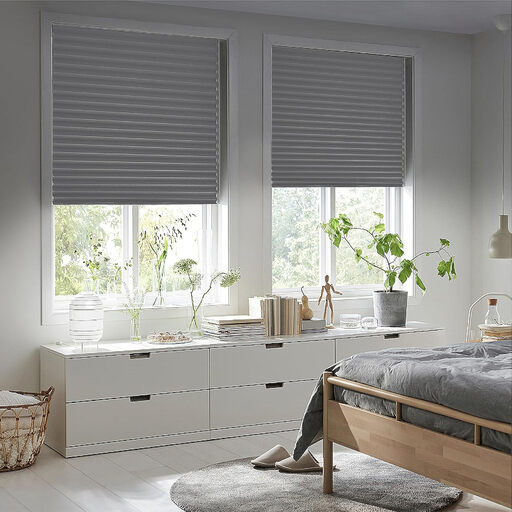
Why this product suits the profile: Its compact size and adhesive brackets are suitable for smaller standard windows in rented homes, kitchens or studies.
The product information specifies exact order sizes, 4 adhesive brackets and cleaning with a damp cloth. This allows you to check the installation and care requirements in advance.
75 x 100 cm, light grey polyester fabric, height-adjustable and installable without drilling.

Why this product suits the profile: Its double honeycomb structure and adjustable clip brackets are designed for rooms where light control and a dense fabric are the main priorities.
The product description distinguishes the opaque fabric from a merely dimming material and specifies a frame range of 10 to 23 mm.
Polyester honeycomb pleated blind, metal frame, operated using top and bottom handles, dimensions 50 x 130 cm.
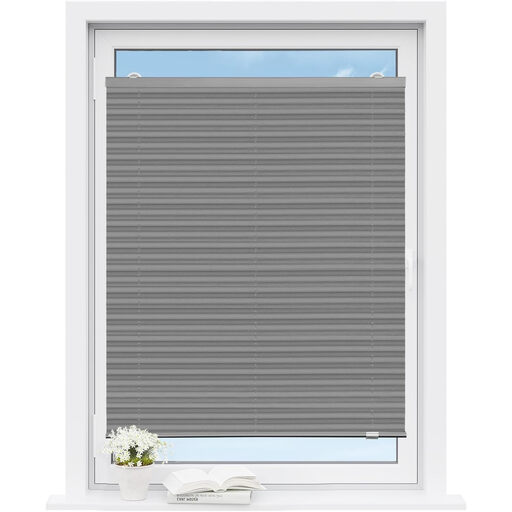
Why this product suits the profile: Suction-cup installation is an appealing option for smooth glass surfaces, balcony doors or certain indoor areas when you need a removable solution.
The product information limits use to smooth surfaces and specifies a semi-transparent version. This prevents it from being mistaken for a blackout pleated blind.
Suction cups, polyester fabric, UV filtering of 70 per cent according to the product information, and suitable for glass or tiles.
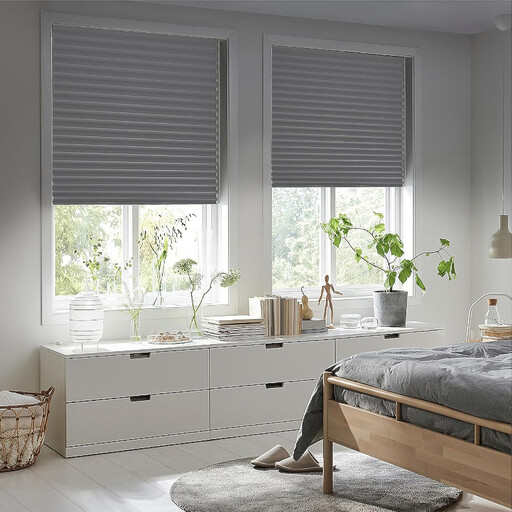
Why this product suits the profile: The 200 cm height also covers tall window or door areas, provided the width and installation area match your measurements.
The product description recommends cleaning the surface before installation and operating the blind carefully. This helps to prevent common adhesion and fabric damage.
75 x 200 cm, semi-transparent polyester fabric, Clip-Fix or adhesive installation, designed for windows and doors.
A no-drill roller blind is not suitable for every surface. Adhesion and materials may be affected on textured walls, in damp areas or where there is direct contact with water. For bathrooms, the product should be specifically designed for this environment; moisture-resistant does not mean waterproof.
We have put together a complete, regularly updated list of products that fully meet these strict selection criteria and the safety regulations applicable in the EU.
Depending on the model, it is attached to the window frame using clip brackets, to a smooth surface with adhesive fittings or to the glass using suction cups. Before buying, check the frame thickness and surface against the manufacturer’s specifications.
Its lifespan depends, among other things, on the installation surface, exposure to sunlight, moisture and how it is operated. Check adhesive holders and clip brackets regularly. If the adhesion weakens or the pleated blind moves, the fitting should be reinstalled or replaced.
A dense blackout pleated blind significantly reduces the amount of light entering the room. However, light may still pass through gaps between the fabric and the frame at the sides. For the lowest possible brightness, you need the correct measurements, sufficient frame coverage and a suitably dense fabric.