
Lieferung heute & morgen

Qualitätsgarantie

Willkommens-Angebote freischalten: KOSTENLOSE Lieferung | Bis zu 80 % RABATT | Kostenlose 30-Tage-JoyPlus-Testphase
App herunterladen
A no-drill pleated blind with clamp brackets is a practical choice for rented homes, owned properties and temporary living arrangements. It attaches to the window frame without plugs or drill holes. However, not every clamp-fit pleated blind will be the right fit. Incorrect measurements, unsuitable frames or unclear information about how much light the fabric lets through can quickly take the shine off your purchase.
As Joybuy Product Recommendation Officer, I’ve sifted through the key details to show you what really matters when choosing a no-drill pleated blind for your windows and doors.
Many people only measure the visible glass or use an existing curtain as a guide. But with a pleated blind fitted using clamp brackets, it’s important to consider which area you want to cover and how much space the window frame provides.
For several Dream-Seeker models, it’s recommended that you choose a blind around 4 cm wider than the glass. For example, if the pane is 51 cm wide, a 55 cm blind may provide better coverage at the sides. Other systems, however, are sized according to the frame width. So check the product’s specific measurements before placing your order.
Terms such as ‘privacy’, ‘light-filtering’ and ‘blackout blind’ describe different features:
So if you’re looking for a pleated blind for a bedroom or child’s room, don’t rely on the word ‘blackout’ alone. Consider the width, coverage at the sides and fitting position too.
A clamp-fit pleated blind needs a suitable frame. Requirements vary between models. For example, the WOLTU clamp-fit system featured below is specified for frame thicknesses of 10 to 23 mm. Other versions are only suitable for smooth surfaces when fitted with adhesive brackets.
Fitting may be restricted on wooden windows, angled windows, roof windows, sliding windows or rough surfaces. Before you buy, check the frame shape and thickness, seals, handles and opening clearance.
Use a metal tape measure and take measurements at several points. If the frame is uneven, note the smallest relevant width. For products with clamp brackets, position the blind so that window handles and any protruding parts aren’t obstructed.
For many models, the height should match the full window or door area. A blind with extra height is usually fine if the fabric can be moved up and down freely. Only trim a pleated blind if the manufacturer explicitly says it can be shortened.
A light-filtering pleated blind can be a good choice for a living room, home office or kitchen if you want to keep some natural light. For workspaces with screens, it’s also worth considering glare. Dark fabric may feel more effective at darkening a room, but its colour alone doesn’t tell you how much light it technically blocks.
For bedrooms, consider privacy or room-darkening options. In a bathroom, check that the product details describe the fabric as moisture-resistant. This doesn’t automatically mean it’s waterproof or suitable for prolonged exposure to direct water.
Clamp-fit brackets attach to the window sash. Adhesive brackets need a clean, dry and preferably smooth surface. Suction cups are best suited to smooth surfaces such as glass or tiles, and may be affected by dust, condensation or changes in temperature.
The operating mechanism matters too: some blinds have a pull cord, while others use handles at the top and bottom. For corded blinds, check that the cord can be secured safely and follow the child-safety guidance.
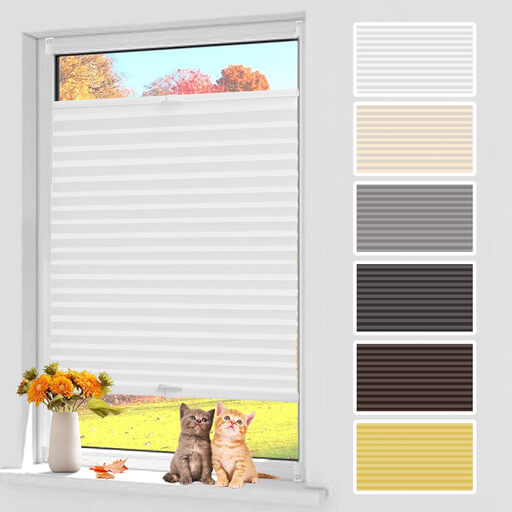
Why it suits this need: Its compact size is suitable for smaller standard windows in rented homes, offices or kitchens. According to the product description, it can be fitted without tools using the clamp-fit system.
The product dimensions are clearly stated as 60 × 100 cm. You’ll still need to check the frame width and maximum clamp thickness before ordering.
Polyester fabric, adjustable light and privacy control, and a stated product weight of 370 g.

Why it suits this need: Its honeycomb structure and top-and-bottom operation will appeal to anyone looking for precise light control in a bedroom, living room or workspace.
The stated frame thickness of 10–23 mm makes the fitting requirements clear. According to the description, this blind isn’t designed for roof windows.
100% polyester according to the product details, a metal frame, clamp-fit installation and smooth adjustment using two handles.
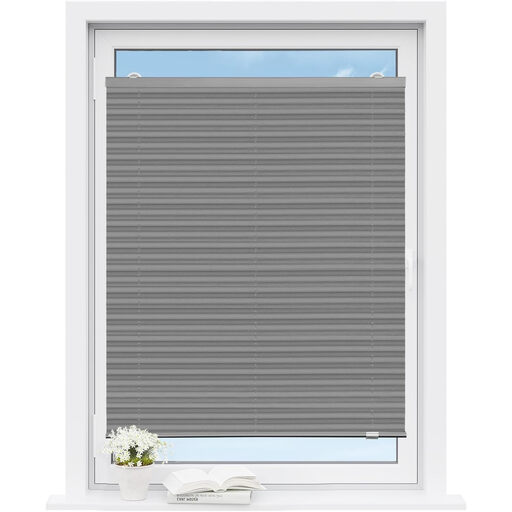
Why it suits this need: Suction cups are an option for smooth glass or tiled surfaces, such as balcony areas, rooflights or windows where clamp brackets aren’t suitable.
The product details clearly state that it’s suitable for smooth surfaces and not for textured walls. The surface must be clean and dry before fitting.
Adjustable width of 50–90 cm according to the product details, light-filtering grey fabric and no-drill installation.
We’ve put together a complete, regularly updated list of products that meet these strict selection criteria and fully comply with the safety regulations in force in the EU.
Depending on the design, you can use clamp brackets, adhesive brackets or suction cups. Clamp brackets attach to the window frame, while adhesive brackets need a smooth, clean surface. Suction cups are mainly intended for smooth glass or tiled surfaces.
Its lifespan depends on the fabric, how often it’s operated, exposure to sunlight and how securely the brackets are fitted. Regularly checking the clamp or adhesive fittings and moving the blind carefully can help keep it in good working order. You can’t determine its lifespan from the fitting method alone.
Yes, according to the product details, some models are designed for windows and doors, including balcony or glass doors. Before buying, check how the door opens, the available frame space, handle position and width. If the door is used frequently, make sure the blind is especially securely fitted.