
Lieferung heute & morgen

Qualitätsgarantie

Willkommens-Angebote freischalten: KOSTENLOSE Lieferung | Bis zu 80 % RABATT | Kostenlose 30-Tage-JoyPlus-Testphase
App herunterladen
Renting an apartment in Germany often means looking for window dressings that avoid drilling into uPVC or timber frames. Klemmfix pleated blinds solve this challenge by clipping directly over the window sash or securing via adhesive strips. Because these blinds sit directly on the moving casement, taking accurate measurements prior to purchase is essential. Even a minor calculation error can leave visible gaps on either side of the glass or cause the fabric to catch repeatedly on the window handle whenever you tilt or open the window.
Achieving an accurate fit requires measuring the visible glass width, calculating the ideal fabric overhang, and verifying clearance around protruding hardware. Alongside width and drop calculations, you must check your window rebate depth and decide whether a room calls for gentle daylight diffusion or comprehensive thermal blackout. This guide walks through the critical measuring principles, common fitting pitfalls, and practical product configurations for your home.
The most frequent measuring mistake is adding a generous overhang to cover the rubber seal without checking the distance to the window handle. If the fabric extends too close to the handle spindle, the pleated material will crush or rub every time the window is turned from closed to tilted. Always measure the distance from the glass edge to the handle base before finalising your width, leaving at least 1 cm of clear operational space.
Clamp brackets require a movable window sash to slide over the top and bottom rebate edges. Fixed-frame glazing, which does not open, provides no rebate for the clamp to grip. Attempting to force clamp brackets into non-opening windows damages the rubber gasket and prevents a secure hold. For non-opening glass sections, select pleated blinds that support frame-mounted adhesive baseplates instead.
Ordering a blind based on the outer perimeter of the window casement results in a blind that is far too wide. The tension cords will fail to sit vertically, and the brackets will interfere with the window reveal or surrounding masonry. Klemmfix blinds are designed to cover the glass pane plus a modest margin, not the entire structural frame. Always start your measurement strictly from the edge of the transparent pane.
Determining blind width requires balancing complete edge-to-edge glass coverage with unobstructed window handle operation.
Clamp mechanisms rely on standard continental window profiles to anchor properly without pinching rubber weather seals.
Select the textile construction based on whether the primary goal is glare control in daytime spaces or light elimination for rest.
These reliable drill-free pleated and roller blinds accommodate standard apartment casements, home working spaces, nurseries and tall balcony doors.
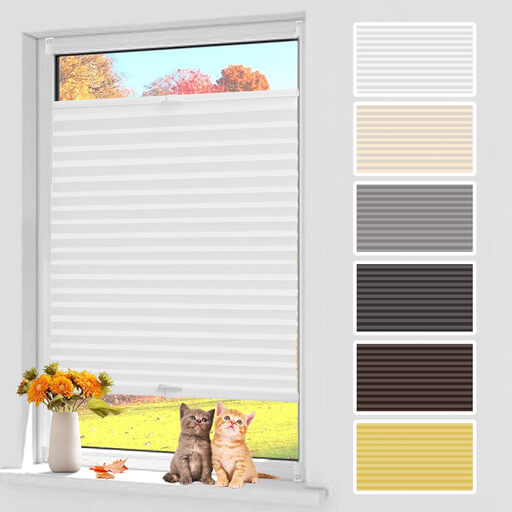
Why This Fits Their Persona: Tailored for smaller casements in compact flats, this 60 x 100 cm white pleated blind mounts without tools using either clamp brackets or adhesive strips. Its opaque 370 g polyester fabric stops bright morning light while fitting standard small-format window glass neatly.
The moderate 60 cm width provides sufficient lateral overhang for narrow glass panes without intruding on close-set window handles often found on compact secondary windows.
Offers dual clamp and adhesive mounting options straight out of the box, giving renters flexibility across varied window frame profiles.
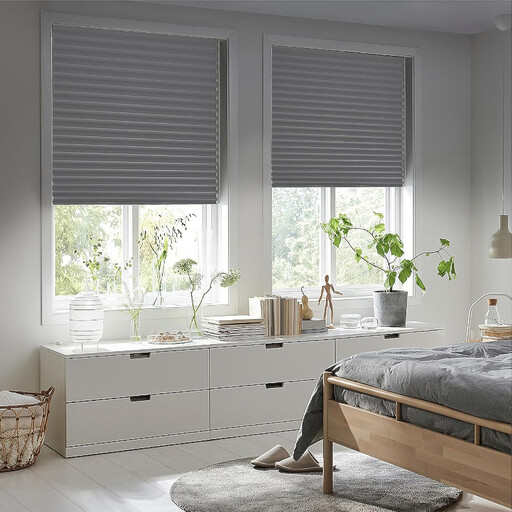
Why This Fits Their Persona: Measuring 100 x 130 cm in a modern light grey shade, this blind softens intense daylight to reduce screen glare while preserving daytime privacy in living rooms and home offices.
Unlike heavy blackout blinds that make communal rooms uncomfortably dark during working hours, this light-filtering weave maintains an airy, naturally lit environment.
The generous 100 cm width suits broad modern casements, attaching securely to opening sashes without drilling into plastic or wood frames.

Why This Fits Their Persona: This 80 x 150 cm white internal roller blind features a cordless spring-tension design that eliminates hanging operating loops, making it an ideal choice for children's bedrooms and family areas.
It eliminates the safety hazards of trailing cords while providing a dense thermal blackout surface that prevents street lighting and early sunrise from disturbing sleep.
Combines internal thermal sun shading with a tidy cordless push-pull operation that clamps directly to the window sash without drilling.

Why This Fits Their Persona: Designed with an extended 200 cm drop, this 90 x 200 cm white blackout pleated blind covers tall patio entrances, glazed terrace doors and floor-to-ceiling windows found in modern continental flats.
Standard 130 cm or 150 cm blinds leave lower door panes exposed to view, whereas this 200 cm length provides seamless vertical coverage from the upper rebate to the bottom rail.
Maintains stable cord tension across a 2-metre drop, keeping the blind close to the door leaf so it stays secure when the balcony door swings open.
The standard recommendation is to add 2 cm to 4 cm to the visible glass width, which equals an overhang of 1 cm to 2 cm on each side. This margin ensures the fabric fully covers the black rubber sealing bead to prevent light leakage while ensuring the blind does not look oversized on the casement.
You should maintain a minimum gap of 1 cm between the outer edge of the fabric and the base of the window handle. If your calculated overhang places the edge of the blind against the handle mechanism, reduce your overhang slightly so the handle can turn freely between closed, open and tilted positions.
Clamp brackets are engineered exclusively for opening inward-tilting or turn-and-tilt window sashes with a top rebate thickness between 15 mm and 25 mm. If your windows are non-opening fixed panes, feature sliding mechanisms, or have frames with rounded profiles that reject standard hooks, adhesive mounting pads are the proper alternative.