
Lieferung heute & morgen

Qualitätsgarantie

Willkommens-Angebote freischalten: KOSTENLOSE Lieferung | Bis zu 80 % RABATT | Kostenlose 30-Tage-JoyPlus-Testphase
App herunterladen
A no-drill clip-on pleated blind can quickly add privacy and sun protection to rented homes, offices and living spaces. However, unclear measurements, unsuitable mounting surfaces or misleading descriptions of light transmission can often lead to the wrong purchase. So it’s not just a question of colour or price: the right choice depends on the window measurements, fixing method, material and the level of light you want.
With some clip-on systems, the stated width includes the entire blind, including the brackets. This means the fabric itself may cover a narrower area. Check whether the seller distinguishes between overall width, fabric width and glass width.
As a useful guide, several Dream-seeker models can be ordered around 2 to 4 cm wider than the glass, depending on the design. Always check the specific product page for the exact recommendation.
A light-filtering pleated blind softens daylight and can reduce visibility from outside. It won’t automatically darken a room, though. For bedrooms, children’s rooms or rooms with direct sunlight, a blackout blind or a more opaque fabric is a different type of product.
Descriptions such as ‘semi-transparent’, ‘light filtering’ and ‘blackout’ shouldn’t be treated as interchangeable. Rooms usually stay brighter with light-coloured fabrics, such as white and light grey pleated blinds, than with blackout fabric.
Clip-on brackets need a suitable window sash and enough space on the frame. Adhesive fitting requires a clean, dry and as smooth as possible surface. Adhesion may be reduced on rough, uneven, dusty or damp surfaces.
Before fitting, also check that the window can still be opened fully and tilted. According to the product descriptions, many of the models mentioned aren’t suitable for sloping roof windows.
Measure the width of the glass pane and the height of the entire window sash or frame. For doors, also check that there’s enough clearance around the handle, seal and frame for the clip-on brackets.
When choosing a clip-on pleated blind for windows and doors, these measurements are particularly important:
One model with adjustable clip-on brackets, for example, is specified for a window frame thickness of 10 to 23 mm. Other systems require a specific frame thickness or can only be fitted with adhesive strips.
A privacy pleated blind made from light-filtering polyester fabric is a good choice for a living room, kitchen or office when you want to retain daylight. In spaces where you work at a screen, a light, diffusing fabric can reduce reflections, but it’s no substitute for planning the room around your needs.
For bedrooms or windows that get a lot of sun, choose a more opaque model or one described as blackout. Claims such as ‘100% blackout’ should be understood as the manufacturer’s or product’s description. The actual effect depends on factors including gaps at the sides, the fitting width and the brightness of the room.
Depending on the design, pleated blinds are adjusted using a handle, a cord or a combination of both. Operating the blind smoothly without pulling too hard helps protect the pleats, brackets and fabric.
Polyester is a widely used material in the products listed. It can usually be cleaned with a soft, slightly damp cloth. Still, check the care instructions for your chosen blind: some versions should only be wiped with a dry cloth, while others can be wiped clean with a damp cloth. Sharp objects, harsh cleaning products and prolonged exposure to moisture can damage the fabric.
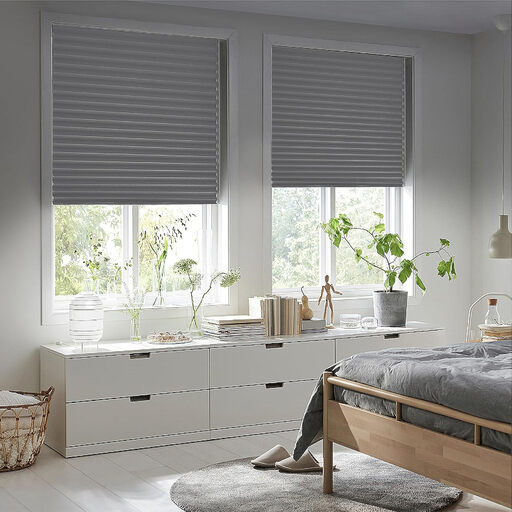
Why this product suits you: Its compact size and adjustable clip-on brackets make it suitable for smaller standard windows when you want a no-drill fitting option.
The product description makes clear that the blind is semi-transparent, so it doesn’t promise to block out all light.
80 × 100 cm, polyester, light-filtering fabric and clip-on brackets for a stated frame thickness of 10 to 23 mm.
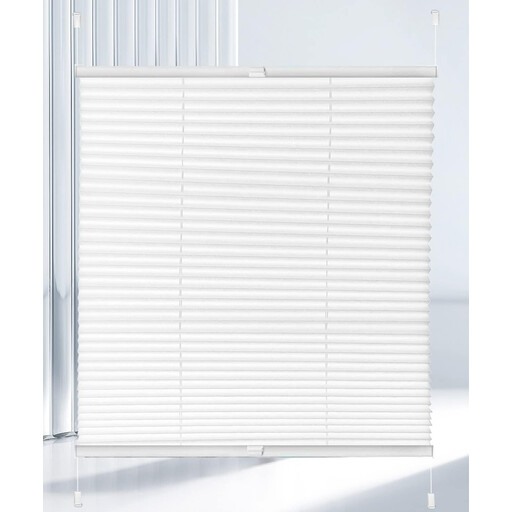
Why this product suits you: Its extra height covers tall windows or doors, while its bright finish lets in natural light.
The product details explicitly describe it as light-filtering, not as a way to black out a room completely.
80 × 200 cm, white polyester fabric, no-drill clip-on fitting and suitable for windows and doors.

Why this product suits you: This design is made for rooms where you want to block out more light and prefer cord-free operation.
The description lists clip-on and drill-mounted fitting separately, and specifies a suitable frame thickness of 16 to 22 mm.
80 × 150 cm, cord-free operation, polyester with a coated backing and two fitting options.
Why this product suits you: Its narrow size suits smaller windows, while the clip-on and adhesive brackets give you flexible fitting options.
The product details state that the surface is moisture-resistant but not waterproof, helping you understand where it can be used.
55 × 120 cm, light grey polyester fabric, clip-on system and four additional adhesive brackets, according to the product description.
If you have children at home, keep cords and small parts out of their reach. Always follow the manufacturer’s safety instructions.
We’ve put together a complete, regularly updated list of products that meet these strict selection criteria and fully comply with the safety regulations in force in the EU.
No. The door frame must be suitable for the clip-on brackets and leave enough room for movement. Adhesive fittings need smooth, clean and dry surfaces. According to the product details, many standard models aren’t suitable for sloping roof windows.
There’s no single answer. It depends on how the blind is fitted, how much sunlight it gets, how often it’s used and how it’s cleaned. Regularly checking the brackets and operating the blind carefully can help prevent premature wear.
It can provide sun protection for windows if the fabric filters direct sunlight. However, the amount of light it blocks varies considerably. A light-filtering, pleated blind lets in more daylight, while one described as blackout can darken the room more effectively. Before buying, compare the product details on the fabric, coating and light-filtering effect.