
Lieferung heute & morgen

Qualitätsgarantie

Willkommens-Angebote freischalten: KOSTENLOSE Lieferung | Bis zu 80 % RABATT | Kostenlose 30-Tage-JoyPlus-Testphase
App herunterladen
A clip-on pleated blind with no drilling is a practical choice for rented homes, people who move frequently or windows with delicate frames. However, ordering in a hurry doesn’t guarantee you’ll get the right window covering. Problems often stem not from the fabric, but from incorrect measurements, unsuitable clip-on brackets or overestimating how much light the blind will block.
This guide explains what to look for when choosing pleated blinds with no drilling, clip-on roller blinds or blackout blinds that don’t require drilling.
For many products, the stated width includes the entire assembly, including the brackets. The fabric itself may be narrower. According to the product description, the fabric on the WOLTU blackout blind is around 4 cm narrower than the overall width.
So make sure you measure:
For the best possible coverage, it’s often recommended to choose a blind around 3 to 4 cm wider than the glass. Always follow the specific fitting instructions for your model.
A privacy blind can prevent people from seeing in while still letting daylight through. Light-filtering or semi-transparent fabrics are a good choice for living rooms, kitchens and home offices, for example. For bedrooms and children’s rooms, a model specifically described as blackout is a better option.
Check the exact product description:
Clip-on brackets are usually attached to the moving window sash, so the frame thickness needs to be right. Depending on the model, they may be designed for frame thicknesses of 10 to 23 mm, 13 to 23 mm or 16 to 22 mm, for example.
Not every pleated blind for windows and doors is suitable for roof windows, sliding windows, wooden frames or angled windows. Rough or uneven surfaces can also affect how well adhesive brackets stick. Before buying, check the fitting instructions and your window’s design.
A pleated blind with clip-on brackets usually attaches to the window sash and, if removed correctly, leaves no holes. This makes it a good option for a rented home. Adhesive fittings need a clean, dry and as smooth as possible surface. According to the product description, suction cups are best suited to smooth surfaces such as glass or tiles.
If you often open or tilt your window, sturdy brackets with guides at the top and bottom are usually more practical than loosely fitted alternatives. Once installed, check that you can still operate the window fully.
Models with handles on the bottom or top rail can be adjusted to any position. The WOLTU blackout blind is raised and lowered using a handle on the bottom aluminium rail, so there’s no loose cord.
Other options use a chain or pull cord. In homes with children or pets, make sure cords and chains are secured out of their reach. Cordless operation can make a blind easier to use, but it doesn’t replace safe fitting and regular checks.
Polyester is widely used for pleated blinds and roller blinds. Depending on the design, the fabric may be light-filtering, provide privacy, repel moisture or have a coated backing. For kitchens and bathrooms, a moisture-resistant option may be useful, but this doesn’t automatically mean it’s waterproof.
For the products mentioned, care usually involves gently wiping the fabric with a damp cloth. Harsh cleaning products, vigorous rubbing and excessive moisture can damage the fabric and its coating.
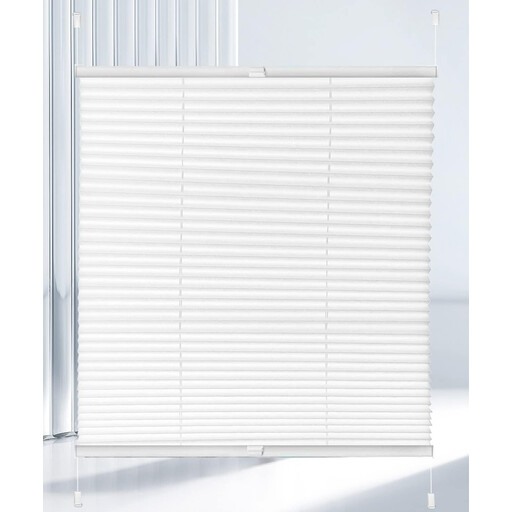
Why it suits this profile: The light-filtering fabric is suitable for living spaces, home offices and anywhere you want to retain natural daylight. It fits using clip-on brackets, with no drilling required.
The description clearly states that the fabric is “light-filtering”, so you won’t expect it to block out all the light. That makes it easier to judge what the blind will do.
Light-filtering polyester fabric and no-drill fitting for windows and doors.

Why it suits this profile: The 80 × 150 cm model combines a silver-coated backing with stated compatibility for frames measuring 16 to 22 mm thick and cordless operation.
The product details specify both the frame thickness and the difference between the overall width and the fabric width. This makes it easier to check your measurements before buying.
200 g/m² polyester according to the product description, a silver-coated backing and operation using a bottom aluminium rail.
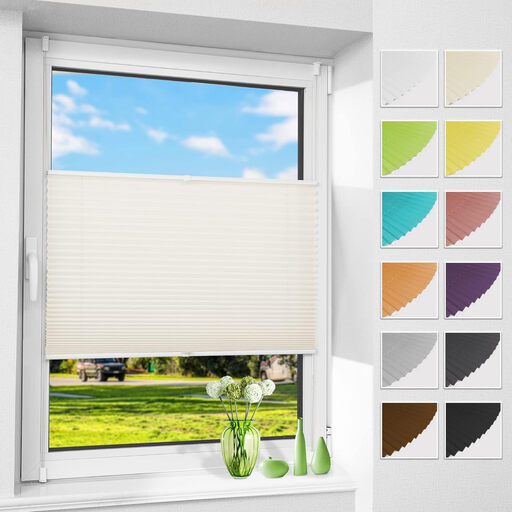
Why it suits this profile: According to the product description, the adjustable brackets fit frames measuring 10 to 23 mm thick. The light-filtering fabric is suitable for kitchens, bathrooms, home offices and living spaces.
The product details explicitly state that it isn’t suitable for roof windows, wooden windows or sliding windows. This helps you avoid fitting it to a window type it wasn’t designed for.
Adjustable clip-on brackets, handles at the top and bottom, and wipe-clean polyester fabric.

Why it suits this profile: This 50 × 130 cm honeycomb pleated blind is designed for indoor spaces such as bedrooms, bathrooms and home offices, and fits using clip-on brackets.
The stated compatibility with frames measuring 10 to 23 mm thick, along with the warning that it isn’t suitable for roof windows, makes it clear where the blind can and can’t be used.
Honeycomb structure, 100% polyester according to the product description, and smooth adjustment using handles at the top and bottom.
We’ve put together a complete, regularly updated list of products that meet these strict selection criteria and fully comply with the safety regulations in force in the EU.
For balcony doors, a longer pleated blind or a suitably sized roller blind may be a good choice. For large door panels, pay particular attention to the stability of the brackets and the space needed to operate the door handle.
How long it lasts depends on the frame thickness, fitting surface, weight of the product and how it’s used. Clip-on brackets need to be suitable for the window sash and checked regularly to make sure they’re secure. Adhesive fittings may come loose if exposed to dust or moisture, or if fitted to an uneven surface.
A model described as blackout or a blackout blind with no drilling can significantly reduce the amount of light coming in. However, light may still get in at the sides if the blind is narrower than the glass or doesn’t fully cover the window frame. By contrast, “light-filtering” means that some light can pass through the fabric.
Yes, as long as the window frame and fitting method are compatible. Clip-on blinds usually don’t require any drilling and can be removed when you move. Still, check that the window remains easy to operate, that the frame thickness is within the permitted range and that adhesive fittings won’t leave residue.