
Lieferung heute & morgen

Qualitätsgarantie

Willkommens-Angebote freischalten: KOSTENLOSE Lieferung | Bis zu 80 % RABATT | Kostenlose 30-Tage-JoyPlus-Testphase
App herunterladen
For renters or homeowners who want to avoid unsightly drill holes in their window frames, a no-drill roller blind is a practical solution. Installation is typically done using clamping or adhesive fixtures directly on the window sash. However, the market is flooded with products of widely varying quality. A poor choice often leads to unstable brackets, inadequate light-blocking, or rapid wear and tear.
This guide highlights the crucial criteria you should check before buying to find a durable and functional solution. We will shed light on the three most common pitfalls and explain how to avoid them.
Many buyers focus solely on colour and price, overlooking the technical details that determine everyday usability.
To make an informed decision, you should carefully examine three core parameters: the mounting type, the fabric properties, and the correct measurements.
The most common method is the clamp-on roller blind. With this method, brackets are simply clamped onto the top edge of the window sash.
The choice of fabric determines how well the blind blocks light, prying eyes, and heat.
To avoid light gaps on the sides, precise measurement is essential.
Here are some product recommendations tailored to specific user profiles that meet the quality criteria mentioned above.
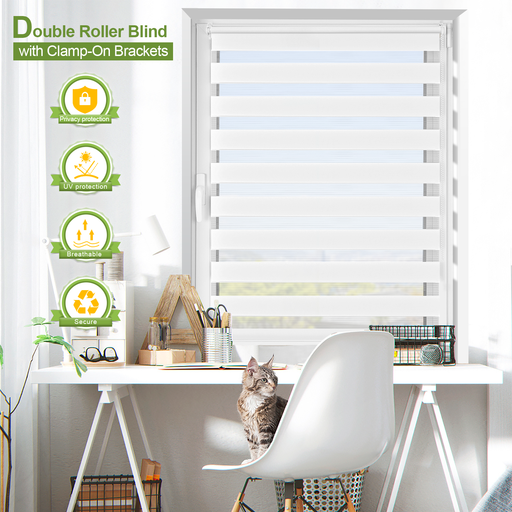
Why it's a good fit: Ideal for living rooms or home offices in rental properties. The dual roller design allows for flexible adjustment of light and privacy without completely darkening the room. Installation is straightforward and leaves no marks.
The clamp brackets are designed for common window frame thicknesses and provide a stable hold. The dual-layer polyester fabric is durable and offers reliable privacy screening.
Infinitely adjustable light control thanks to alternating transparent and opaque stripes (Zebra effect).

Why it's a good fit: Perfect for bedrooms and nurseries where complete darkness and a stable room temperature are desired. The cordless design enhances safety as there are no loose cords.
The silver coating on the back ensures a verifiable blackout and thermal function, unlike simple dark-coloured fabrics. The OEKO-TEX certified material stands for tested quality.
Provides 100% blackout effect and insulating properties, according to the manufacturer, which helps regulate room temperature.

Why it's a good fit: For anyone seeking a modern aesthetic and maximum flexibility. The pleated blind can be adjusted from both the top and bottom to precisely control light and privacy. The honeycomb structure gives it a high-end look.
The honeycomb structure is more dimensionally stable than a simple fabric and offers improved insulation performance. The adjustable clamp brackets are suitable for a wide range of window frame thicknesses (10–23 mm).
Flexible top-down and bottom-up positioning, plus additional heat and sound insulation from the honeycomb structure's air pockets.
We've compiled a full, up-to-date list of products that fully meet these strict selection criteria and UK safety regulations.
The lifespan of a clamp-on roller blind heavily depends on the quality of the brackets and the fabric. High-quality models with robust clamp brackets and durable fabric can last for several years with normal use. Inexpensive models with brittle plastic parts can lose their tension after just a few months, especially with heavy sun exposure.
Most clamp brackets are designed for modern uPVC windows with a standard frame thickness. For wooden or aluminium windows, the shape and thickness of the frame may differ. Check the product description carefully for compatibility. Some manufacturers explicitly state that their products are not suitable for wooden windows, as the clamping mechanism could damage the frame or not hold securely.
Most polyester blind fabrics can be gently wiped with a slightly damp cloth. Alternatively, a soft brush or the brush attachment of a vacuum cleaner on the lowest setting can be used to remove dust. Avoid harsh cleaning agents or vigorous rubbing, as this could damage the colour or any thermal coating. Machine washing is generally not possible.