
Lieferung heute & morgen

Qualitätsgarantie

Willkommens-Angebote freischalten: KOSTENLOSE Lieferung | Bis zu 80 % RABATT | Kostenlose 30-Tage-JoyPlus-Testphase
App herunterladen
Whether you're a renter or a homeowner, you know the problem: you need effective privacy and sun protection, but you don't want to damage your window frames with drill holes. A no-drill roller blind seems like the ideal solution. But the market is flooded with products of widely varying quality. Many buyers end up frustrated with unstable brackets, fabrics that don't truly black out light, or an imprecise fit. This guide will show you what to look for to avoid bad purchases and find a functional, durable solution for your windows.
Before you make a decision, you should carefully examine three technical aspects. These determine whether a roller blind will perform its function reliably for years or show defects after only a short time.
The entire weight of the blind rests on the clamp brackets. This is what separates high-quality products from the rest. A common flaw is brackets made of brittle plastic that can break under tension or warp over time.
Look for adjustable clamp brackets that can be precisely fitted to the thickness of your window sash. Most models are designed for a frame thickness of about 1 to 2.3 cm. Check this specification carefully in the product description. High-quality systems use robust plastic or metal components that ensure a permanently secure fit without damaging the frame. A good clamp-on roller blind fits tightly and won't wobble, even with daily use.
The term "roller blind" covers various functions. Your choice should depend on the room and its intended purpose.
A common mistake is misinterpreting the size specifications. The specified order width always refers to the total width of the blind, including the side brackets. The fabric width itself is always narrower due to the design (usually by about 4 cm).
How to Measure Correctly:
Instead of making a blanket recommendation, we have selected products for specific user profiles.
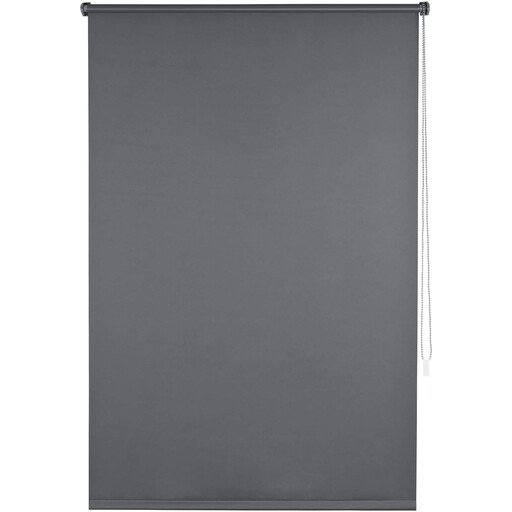
Why This Fits Their Persona: Ideal for shift workers or light-sensitive individuals who need near-total darkness in a bedroom or nursery. Functionality is the clear priority here.
It avoids the "pseudo-blackout fabric" trap. The special aluminium coating on the back effectively blocks light and also provides thermal insulation.
High blackout rate thanks to the special coating. Added thermal effect (heat protection in summer, cold protection in winter).
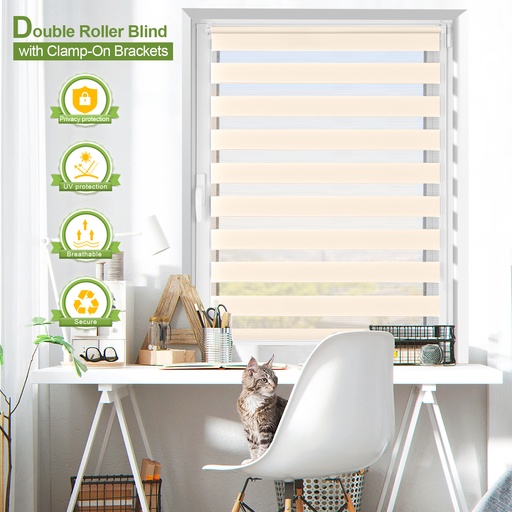
Why This Fits Their Persona: Perfect for users in living and work areas who want to precisely control light and privacy depending on the time of day, without having to choose between just "light" and "dark."
Solves the "all-or-nothing" problem of conventional blinds. Instead of just rolling up or down, the two fabric panels allow for fine-tuning the light.
Stepless regulation of transparency and privacy. A modern design that combines functionality with aesthetics.
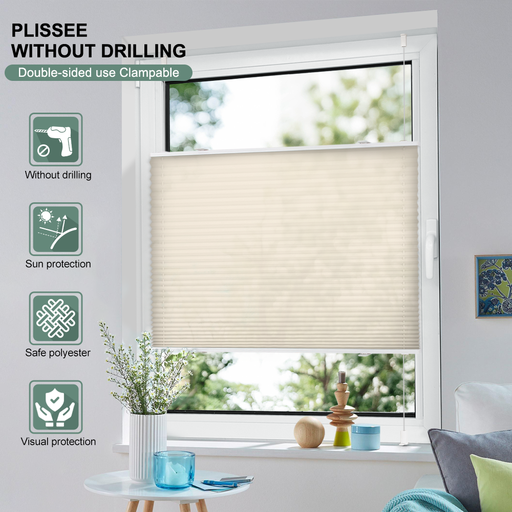
Why This Fits Their Persona: A pragmatic choice for renters looking for a quick, easy, and flexible solution for standard windows in the bathroom, kitchen, or hallway. The focus is on simple privacy and easy installation.
Bypasses the problem of rigid blinds. The pleated blind can be freely positioned from the top and bottom, allowing for flexible adjustment to the sun's position or the desired area of privacy.
Highly flexible positioning on the window. The clamp-on installation is straightforward and quick to complete.
Measure the width of the window pane and add 4 cm. This is your ideal order width. The blind should overlap the pane by about 2 cm on both sides to ensure good privacy and light protection. Check that the window handle can still move freely.
Clamp-on systems are designed for most modern uPVC windows with a standard sash thickness. They are not suitable for fixed windows (that don't open), wooden windows with very wide or ornate frames, or skylights. Specialised blind systems are available for skylights.
A double roller blind controls light incidence by sliding two fabric panels with alternating opaque and transparent stripes. It is rolled up and down like a classic roller blind. A pleated blind consists of a single, folded fabric panel. Its strength lies in its flexible positioning: it can be moved freely up and down the window to cover specific areas.