
Lieferung heute & morgen

Qualitätsgarantie

Willkommens-Angebote freischalten: KOSTENLOSE Lieferung | Bis zu 80 % RABATT | Kostenlose 30-Tage-JoyPlus-Testphase
App herunterladen
A no-drill roller blind is the ideal solution for many renters and homeowners who want to add privacy or sun protection to windows and doors without causing permanent damage. Installation is quick and requires no tools. However, the market is flooded with products of widely varying quality. Certain design flaws or misleading product descriptions often lead to disappointment and unnecessary expense.
This guide, compiled by the Joybuy Product Recommendation Officer, highlights the most common pitfalls and explains which technical parameters you need to look for to make an informed decision.
The selection of drill-free window blinds is vast, but not all deliver on their promises. Pay special attention to these three critical points to avoid a bad purchase:
To find the right solution for your needs, it's important to understand the basic technical features and types.
The most common method for a no-drill roller blind is the clamp-fit blind (also known as an easy-fit blind). This involves simply clamping adjustable brackets onto the window sash. This method is suitable for most standard uPVC windows that can be opened. The crucial factor here is the sash thickness (the depth of the window frame), which should typically be between 15 and 25 mm. For fixed windows or glass fronts, there are alternatives with special adhesive strips or suction cups, but these require a very smooth and clean surface.
The functionality of a roller blind is largely determined by its fabric. There are three main categories:
Besides the classic window blind made from a single panel of fabric, there are specialised versions:
Here are some product recommendations tailored to specific use cases and requirements.
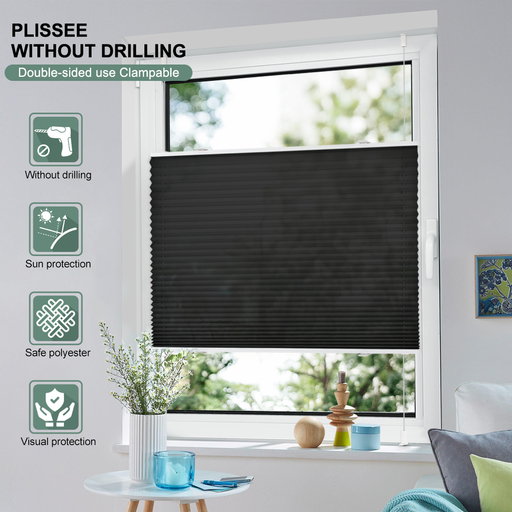
Why This Fits Their Persona: Ideal for rental properties where a damage-free and flexible privacy solution is required. The pleated blind can be infinitely adjusted to create privacy without completely darkening the room. Installation is tool-free.
The product is described as an opaque privacy and sun shield, not a blackout blind. This avoids false expectations. The clamp-fit system is designed for standard windows and ensures a stable hold.
The top-down, bottom-up adjustability offers maximum flexibility in light control. The opaque polyester fabric is easy to clean.

Why This Fits Their Persona: Perfect for bedrooms or other rooms where maximum darkness is essential. The special coating effectively blocks light and helps regulate temperature, enhancing sleep comfort.
This blind avoids the 'false blackout' trap by using a silver coating on the back, which the manufacturer claims provides 100% blackout. This is an objective feature that goes beyond that of a standard opaque fabric.
Offers blackout and thermal insulation in one product. The fabric is certified to OEKO-TEX standards, water-repellent, and tear-resistant.
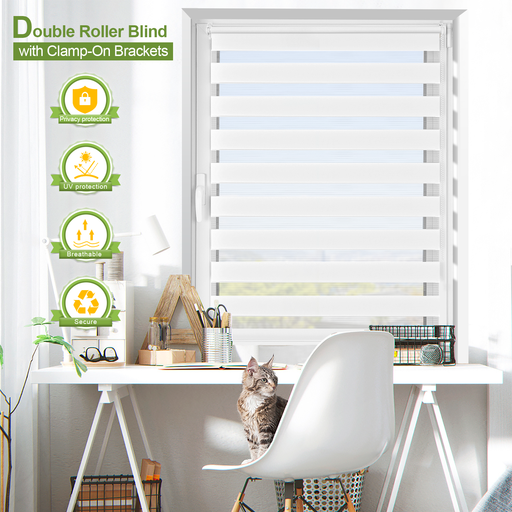
Why This Fits Their Persona: For users who want to combine a modern aesthetic with high functionality. The double roller blind allows for precise control of light and privacy, fitting well in living rooms, kitchens, or offices.
The product description clearly explains the function of the two fabric panels. Users know exactly that they are getting a flexible system for light control, not a pure blackout solution. The clamp brackets are designed for simple and stable installation.
Infinitely variable light control thanks to alternating transparent and opaque segments. Combines the functions of a privacy screen and a translucent blind in one product.
We have compiled a complete, real-time list of products that fully satisfy these strict selection criteria and UK safety regulations.
First, measure the width of the glass pane. For optimal coverage, the blind's fabric should be about 2 cm wider than the pane on each side to minimise light gaps. However, the order width you select is the total width of the blind, including the brackets. This is usually about 4 cm wider than the fabric width. Also, check the thickness of your window sash (frame) to ensure the clamp brackets will fit.
When installed correctly on a compatible window sash, clamp-fit systems provide a secure and stable hold for everyday use. It is important to tighten the clamp brackets firmly according to the instructions and not to operate the blind with sudden jerks. For very large or heavy blinds, additional screwing (if possible) can further increase stability, but this contradicts the "no-drill" principle.
The main difference lies in their function and appearance. A double roller blind consists of two fabric panels with stripes that slide past each other to control the light. A pleated blind consists of a single, folded panel of fabric. It is often tension-mounted within the window frame and can be flexibly adjusted from the top and bottom, allowing for very precise positioning of the privacy screen.