The search for the right sun or privacy protection for rental apartments or your own home often leads to a central challenge: How do you mount a roller blind without damaging the window frame with drill holes? A no-drill roller blind seems like the ideal solution. However, the market is flooded with products whose promises don't always hold up in practice. Before you make a decision, it's crucial to understand the typical weaknesses that can lead to frustration and unnecessary expenses.
As your Joybuy Product Recommendation Officer, I'll help you separate the wheat from the chaff. This guide focuses on the objective criteria that truly matter and shows you how to avoid the three most common purchasing traps.
The 3 Most Common Mistakes When Buying Clip-On Blinds
Many products advertise easy installation and high functionality. In reality, however, they often fail on fundamental details that make the difference between a durable solution and a daily annoyance.
- Trap 1: Unstable Mounting Brackets and an Improper Fit. The core of any clamp-fit system is its bracket. Low-quality models made of brittle plastic or with insufficient tension are prone to slipping or even breaking after a short time. Another problem is a lack of compatibility: many buyers overlook the need to measure the thickness of the window frame precisely. A mounting bracket designed for 16-22 mm will not hold on a 24 mm frame, or it will damage it.
- Trap 2: The "Blackout" Blind That Doesn't Black Out. A no-drill blackout roller blind is supposed to completely darken a room. However, budget models often use only a dark-coloured fabric that still lets a significant amount of light through. True blackout functionality requires a special, opaque coating on the back of the fabric. Furthermore, it's often not mentioned that the fabric width is always narrower than the total width specified. If the blind isn't wide enough to overlap the glass pane on the sides, annoying light gaps will appear.
- Trap 3: Misleading "Easy" Installation. A product advertised as "no-drill" should be intuitive to assemble. In practice, incomprehensible instructions, missing small parts, or poorly designed spring mechanisms lead to considerable frustration. Especially with spring-tensioned blinds, a single wrong move, like removing a safety strap prematurely, can irreparably damage the mechanism.
What Really Matters: The Decisive Parameters
To avoid these traps, you should focus on three core technical parameters. These determine the functionality, durability, and suitability for your specific use case.
1. Mounting System: Clamp-Fit, Adhesive, or Suction Cup?
The mounting method is paramount. The most common and often most reliable option is the clamp-fit roller blind.
- Clamp Brackets (Clamp-Fit): These adjustable brackets are clamped directly onto the window sash. Be sure to pay close attention to the manufacturer's specified permissible frame thickness (e.g., 16–22 mm) and measure your window frame (excluding the seal) precisely. High-quality clamp brackets are made of robust metal or reinforced plastic.
- Adhesive Mounting: Some pleated or lightweight blinds are attached directly to the window frame or pane with special adhesive strips. This method is only suitable for very smooth, clean surfaces and can lose its adhesion in direct sunlight.
- Suction Cups: This option is mainly found on pleated blinds for skylights or fixed glazing. The holding power is highly dependent on the surface texture and cleanliness of the glass.
2. Fabric Properties: From Translucent to Thermally Insulating
The function of your roller blind is determined by its material. Choose based on your desired purpose:
- No-Drill Privacy Blinds: These blinds are opaque but still allow daylight to pass through. They are ideal for living areas or offices where privacy is desired, but the room should remain bright.
- No-Drill Blackout Blinds: For bedrooms or children's rooms, complete darkness is crucial. Look for products with a special coating on the back (often silver-coloured) that blocks 100% of light. To minimise light leakage from the sides, the fabric width should extend about 4 cm beyond the glass width.
- Thermal Clamp-Fit Blinds: These blinds have a reflective coating or a special honeycomb structure (honeycomb pleated blind). They help keep heat out in the summer and warmth in during the winter, which can contribute to regulating the room's climate.
3. Blind Type: Standard, Dual Roller, or Pleated?
In addition to the classic roller blind, there are other variants with specific advantages:
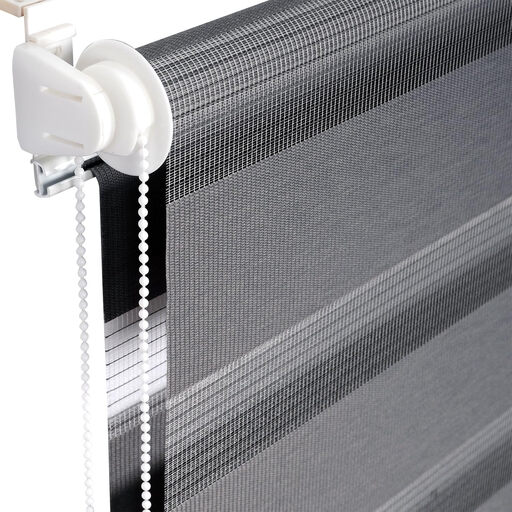
- No-Drill Dual Roller Blind (Zebra Blind): Consists of two parallel fabric panels with alternating transparent and opaque stripes. By shifting the panels, you can seamlessly adjust the light level—from nearly transparent to completely opaque.
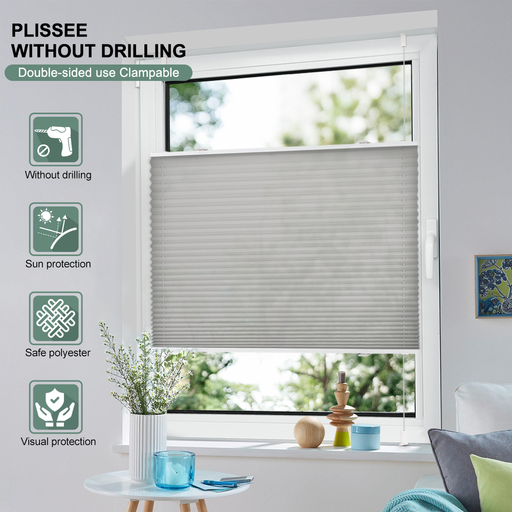
- No-Drill Pleated Blind (Clamp-Fit Pleated Blind): This folded blind is particularly flexible. It is often tensioned at the top and bottom and can be positioned freely on the window. This allows you to cover just the bottom, the top, or a middle section of the window as needed.
Recommended Options for Different Needs
Here are three products that represent a considered choice for different user profiles based on their objective features.
MATCH FOR: Budget-Conscious Renters
Why This Fits Their Persona: Ideal for renters seeking a straightforward, functional, and cost-effective solution for privacy and light sun protection. The tool-free clamp-fit installation protects the window frame and is easy to remove when moving.
How It Avoids the Trap
The product uses a standardised clamp-fit system with a clearly defined installation process, minimising the risk of user error (avoids Trap 3).
Key Advantage & Pros
Offers flexible privacy thanks to the freely positionable pleated design. The fabric is opaque but translucent, maintaining brightness in the room.
MATCH FOR: Comfort & Design-Focused Users
Why This Fits Their Persona: For users who value aesthetics and flexible light control. The zebra blind design allows for seamless adjustment of brightness and privacy, adding a modern touch to any living space or office.
How It Avoids the Trap
The clamp brackets are designed for a specific frame thickness (13–23 mm), which ensures a secure hold when measured correctly, thus avoiding the unstable mechanism pitfall (Trap 1).
Key Advantage & Pros
The alternating fabric panels allow for precise control of incoming light. The chain pull can be mounted on either the left or right side, offering flexible operation.
MATCH FOR: Bedroom Peace-Seekers
Why This Fits Their Persona: Perfect for individuals who need maximum darkness, temperature regulation, and a degree of sound insulation in the bedroom. The honeycomb structure offers functional benefits that go beyond simple privacy.
How It Avoids the Trap
This product addresses the "pseudo-blackout blind" pitfall (Trap 2) with an opaque polyester construction that, according to the manufacturer, effectively darkens and insulates.
Key Advantage & Pros
The honeycomb structure traps air, creating an insulating barrier. This can contribute to both thermal and acoustic insulation. The stepless adjustment via a handle is also child-safe.
Looking for more options?
We have compiled a complete, up-to-date list of products that fully meet these strict selection criteria and German safety regulations.
Frequently Asked Questions (FAQ)
How do I measure correctly for a no-drill roller blind?
Correct measurement is crucial for a perfect fit. Follow these two steps:
- Determine the Width: Measure the width of the glass pane (from seal to seal). To prevent light gaps on the sides, it is recommended to choose an order width that is approx. 4 cm wider than the measured glass width. Make sure the blind does not interfere with the window handle. The fabric width is typically about 4 cm narrower than the total width of the blind.
- Check the Frame Thickness: Measure the thickness of your window sash (excluding the rubber seal). Compare this value with the clamp bracket compatibility specified by the manufacturer (e.g., 10–23 mm).
Does a clamp-fit roller blind really hold securely on the window?
Yes, with correct installation and selection, a clip-on roller blind holds reliably. The prerequisite is that the thickness of your window frame is within the range specified by the manufacturer and that the clamp brackets are tightened firmly. These systems are designed for standard uPVC windows with a tilt-and-turn function. They are generally not suitable for skylights or fixed-pane windows.
Can I also install a no-drill roller blind on a balcony or patio door?
Yes, installation on a door is possible, provided it is a standard glass door with a window frame suitable for clamp mounting. Measure the height of the entire window sash to determine the correct length of the blind. For such applications, there are special blackout blinds for patio doors available in appropriate lengths.